
Прогрес читання
Дотримуйся гайду крок за кроком
Використовуй швидкі переходи між розділами й не втрачай своє місце під час читання.
поточний розділ: —
Indian weddings aren't a single ceremony — they're a multi-day cultural production built from centuries-old rituals, family etiquette, and regional variations that shift dramatically from Punjab to Kerala. This guide walks through the core ceremonies in order, explains what each one means, and gives practical guidance for planning or attending one respectfully.
Why Indian Weddings Span Multiple Days
A single 'wedding day' is a Western concept that doesn't really apply here. A typical Indian wedding — Hindu, Sikh, or Jain — unfolds across three to five separate functions, each with its own rituals, dress code, and guest list logic. The engagement and pre-wedding rituals (Roka, Sagai, Mehndi, Sangeet) usually happen over two or three days, followed by the wedding ceremony itself and then a separate reception, often the night after. Muslim weddings follow a parallel structure with Mangni, Mehndi, Nikah, and Walima. This staggered format exists partly for practical reasons — extended families travel from other cities or countries, so spreading events out lets everyone attend without a single overwhelming day — and partly because each ritual has its own religious or social purpose that can't be compressed. If you're planning one, the first decision isn't the venue; it's deciding which functions you're actually hosting, since that determines everything downstream: guest counts, catering, decor themes, and budget allocation.
The Pre-Wedding Rituals: Roka, Mehndi, and Sangeet
The Roka (or Sagai) is the formal engagement announcement, often a smaller, family-only gathering where both families exchange sweets and gifts and bless the couple. It can happen months or even a year before the wedding. The Mehndi ceremony, typically held one or two days before the wedding, involves intricate henna designs applied to the bride's hands and feet by a professional mehndi artist, while female relatives and friends often get smaller designs too. It's traditionally a women-centric, festive event with folk songs and dancing, though many modern couples now host it as a co-ed daytime party. The Sangeet — literally 'sung together' — is the music and dance night, usually the evening before the wedding. Families prepare choreographed dance performances, and it has become, in many contemporary Indian weddings, the single most elaborate and expensive pre-wedding event, sometimes rivaling the wedding reception itself in scale. If you're a guest, expect vibrant colors (avoid white or black, which read as mourning attire), and don't be surprised if you're pulled onto the dance floor.
The Wedding Day: Baraat, Varmala, and Saptapadi
The wedding day itself follows a sequence rooted in Hindu Vedic tradition, though details vary by region and family. It typically opens with the Baraat — the groom's processional arrival, often on a decorated horse or in an ornate car, accompanied by a dhol drummer and dancing relatives. At the entrance, the bride's family performs the Milni, a formal welcome where corresponding family members (fathers, uncles, brothers) exchange garlands and embraces. The Varmala (or Jaimala) follows: the bride and groom exchange flower garlands, symbolizing mutual acceptance — historically this was even done playfully, with families lifting the groom or bride to make garlanding harder, though this custom has softened in most modern weddings. The core religious ceremony happens under a mandap, a four-pillared canopy representing the four stages of life. Here you'll see Kanyadaan (the father giving away the bride), the lighting of the sacred fire (Agni), and the Saptapadi — seven steps taken together around the fire, each step representing a vow (nourishment, strength, prosperity, wisdom, family, longevity, and friendship). This is the moment the couple is considered legally and spiritually married. The whole ceremony, led by a pandit reciting Sanskrit mantras, can run anywhere from ninety minutes to over three hours depending on family tradition.
Regional Variations Worth Knowing
India's wedding traditions shift enormously by region, and treating 'Indian wedding' as one monolith is a common mistake for planners and guests alike. Punjabi weddings are loud, high-energy, and dhol-heavy, with the Chooda ceremony (red and white bangles gifted by the maternal uncle) marking the bride's transition. Bengali weddings include the Shubho Drishti, where the bride is carried on a wooden stool (piri) and circled around the groom seven times before their eyes meet for the first time that day, and brides traditionally wear a white-and-red Benarasi saree with a distinctive white 'mukut' headpiece. South Indian weddings — Tamil, Telugu, or Kannada — are typically shorter and more ritual-dense, held in the morning per auspicious timing (muhurtham), featuring the tying of the Mangalsutra or thali instead of a Western-style ring exchange, and rice-throwing (Talambralu) rather than confetti. Gujarati weddings include the Mandvo and Griha Shanti rituals for peace and prosperity, and the reception often features a distinct garba or dandiya dance segment. Kerala Christian and Syrian Christian weddings blend Catholic Mass structure with regional customs like the tying of a minnu (a gold pendant on thread) instead of a ring. Knowing which regional tradition a couple follows changes everything from the color palette to the ceremony length, so never assume 'Indian wedding' means one fixed script.
Planning Seating for a Large, Multi-Function Indian Wedding
Indian wedding receptions routinely run into the hundreds of guests — 300 to 600 is common even for a 'medium' wedding — because invitation lists extend to extended family, family friends, business contacts, and community elders. That scale makes seating logistics genuinely difficult: you're usually balancing separate tables for the bride's side and groom's side, VIP tables for elders and priests, and mixed tables for younger guests and friend groups, often across two or three separate events with different guest lists each night. This is exactly the kind of complexity where a dedicated tool pays off — using a wedding seating chart maker lets you build out table assignments visually, track RSVPs from both families separately, and reshuffle tables in minutes when a last-minute cousin confirms attendance two days before the Sangeet. Many Indian wedding receptions also use a banquet-style head table for the couple and immediate family flanked by round tables for guests, so it's worth reading up on banquet vs round wedding tables before locking in your floor plan, since the choice affects both photography sightlines and how easily servers can navigate a large hall. If you're deciding whether to formally assign every seat or let guests choose within a section — a real dilemma at big Indian functions where families expect proximity to their own side — a comparison of assigned seating vs open seating can help you weigh the tradeoffs before the invitations go out.
Attire and Color Symbolism
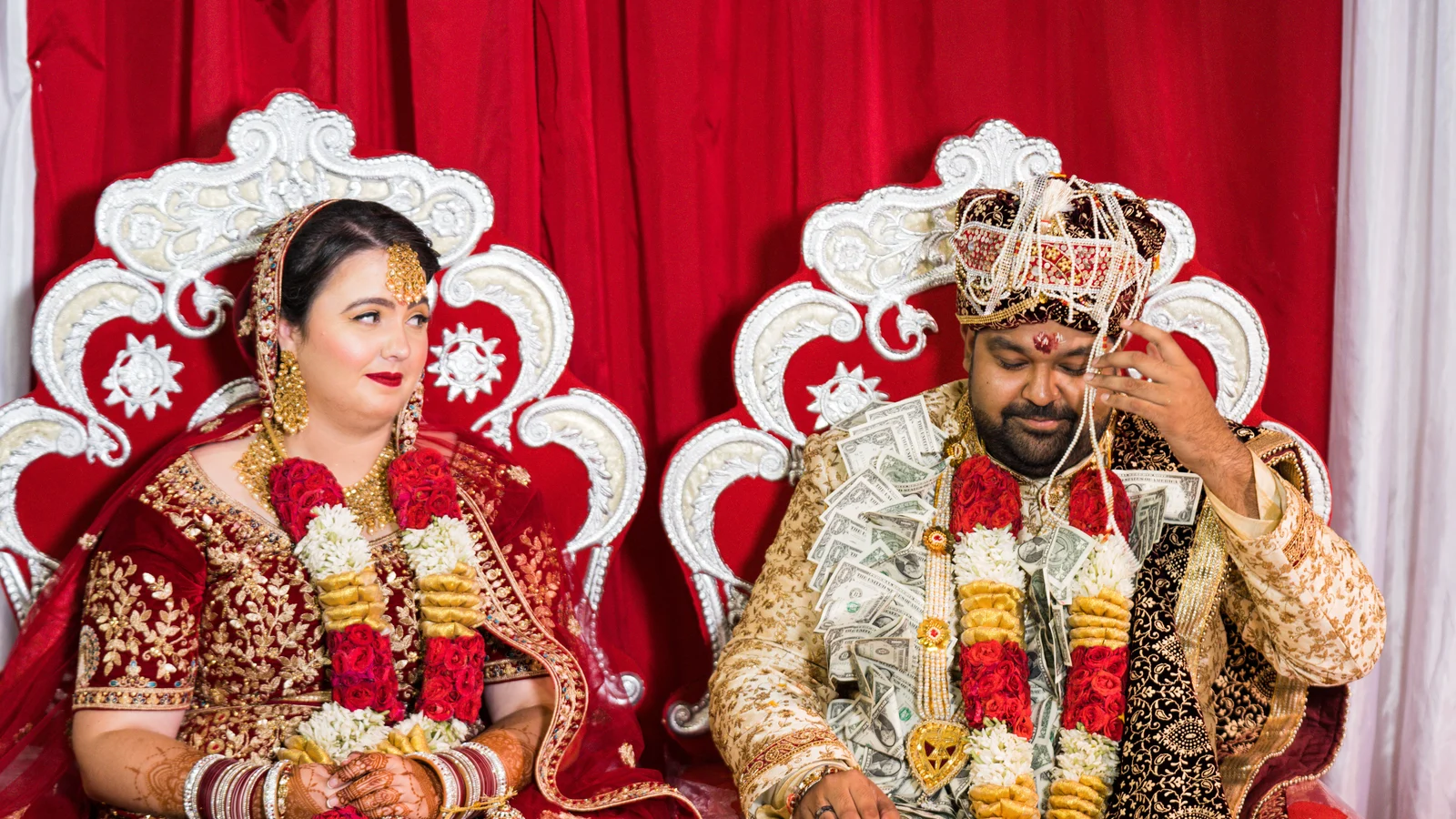
Color carries deep meaning at Indian weddings. Red is the most traditional bridal color across North India, symbolizing prosperity and fertility, though contemporary brides increasingly choose maroon, deep pink, or even pastel lehengas for pre-wedding events while reserving red or a traditional Benarasi saree for the main ceremony. White is generally avoided for the bride (it's associated with mourning in Hindu tradition), though this taboo is weaker in South Indian Christian communities where white is standard bridal wear. Grooms typically wear a sherwani (a long, fitted coat) with a churidar, often topped with a safa or turban, and a sehra — a veil of flowers or beads hung from the turban to shield the groom's face during the Baraat. Guests should avoid all-white or all-black outfits at the ceremony and lean into bright colors; women commonly wear sarees, lehengas, or Anarkali suits, while men wear kurta pajamas or bandhgalas. Dress codes are frequently specified on the invitation itself (a 'festive' or specific color-themed Sangeet, for instance), so always check before assuming standard Western formalwear is appropriate.
Gifts, Shagun, and Guest Etiquette
Cash gifts, known as Shagun, remain the most common and expected gift at Indian weddings, typically given in odd-numbered amounts (₹501, ₹1,001, ₹2,001) because odd numbers are considered auspicious — the extra rupee symbolizes continuity and growth rather than a closed, even sum. Gifts are usually handed over discreetly in an envelope during the reception line rather than opened publicly. Beyond cash, gold jewelry is a significant gift category, especially from close family, and registries in the Western sense are far less common, though younger urban couples are increasingly adopting them. As a guest, arriving with a small gift or shagun envelope is expected at every function you attend, not just the main wedding — though the amount typically scales down for smaller pre-wedding events. It's also considered polite to greet elders first, touch the feet of parents and grandparents as a mark of respect if you're part of the family, and avoid leaving before the couple has completed their post-ceremony blessings and photos, since an early exit can read as disrespectful at a tightly-scripted, ritual-heavy event.
Modern Fusion and Destination Weddings
Contemporary Indian weddings increasingly blend tradition with modern format changes. Destination weddings — in Udaipur, Goa, or increasingly abroad in Thailand, Italy, or the UAE — have become common among urban, upper-middle-class families, condensing the traditional multi-day format into a tighter three-to-four-day itinerary at a single resort. Fusion weddings, common among interfaith or diaspora couples, might pair a traditional Hindu ceremony with a Western-style reception featuring a first dance, a live band or DJ, and a cake cutting alongside the ritual fire ceremony — if you're weighing entertainment for that reception segment, it's worth comparing a band vs a DJ for the reception, since Indian receptions often need music that can pivot between Bollywood remixes, regional folk songs, and Western dance tracks in the same night. Cocktail hours, welcome dinners, and Western-style seated dinners with printed menus are increasingly layered onto the traditional ceremony structure, particularly for NRI (non-resident Indian) families planning weddings that need to feel familiar to both Indian and international guests.
Budgeting Across Multiple Events
Because an Indian wedding is really several weddings stitched together, budgeting works differently than for a single-day Western wedding. Families typically allocate spend across distinct buckets — Mehndi decor and artists, Sangeet choreography and staging, the main ceremony's mandap and priest fees, and a separate reception venue and catering — and costs can vary wildly by city, guest count, and how many functions are hosted versus scaled down. Catering alone often becomes the largest line item given the sheer guest volume and the expectation of an extensive, multi-cuisine buffet spanning regional Indian dishes plus continental and Chinese counters, a near-universal feature of large Indian wedding catering. If you're building a budget from scratch, a general average wedding cost breakdown is a useful starting framework even though Indian weddings typically need extra categories layered in for the additional functions, priest and ritual fees, and mehndi artists that a standard breakdown won't account for.
Часті запитання
How many days does a typical Indian wedding last?
What should I wear as a guest to an Indian wedding?
Is it rude to skip the pre-wedding events and only attend the wedding?
How much should I give as a cash gift (Shagun)?
Are Indian wedding traditions the same across all religions in India?
What's the difference between the wedding ceremony and the reception?
Planning a multi-function Indian wedding with hundreds of guests across several events? Build and organize your seating charts free in Wedding Seat and keep every family's side sorted with ease. wedding seating chart maker
Продовжуй планування
Перейди до наступної теми планування
Переходь між пов'язаними темами, щоб побудувати міцніший шлях планування.