
Wedding Invitation Wording — Examples & Templates for Every Style
Find the right words for your invitations and RSVPs: formal, casual, destination and more — with examples you can copy. Free to use.
- Copy-ready examples for every style
- Formal, casual & destination wording
- Host lines for couples & parents
- RSVP & save-the-date wording
The wording sets the tone of your whole wedding. Whether you're hosting yourselves, your parents are hosting, or you want a relaxed, modern feel, these guides give you ready-to-use examples you can adapt in minutes.

Wording guides & examples
Copy-ready wording for every host situation and style.
The words on your wedding invitation set the tone before a single guest walks through the door — they signal formality, who's paying, what to wear, and whether kids are welcome. Get the phrasing right and everyone shows up prepared and excited; get it wrong and you'll spend weeks fielding confused texts. Here's exactly how to word yours, style by style, using the tool above.
Anatomy of a Wedding Invitation That Reads Right
Every well-worded invitation follows a predictable structure, even when the tone is playful. First comes the host line — whoever is named here is, by tradition, whoever is paying or presenting the wedding, even if that's simply 'Together with their families' or the couple themselves. Then the request line ('request the honor of your presence' for a religious ceremony, or 'invite you to celebrate their marriage' for anywhere else), the couple's names, and the event details: date, time, ceremony venue, and — usually on a separate line or insert — the reception details. Formal invitations spell out the date and time in full ('Saturday, the fourteenth of June, at four o'clock in the afternoon'); casual ones use numerals ('Saturday, June 14 at 4 PM'). Below that sits the practical layer: dress code, reception location if different from the ceremony, and how to RSVP. Skipping any one line is how guests end up showing up in the wrong outfit at the wrong address.
- Host line names who is presenting the wedding
- Request line signals ceremony type and formality
- Names formatted to match the overall tone
- Date and time spelled out or numeral, never mixed
- Venue, dress code, and RSVP each on their own line
What People Actually Call This
Nobody walks into a stationer and asks for 'invitation phraseology' — the real, working terms are simpler and vary by who's talking. Couples usually just say 'the wording' or 'invite wording' when they're figuring out what to write. Stationers and paper-goods shops call the whole package the 'invitation suite,' which bundles the main card, the reply card, and any details or accommodations card — each with its own wording. Etiquette writers and formal print shops still use 'invitation verbiage' or 'invitation etiquette,' especially when discussing traditional, engraved-style cards. In British English, you'll more often hear 'wedding stationery wording' or simply 'the invite' used as shorthand for the whole card. None of these terms are wrong — they just signal how formal the conversation is, so use whichever matches your crowd.
- 'The wording' or 'invite wording' — everyday couple-speak
- 'Invitation suite' — stationer's term for the full card set
- 'Invitation verbiage/etiquette' — formal print-shop language
- 'Wedding stationery wording' — common British phrasing
How to Word Your Invitation Using the Tool Above
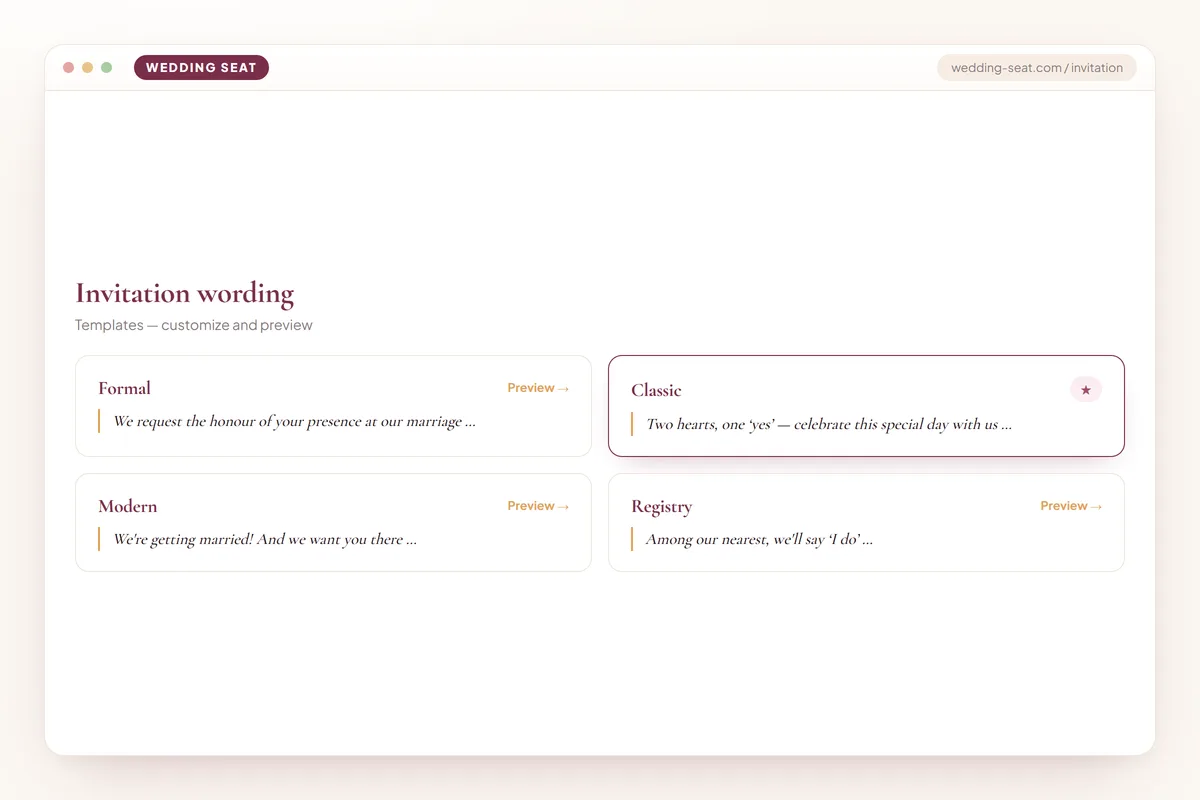
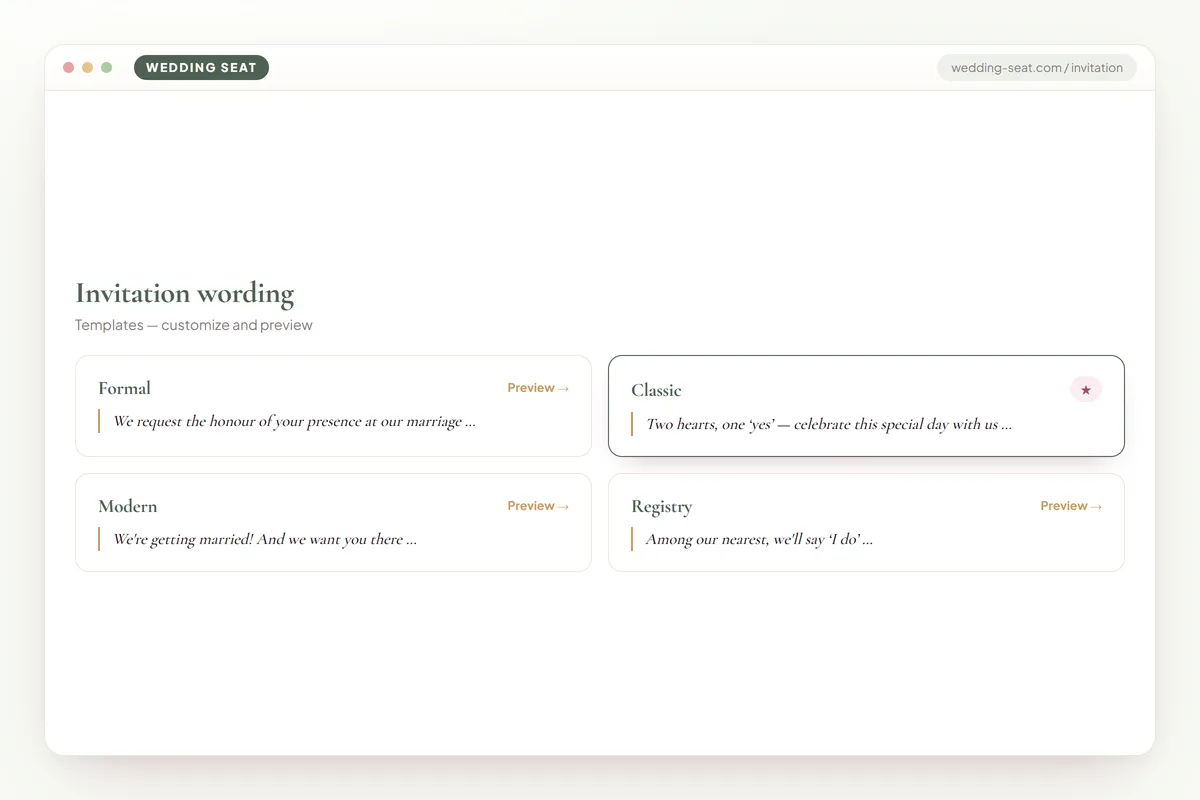
1. Choose your hosting scenario first. The tool asks who is hosting — the couple alone, one or both sets of parents, or an extended family — because this single choice rewrites the entire opening line. 2. Enter names exactly as you want them printed. Decide whether to use full names, first-and-middle, or informal first names only; the tool adjusts surrounding grammar (like 'son of' or 'daughter of' phrasing) to match. 3. Pick your tone: formal, semi-formal, or casual. This changes whether the date reads as 'the fourteenth of June' or 'June 14,' and whether the request line reads as 'request the honour of your presence' or 'invite you to share in their joy.' 4. Fill in the date, time, and venue fields. The tool formats these consistently so you don't end up spelling the date but numbering the time. 5. Add reception, dress code, and adults-only lines if they apply — these generate as polite add-on lines rather than blunt instructions. 6. Copy the finished wording into your card designer or send it straight to your printer or stationer as final proof text.
Real Invitation Wording, Style by Style
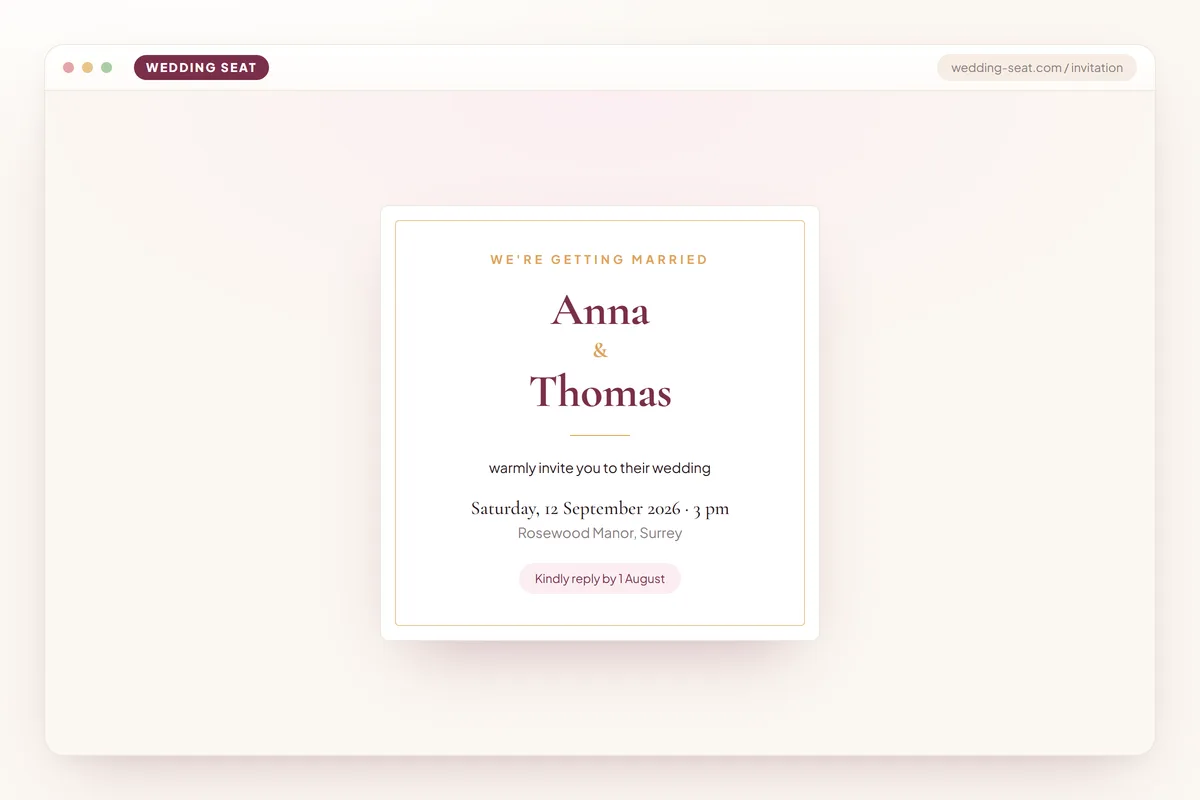
Seeing the same information dressed differently makes the choices click faster than any rule list. Below are the layouts the tool can generate, each built for a different kind of wedding day.
- Traditional church wedding — parents host, fully spelled-out date and honor-line request
- Modern couple-hosted wedding — first names only, 'invite you to celebrate' opening
- Backyard or casual wedding — conversational tone, numerals, playful reception note
- Black-tie, adults-only affair — formal phrasing with a tactfully worded 'adult reception' line
- Destination or beach wedding — travel-friendly wording with accommodation and RSVP-by-mail cues
- Second marriage or vow renewal — couple-hosted, warm phrasing without parental host lines
Who Hosts, Whose Name Comes First
The host line is where most couples get stuck, because it used to encode who paid for the wedding. Traditionally, if the bride's parents hosted, their names led ('Mr. and Mrs. Robert Smith request the honor of your presence at the marriage of their daughter'), and the groom's name appeared with 'son of Mr. and Mrs. James Carter.' Today, most couples split costs or pay for it themselves, so 'Together with their families' or simply the couple's own names as hosts is standard and perfectly polite — no one will think you're being rude to your parents by leaving them off the host line if they're thanked elsewhere, like on your wedding website. Divorced parents each get their own line without 'and,' remarried parents are listed with their current spouse's name, and if one side is hosting alone, only that side appears at the top. Whichever name is listed first in the couple's own names is usually just alphabetical or a personal choice today — the old bride-first rule is fading, especially for same-sex couples, where alphabetical or age order is common.
Etiquette and the Mistakes That Actually Show
The most common slip is vague plus-one wording — 'and Guest' on the outer envelope but no name on the inner one leaves guests unsure if it means them. Address envelopes to the specific people invited; if children aren't included, list only the parents' names, and let the invitation's silence do the talking rather than printing 'no kids please,' which reads as blunt no matter how it's phrased. Adults-only weddings should never state the policy outright on the invitation itself — address envelopes precisely and, if pressed, explain by phone. Never print registry information on the invitation proper; it belongs on your wedding website or a separate insert, since listing gifts alongside an invitation to celebrate reads as presumptuous. Also double-check your RSVP deadline math — three to four weeks before the wedding is standard, giving your caterer real time to finalize counts. Finally, keep formality consistent: mixing 'request the honour of your presence' with a casual numeral date signals a proofreading miss, not a style choice.
If you're worried about the adults-only message landing softly, our dedicated wording guide for adults-only weddings has envelope-only phrasing that never has to appear on the card itself.
Examples in every theme
1.Invitation wording · Sage & Olive 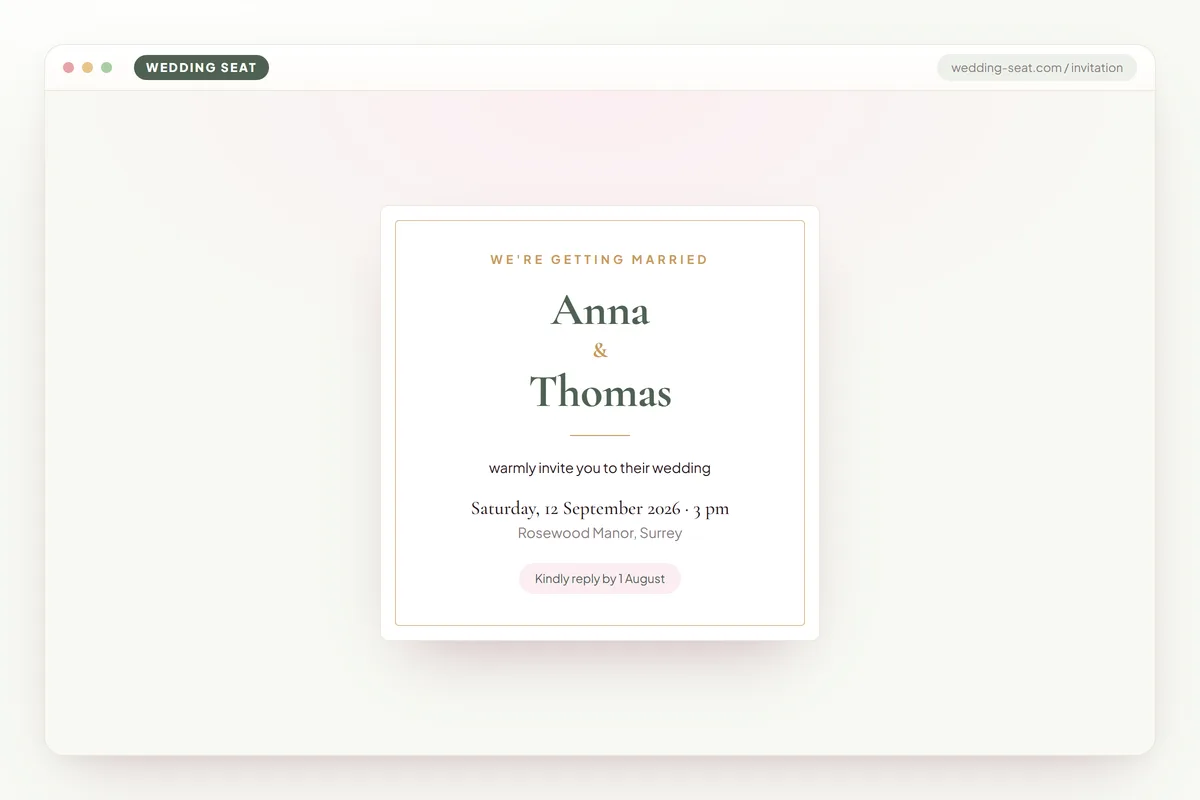
2.Invitation – preview · Sage & Olive 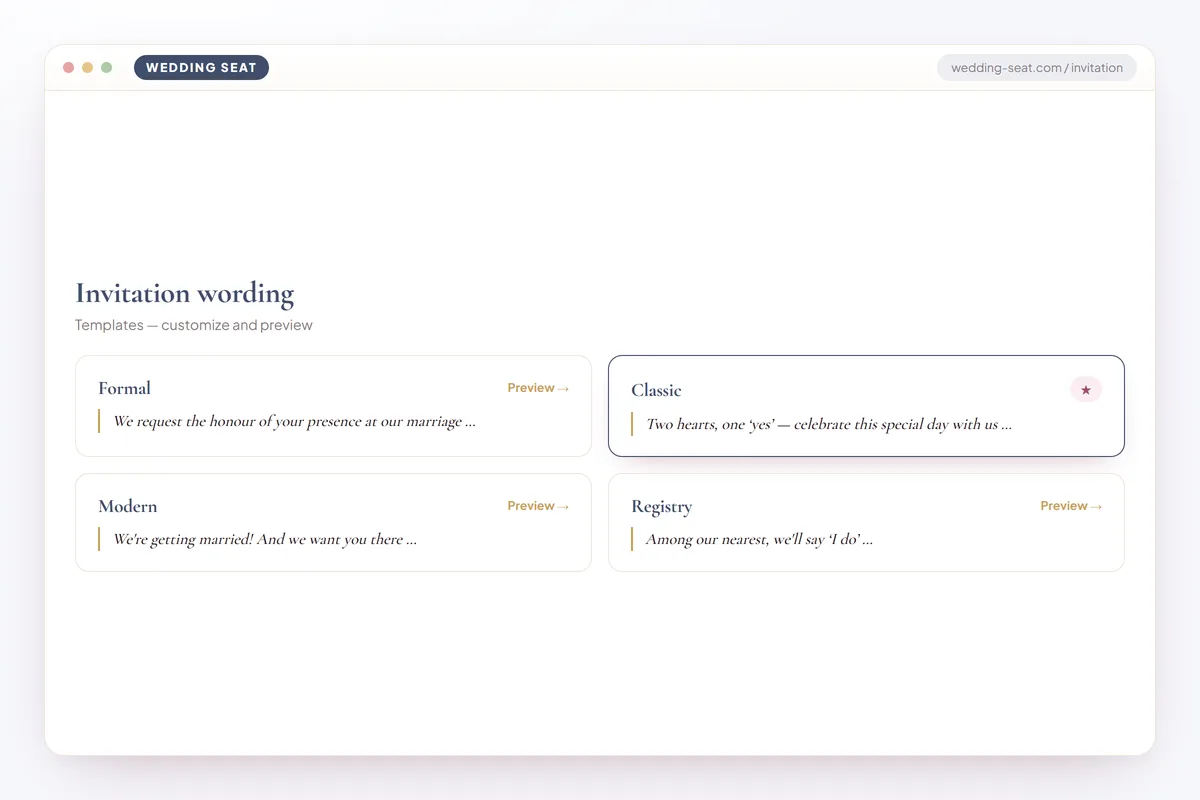
3.Invitation wording · Dusk Blue 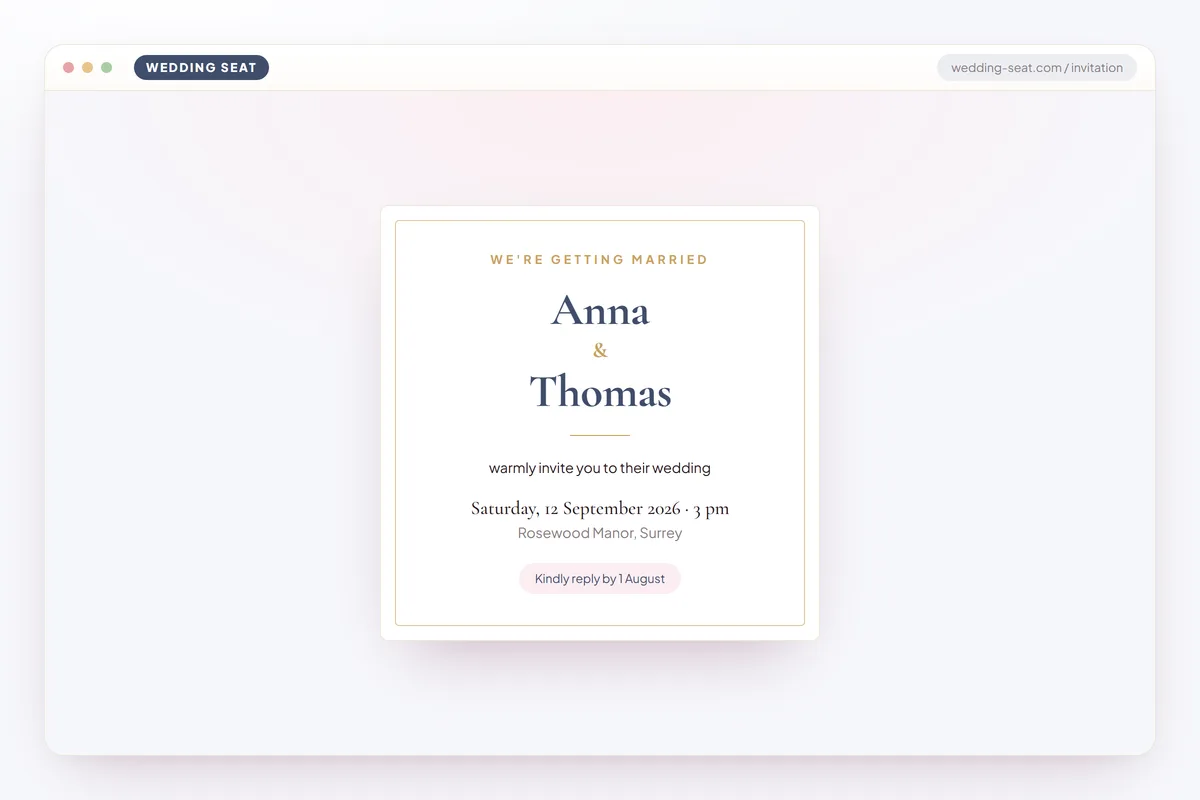
4.Invitation – preview · Dusk Blue 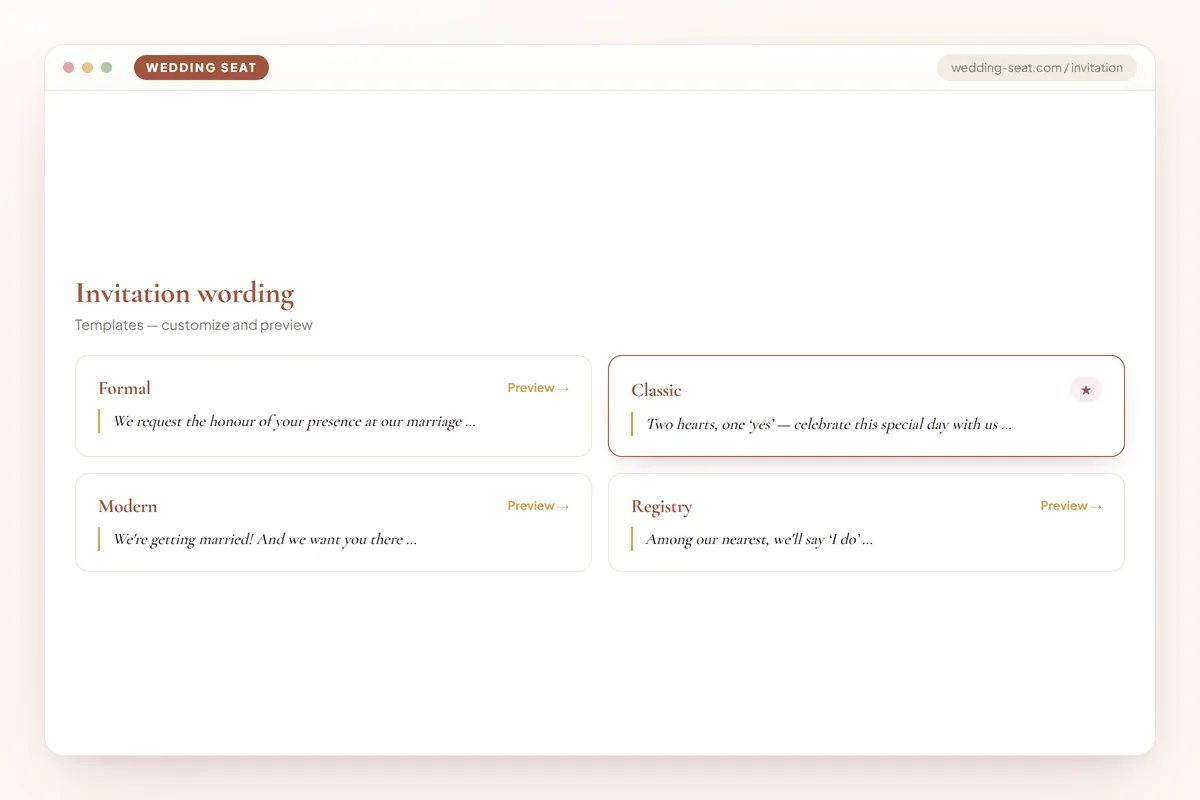
5.Invitation wording · Terracotta 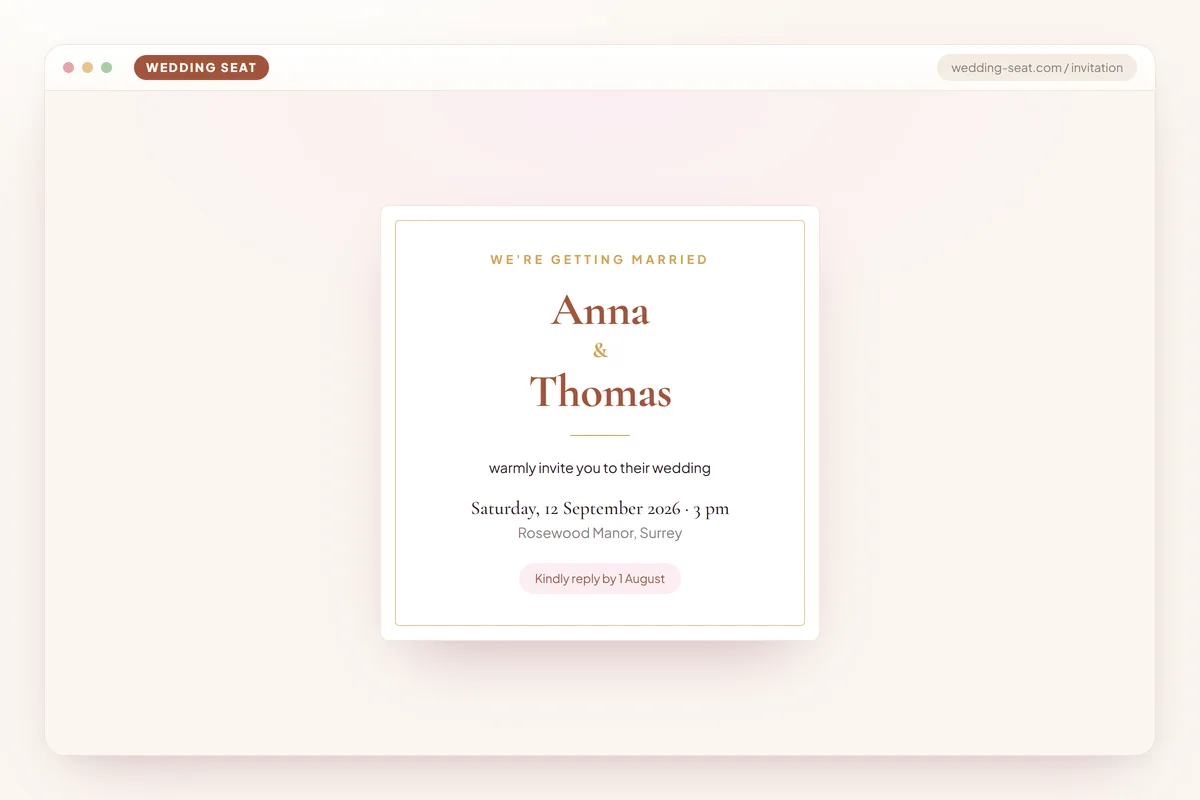
6.Invitation – preview · Terracotta
Frequently asked questions
Do we have to spell out the date and time on a formal invitation?
Yes, for traditional formal wording the convention is to spell everything out — 'Saturday, the fourteenth of June, two thousand twenty-six, at four o'clock in the afternoon' — with no numerals anywhere on the main card. Semi-formal and casual invitations can use numerals freely, and the tool switches formatting automatically based on the tone you select.
How do we word an invitation when we're paying for the wedding ourselves?
Simply list yourselves as the hosts: 'Emma Carter and James Reilly invite you to celebrate their marriage' works perfectly and is now the most common opening line in modern invitations. There's no obligation to credit parents in the host line if they aren't financially hosting — you can still thank them elsewhere, such as in a wedding program or on your website.
What's the polite way to say the wedding is adults-only?
Don't state it on the invitation at all — instead, address the outer and inner envelopes only to the adults you're inviting, with no 'and family' or blank line for extra names. If guests ask directly, a brief personal explanation ('we've kept the guest list adults-only, we hope you understand') works better than any printed phrasing.
Should the reception details go on the same card as the ceremony?
If the ceremony and reception are at the same venue, you can combine them into one line ('reception to follow'). If they're at different locations, use a separate small reception card so the main invitation stays clean, especially for formal layouts where every added line increases visual clutter.
How far in advance should the RSVP deadline be?
Set your RSVP date three to four weeks before the wedding, giving you a real buffer to chase non-responders and hand a final headcount to your caterer roughly one to two weeks out. Destination weddings should extend this window since travel planning takes guests longer to confirm.
Is it rude to mention our registry on the invitation?
Yes — etiquette still treats this as presumptuous, even though most guests expect to give a gift. Keep the invitation focused purely on the celebration and put registry links on your wedding website, mentioned via a small enclosure card or simply word of mouth through close family.
What's the difference between 'request the honour of your presence' and 'request the pleasure of your company'?
'Honour of your presence' traditionally signals a religious ceremony, often held in a church, synagogue, or other place of worship, while 'pleasure of your company' is used for a civil ceremony at a non-religious venue like a hotel, garden, or event space. Choosing the wrong one is a small but noticeable slip to guests familiar with formal wording.
Ready to see your own words in print? Head back up to the tool, plug in your hosts, tone, and details, and get polished invitation wording you can copy straight into your stationery in minutes.
Plan the rest in one place
From guest list to seating chart — organise your whole wedding for free.
Start free