
Wedding Budget
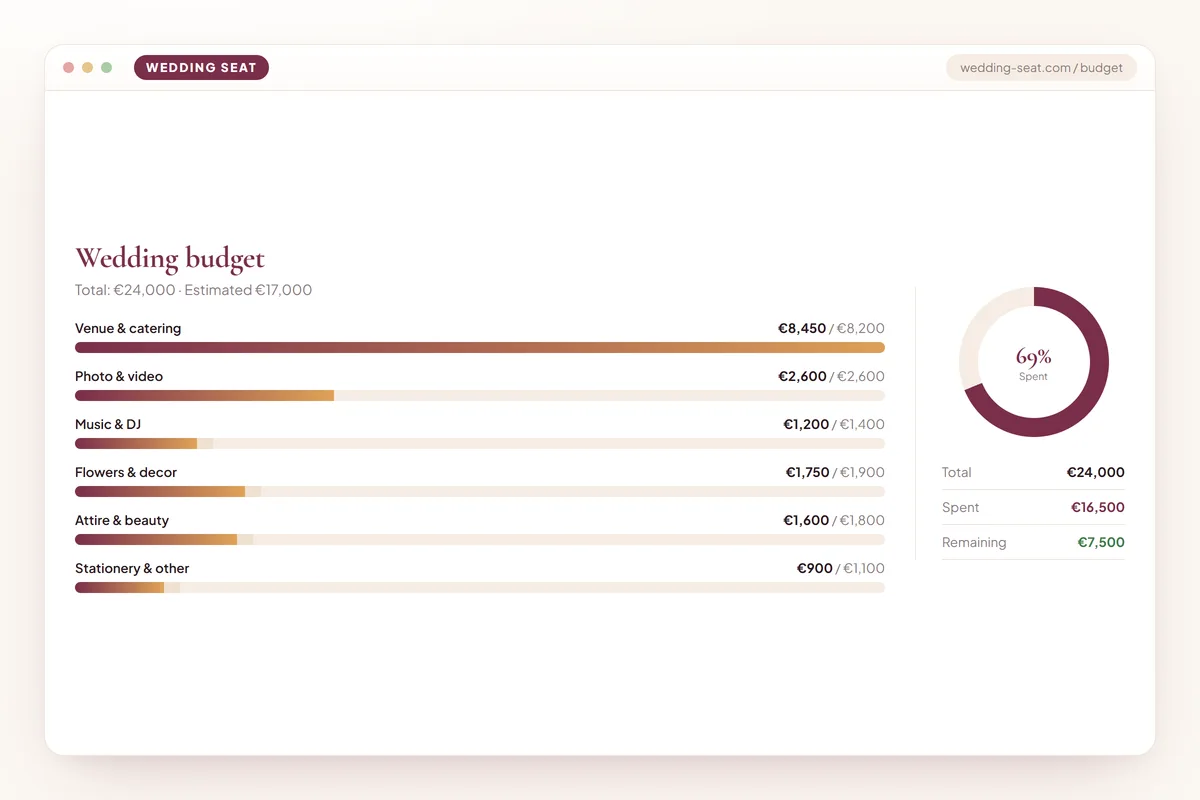
Plan your wedding budget in one place. Track costs, avoid overspending, and keep everyone aligned.
- See total, paid, and remaining
- Categories for every wedding cost
- Share updates with family
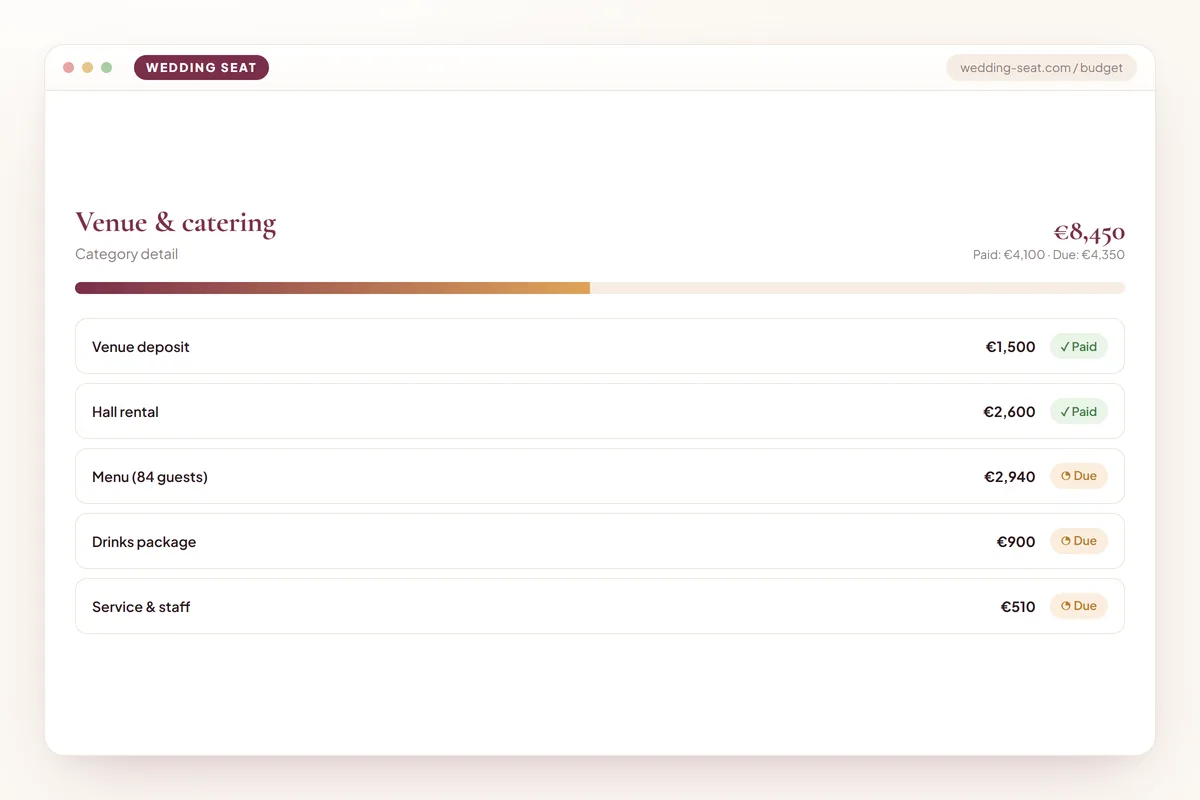
- Clear category breakdown
- Notes for each expense
- Live totals update automatically
- Works on mobile and desktop

Why wedding budgets go off track
Most budgets fail for the same reasons: hidden costs, scattered tracking, and estimates that never get updated.
How the wedding budget works
Set categories, add estimates, then update actuals as you book vendors. Totals stay accurate automatically.
1) Add categories that match your wedding
Start from a ready structure and adjust it to your priorities.
2) Enter estimates and deposits
Track expected costs plus what’s already paid.
3) Update actuals as plans change
Keep the remaining amount accurate as invoices come in.
What you can track with a wedding budget
A budget is more than one number — it’s a live picture of your plan.
Wedding budget: app vs spreadsheet
Spreadsheets work until payments, deposits, and changes stack up. A live budget keeps totals consistent.
Spreadsheets
- Easy to create conflicting versions
- Manual totals break over time
- Hard to track deposits and due dates
- Updates get lost in group chats
Wedding Seat
- One source of truth
- Totals update automatically
- Track paid vs remaining clearly
- Share one private link
More wedding planning tools
Wedding Guest List
Track invitations, RSVPs, plus-ones, and families in one place.
Guest List Template
Use a live template instead of spreadsheets — always accurate.
Wedding Seating Chart
Build a visual seating plan and share for approvals.
Seating Chart Template
A live seating template that stays consistent as guests change.
Wedding Checklist
Stay on track with a checklist that adapts as you plan.
Wedding RSVP
Collect replies, meal choices, and plus-ones online.
Wedding Timeline
Build the wedding-day schedule and share it with vendors.
Wedding Website
Publish a shareable site with details, RSVP, and registry.
Building a wedding budget is less about restricting your dreams and more about giving them a container that won't overflow. The tool above turns rough guesses into a real plan — this guide below it walks you through the exact terminology, math, and etiquette American couples use to make that plan stick, from the first spreadsheet draft to the final vendor payment.
What Americans Actually Call This Tool
Wedding planning circles in the US rarely use one single phrase for this — you'll hear it named differently depending on who's talking. Planners and bridal magazines say 'wedding budget breakdown' or 'line-item budget,' while couples in Facebook groups and subreddits shorthand it to 'the budget' or 'our number.' A planner asking 'what's your all-in cost' means the grand total after tax, tip, and fees — not just the venue quote. 'Cost per head' or 'per-plate cost' refers to catering and rentals divided by guest count, a figure caterers themselves quote in proposals. 'Budget vs. actual' is the tracker couples build once deposits start going out, comparing what they planned against what they've truly spent. None of these are wrong — they're just different rooms in the same house, and this page uses them interchangeably so you recognize them wherever you encounter them.
- Wedding budget breakdown = full itemized plan
- Our number / the budget = colloquial shorthand for total spend
- All-in cost = grand total including tax, tips, fees
- Cost per head / per-plate cost = spend divided by guest count
- Budget vs. actual = planned amount compared to real spend
Why a Written Budget Beats a Mental One
Couples who keep their budget in their heads almost always end up 15-30% over what they intended to spend, simply because verbal estimates from vendors ('probably around $8,000') get remembered as firm numbers and then get stacked on top of each other without anyone adding them up. A written budget forces addition to happen in real time, the moment a quote comes in, not three vendors later when the math has already gone sideways. It also gives you a shared reference point for family conversations. When a parent offers help or a future in-law asks 'how much are you spending on flowers,' pointing to a shared document ends the guessing game and keeps emotion out of what should be a logistics conversation. The tool above exists precisely so you're not building this in a notebook that only one partner can see — every number both of you enter becomes visible, dated, and easy to revisit before the next vendor call.
Set a recurring 15-minute 'budget check-in' every Sunday — couples who review weekly catch overspending while it's still fixable.
How Much Does a Wedding Actually Cost in the US
Total wedding spend in the US swings enormously by region, guest count, and how much is DIY versus fully outsourced — a backyard wedding for 40 in a small town and a hotel ballroom wedding for 180 in a major metro are barely the same category of expense. Rather than fixating on one national average, it's more useful to build your number from the ground up: venue and catering typically eat the largest single share, followed by photography/videography, then attire, flowers, music, and stationery filling out the rest. Metro areas (New York, LA, Chicago, DC) run meaningfully higher than suburban or rural venues for the same guest count, largely because catering minimums and venue rental floors are higher. Off-season and weekday weddings can undercut peak Saturday-in-June pricing by a wide margin. For a deeper category-by-category reference point, our guide on the average wedding cost breakdown lays out how each slice typically compares so you can sanity-check your own numbers against real ranges rather than a single flat figure.
Get three venue quotes before setting your total budget — venue and catering pricing varies so widely by region that a national average is nearly useless for your specific wedding.
Step-by-Step: Building Your Budget in the Tool Above
1. Enter your total guest count first. Every other number in the tool scales off this, so an accurate headcount (even a working estimate) makes every downstream percentage meaningful. 2. Set your overall spending ceiling — the absolute top number you and your partner (and any contributing family) are comfortable committing to, before you allocate a single dollar to a category. 3. Let the tool suggest category percentages, then adjust them. If you know flowers matter more to you than a live band, drag that allocation up and let another category absorb the difference — the ceiling from step 2 shouldn't move. 4. Add real vendor quotes as they arrive, replacing the tool's placeholder estimates with actual numbers. This is where a budget stops being theoretical. 5. Mark each line item's payment status — deposit paid, balance due, or fully paid — so the tool's running total reflects cash already spent, not just cash allocated. 6. Review the variance column monthly. Categories running over should trigger a same-week conversation about where to trim elsewhere, not a shrug at the final invoice.
Setting Percentages by Category
A workable starting split for a typical full-service US wedding looks roughly like: venue and catering together 45-50% of total spend, photography and videography 10-12%, attire and beauty 8-10%, flowers and decor 8-10%, entertainment/music 8-10%, stationery 2-3%, and the remaining 10-12% spread across favors, transportation, officiant fees, and a contingency cushion. These aren't rules carved in stone — a couple who cares deeply about photography and less about flowers should shift 3-4 points from decor into photography without guilt. The mistake to avoid is treating percentages as fixed before you have real quotes. Percentages are a planning scaffold for month one; by month three, your actual vendor contracts should be doing the talking. If catering alone is running 55% because your venue requires a specific caterer with a high minimum, don't force the other categories to match an outdated percentage — rebuild the split around the real number and adjust your ceiling or your guest count instead.
- Venue + catering: 45-50%
- Photo/video: 10-12%
- Attire + beauty: 8-10%
- Flowers + decor: 8-10%
- Contingency: 5-10% held back untouched
Cost-Per-Guest Math That Actually Predicts Your Total
Cost per guest (or 'per head') is the single most reliable lever for controlling total spend, because catering, rentals, favors, and often venue minimums scale directly with headcount — cutting your guest list from 150 to 100 doesn't just save on food, it ripples through rentals, stationery, and favors too. Calculate it by dividing your full catering-plus-beverage line by confirmed guest count, then use that per-head figure to model 'what if we cut 20 guests' scenarios before invitations go out, not after. A common miscalculation is using the catering quote's 'per person' price as the full per-guest cost — it usually excludes service charge, gratuity, rentals, and cake cutting fees, which can add another 20-30% on top. Always ask your caterer for an 'all-in per-person number' that includes tax and service charge before plugging it into your model, and check our wedding budget for 50 guests and wedding budget for 150 guests guides to see how the same percentages play out at very different scales.
The Hidden Costs Nobody Budgets For First
Every couple remembers to budget for the venue, the dress, and the cake. Far fewer remember delivery and setup fees for rentals, marriage license costs, alterations (often $200-600 on top of the dress itself), gratuities for vendors who don't include service charges, day-of coordinator fees if you add one late, overtime charges when the reception runs past the contracted hour, and postage for invitations that are heavier or larger than a standard envelope. Another frequently missed line: sales tax on services in states that apply it to event contracts, which can add several hundred to several thousand dollars depending on total spend and local rate. Cake cutting and corkage fees at venues that don't provide in-house catering are also routinely left off first drafts. Build a dedicated 'miscellaneous and fees' line at 5-8% of total budget specifically to absorb these, rather than discovering them one invoice at a time. Our hidden wedding costs checklist walks through the full list of line items couples consistently forget until the final invoice arrives.
Showcase: What Different Budget Styles Look Like
The tool above adapts to very different wedding styles, and seeing how the same framework renders for each helps you picture your own. A backyard or barn wedding for 60 guests typically shows a heavier decor and rental allocation (renting everything from chairs to a tent) but a much lighter catering line if food is potluck or truck-catered. A hotel ballroom wedding for 180 shows the opposite: catering and venue dominate the pie, decor shrinks because the room needs less dressing, and a room block line appears for out-of-town guests. A destination wedding for 40 close family shows travel and lodging subsidies as a real budget line alongside a smaller catering total, since the venue often includes food in a package rate. A multi-day South Asian or multi-event celebration shows the budget split across several distinct event tabs — sangeet, ceremony, reception — each with its own guest count and category breakdown rather than one combined total.
- Backyard wedding: rentals up, catering down
- Ballroom wedding: venue + catering dominate, decor lighter
- Destination wedding: travel/lodging becomes its own budget line
- Multi-event celebration: separate budget tab per event day
- Micro-wedding under 30: photography and venue take a larger % share
Etiquette Around Who Pays and Common Mistakes
Traditional US etiquette once assigned the bride's family the majority of costs and the groom's family the rehearsal dinner and officiant fee, but most couples today build a blended budget from multiple sources — their own savings, both sets of parents, and sometimes a joint contribution structure where whoever offers help contributes to a category rather than a lump percentage. The etiquette that still holds firm: whoever is contributing money should be part of the budget conversation from the start, not handed a bill after decisions are made. Surprising a contributing parent with a final number they weren't consulted on is the single most common source of wedding-planning family friction. Common mistakes to avoid: booking a venue before setting a ceiling (the venue then dictates your whole budget instead of the other way around), not accounting for tax and service charge until the final invoice, assuming every vendor takes card without a processing fee, and forgetting that a Friday or Sunday date, or an off-season month, can lower venue and catering minimums by a meaningful margin without changing anything else about the wedding.
If parents are contributing, ask them to name a specific category (flowers, bar, photography) rather than a lump sum — it prevents awkward line-by-line justification later.
When to Lock Your Budget vs. When to Leave It Flexible
Lock your total ceiling and your guest count early — these two numbers anchor everything else, and changing either mid-planning forces a rebuild of every category underneath them. Everything below that ceiling should stay flexible for the first two to three months while real vendor quotes replace placeholder estimates; a florist quote that comes in 40% under your placeholder frees up room for a better DJ, and that flexibility only works if you haven't already locked every sub-category in stone. By roughly four months before the wedding, most major vendors should be booked and their contracts should replace estimates entirely — at that point, lock the remaining categories (favors, stationery extras, day-of miscellaneous) since there's little new information left to wait for. Keep a genuine contingency line untouched until the final month; it exists specifically to absorb the last-minute additions — a forgotten rental, a final guest count bump, a vendor overtime fee — that appear in every wedding regardless of how carefully the rest was planned.
Vendor Deposits and Payment Schedules
Most US vendors require a signing deposit of 25-50% to hold your date, with the balance due on a schedule — commonly 50% at booking, 25% at the halfway mark, and the final 25% one to two weeks before the wedding, though every contract varies. Track these due dates in the same place as your budget totals, because a missed payment deadline can trigger late fees or, in rare cases, forfeit the booking entirely. When a payment schedule doesn't match your cash flow — for example, three vendor balances all due the same month — it's worth asking vendors directly whether the schedule is flexible; many will split a balance into two smaller payments if asked before signing, far fewer will accommodate that request after the contract is signed. Keep every deposit receipt and contract PDF in one folder alongside your budget document, so if a dispute arises about what was paid and when, you have dated proof rather than a memory of a conversation.
Tipping and Gratuities Nobody Puts in the Original Estimate
Gratuity is one of the most consistently under-budgeted lines in American weddings because it's rarely included in the headline vendor quote. General guidance: catering staff and bartenders 15-20% of the food and bar total (check first whether service charge already covers this — many contracts bundle an 18-20% service charge that is not the same as a tip and doesn't always go to staff), delivery and setup crews $10-20 per person in cash, hair and makeup artists 15-20% per stylist, photographers and videographers optional but common at $50-200 each if they're not the business owner, and officiants a $50-150 donation particularly for religious officiants who don't charge a formal fee. Budget for tips as a distinct line item at 3-5% of your total spend, in cash, organized into labeled envelopes the week of the wedding. Assign one trusted person (best man, day-of coordinator, or a parent) to distribute envelopes on the day — this removes the awkwardness of the couple handling cash during their own reception and ensures every vendor is tipped before they leave.
Cutting Costs Without Cutting the Wedding You Want
The most effective cost cuts come from decisions made early, not compromises made under pressure later. Trimming the guest list by even 15-20 people has the largest single impact on total cost because it reduces catering, rentals, favors, and stationery simultaneously. Choosing a Friday, Sunday, or off-peak season date can lower venue and catering minimums substantially without changing your vision at all. Buffet or family-style service typically undercuts plated service, and a single well-chosen statement florals moment (arch, head table) paired with modest centerpieces reads as intentional rather than sparse. Weaker cost cuts — the ones that show — include cutting photography hours short (missing key moments), skipping a day-of coordinator (shifting stress onto a family member instead), or choosing the cheapest available caterer without a tasting. If a category must shrink, shrink the ones your guests won't remember (elaborate favors, oversized welcome signage) before the ones they will (food quality, photography coverage, sound quality for toasts and dancing).
Building a Realistic Contingency Fund
A contingency line of 5-10% of total budget, held aside and genuinely untouched until needed, is the difference between a minor surprise and a budget crisis. This fund absorbs the categories that almost every wedding hits: a final guest count increase after RSVPs come in higher than the save-the-date estimate, a weather-driven rental addition (tent sides, heaters, a backup indoor space fee), vendor overtime when a reception runs past its contracted end time, or a last-minute alteration need. The discipline that makes a contingency fund work is treating it as genuinely off-limits for anything except true surprises — not a secondary pool for 'we found nicer flowers.' If, by the final month, the contingency remains largely untouched, that's a good sign your planning was accurate, and the leftover amount can go toward a honeymoon fund or simply stay as peace of mind through the final weeks.
Tracking Budget vs. Actual as Deposits Go Out
A budget is only useful if it's compared against real spending on a rolling basis, which is what separates a 'budget vs. actual' tracker from a one-time estimate sheet. Every time a deposit or final payment is made, log the actual amount next to the originally estimated line — not after the wedding, but the same week the payment clears. This turns your budget document into a live financial record rather than a wish list. Watching the variance column (planned minus actual) monthly reveals patterns early: if three categories in a row are running 10% over, that's a signal to adjust the ceiling or find offsetting savings elsewhere before it compounds. It also becomes the exact document you'll want on hand if a dispute arises with a vendor about what was quoted versus what was invoiced, or if you simply want a clear final number for your own records once the wedding is over.
Spreadsheet vs. Digital Tool: Why the Format Matters
A basic spreadsheet can absolutely track a wedding budget, but it requires manual formula-building for percentages, guest-count scaling, and payment-due reminders — work that a purpose-built tool like the one above handles automatically. The real advantage of a shared digital tool over a spreadsheet passed back and forth by email is real-time visibility: both partners (and any contributing parents, if invited in) see the same live numbers instead of comparing outdated file versions. Whichever format you choose, the non-negotiables are the same: both partners with edit access, a visible running total against the ceiling, a payment-due date next to every line item, and a contingency line that isn't quietly absorbed into 'miscellaneous' and forgotten. If you do use a spreadsheet, export or back it up monthly — losing the only copy of a half-finished wedding budget three months before the date is a genuinely common and avoidable stress.
Regional Price Differences Worth Planning Around
Wedding costs in the US vary more by metro area than by almost any other single factor. Major coastal cities and their close suburbs (New York, San Francisco, Los Angeles, Boston, DC) carry meaningfully higher venue rental floors and catering minimums than the same guest count in a mid-size Midwest or Southern city, largely driven by real estate and labor costs rather than quality differences. Couples with family in a lower-cost region sometimes choose to marry there specifically to stretch the same budget further, accepting the trade-off of more out-of-town guests needing travel support. Within a single region, price also swings by venue type: an all-inclusive venue package (venue plus in-house catering plus some rentals) often nets out cheaper than assembling every piece separately, purely because vendors bundle at a discount for exclusivity. Before assuming a DIY, piece-by-piece approach saves money, price both paths for your actual guest count — the assumption that 'DIY is always cheaper' doesn't hold once delivery fees, rental minimums, and your own time are counted.
Planning a Destination Wedding Budget
Destination weddings shift the budget structure fundamentally: travel and lodging move from a guest-side expense to a couple-side budget line if you're subsidizing rooms or a welcome dinner, and catering is frequently bundled into a resort or venue package rather than sourced separately. Because guest count for a destination wedding is typically smaller (accepting that many invited guests won't travel), per-person spend on the ceremony itself often rises even while the total budget falls compared to a large local wedding. Budget specifically for: your own travel and lodging for planning trips or site visits, a welcome dinner or farewell brunch if you're hosting guests for multiple days, vendor travel fees if you're bringing a photographer or planner from home rather than hiring locally, and currency exchange or international payment fees if the venue is abroad. Our destination wedding budget tips guide covers the specific negotiating and payment-timing differences that come with booking a venue outside your home country or state.
Negotiating With Vendors Without Damaging the Relationship
Vendors negotiate more often than most couples assume, but the approach matters. Asking a vendor to simply lower their listed price rarely works and can sour the relationship before you've even booked. Asking instead for a different package configuration — fewer hours, a second shooter dropped, a smaller floral package — respects their pricing structure while still landing at a lower total. Off-peak dates (weekdays, January-March, avoiding October's peak wedding season in most of the country) are the single most reliable lever for a genuine price reduction rather than a package cut. Always negotiate before signing, never after — a signed contract is a signed contract, and asking for a discount post-signature reads as bad faith even if your intentions are good. If a vendor won't move on price, ask what they can add at the same price point (an extra hour, a print release, a rehearsal dinner add-on) — many vendors have more flexibility on value-adds than on the number itself.
Reading Vendor Contracts Before You Budget Around Them
A quoted price and a contracted price are not always the same number, and the gap usually lives in the fine print: overtime rates per hour if the event runs long, cancellation and rescheduling fee schedules, travel fees beyond a stated radius, and whether the quote includes tax and service charge or adds them separately at signing. Read every contract for these four items specifically before entering the number into your budget tool, since the headline figure a vendor gives verbally is frequently the pre-tax, pre-fee base price. Also check the payment schedule and refund policy for each contract — if a wedding date changes due to unforeseen circumstances, knowing in advance whether deposits are refundable, transferable, or forfeited changes how much risk that vendor represents to your overall budget. Keep a signed copy of every contract in the same folder as your budget tracker so the true, all-in number — not the marketing number — is what you're planning around.
Stationery, Postage, and the Small Costs That Add Up
Stationery is usually budgeted as one line item, but it's actually five: save-the-dates, invitations, RSVP cards, day-of materials (programs, menus, table numbers, signage), and postage — each of which can be underestimated on its own. Custom or letterpress invitations run notably higher than digital-print options, and oversized or heavier envelopes (square shapes, wax seals, multiple insert cards) frequently exceed standard postage weight, requiring additional stamps that couples routinely forget to price in until they're at the post office with 150 envelopes. A practical budget approach: price stationery per guest household rather than per guest (since couples typically receive one invitation), confirm postage cost by weighing one fully-assembled sample envelope before ordering stamps for all of them, and set aside 1-2% of total budget for stationery as a realistic range for a mid-tier design and print approach — higher if calligraphy or custom illustration is involved.
Final Month Budget Checklist
In the final month, shift from planning mode to reconciliation mode. Confirm every vendor's final balance and due date against your tracker, and pay final balances on time — vendors rarely chase a couple for a missed final payment before the wedding, but a missed payment can create real friction on the day itself. Recount your final guest list against your catering guarantee, since most caterers require a final headcount 7-14 days out and will bill based on whichever number is higher, not lower. Prepare tip envelopes, confirm who is distributing them, and do a final pass through your contingency line to see what's genuinely left. Print or export a final copy of your full budget vs. actual sheet — not for anyone else, but because having one clean, final number after the wedding gives real closure to a process that's had a lot of moving pieces, and it's genuinely useful reference for anniversary planning or if you're asked for advice by a newly engaged friend.
Examples in every theme
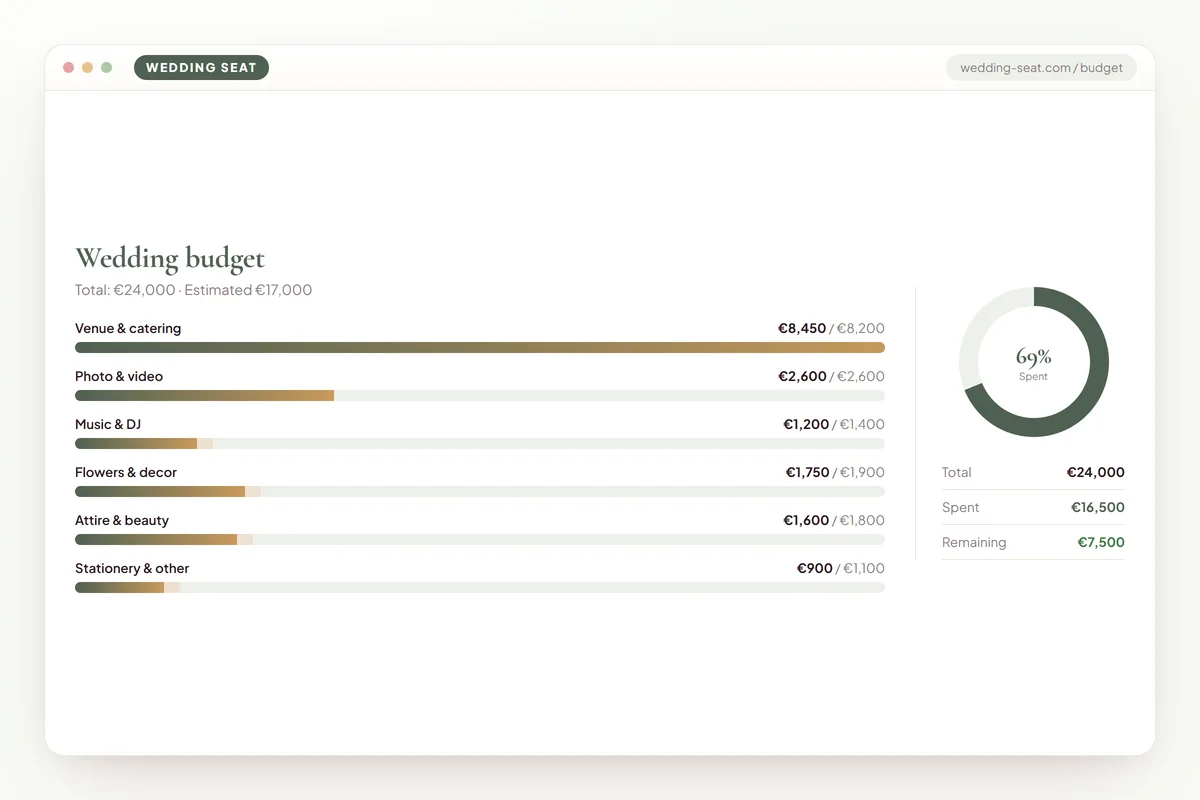
1.Wedding budget · Sage & Olive 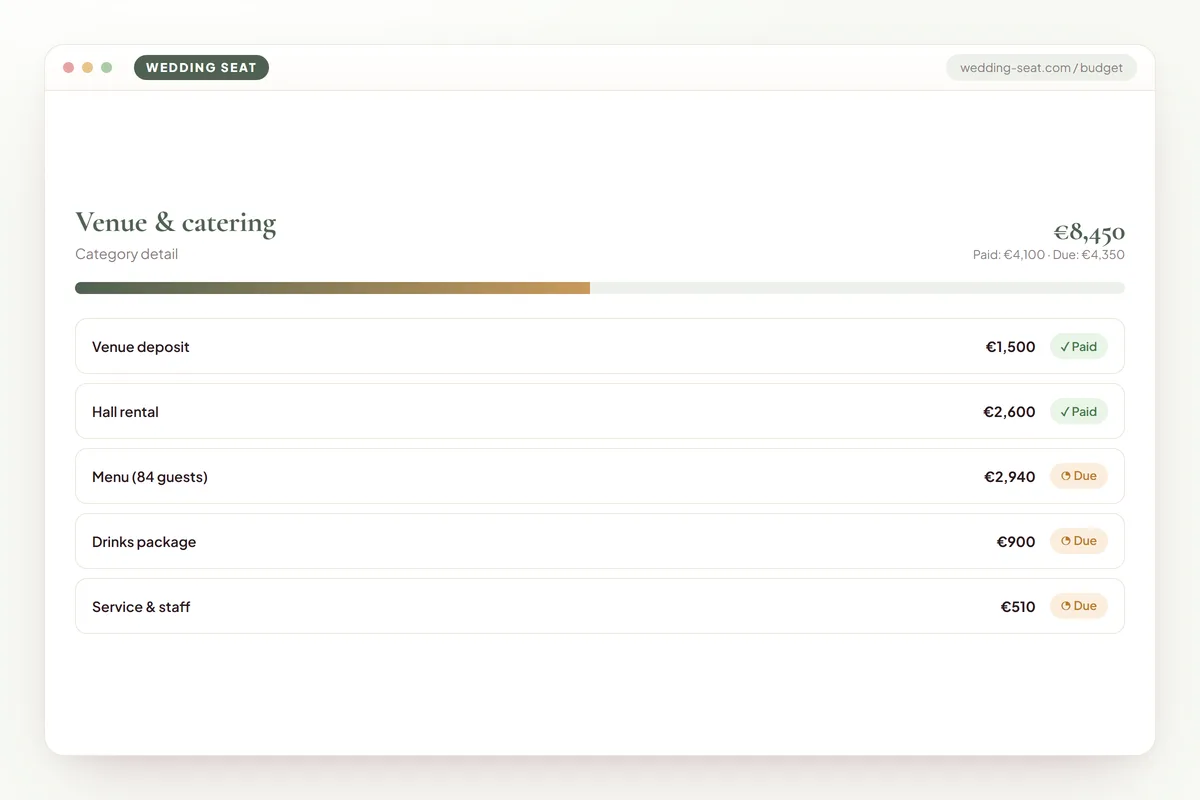
2.Venue & catering — Category detail · Sage & Olive 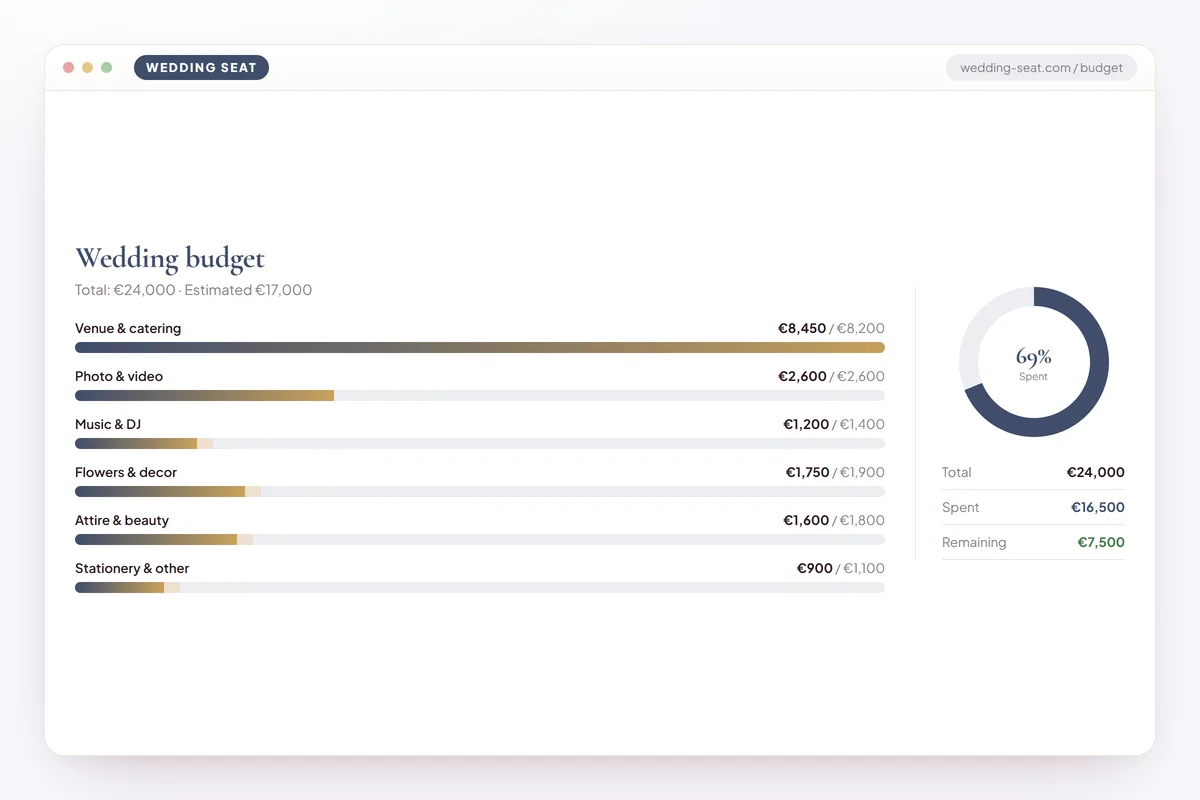
3.Wedding budget · Dusk Blue 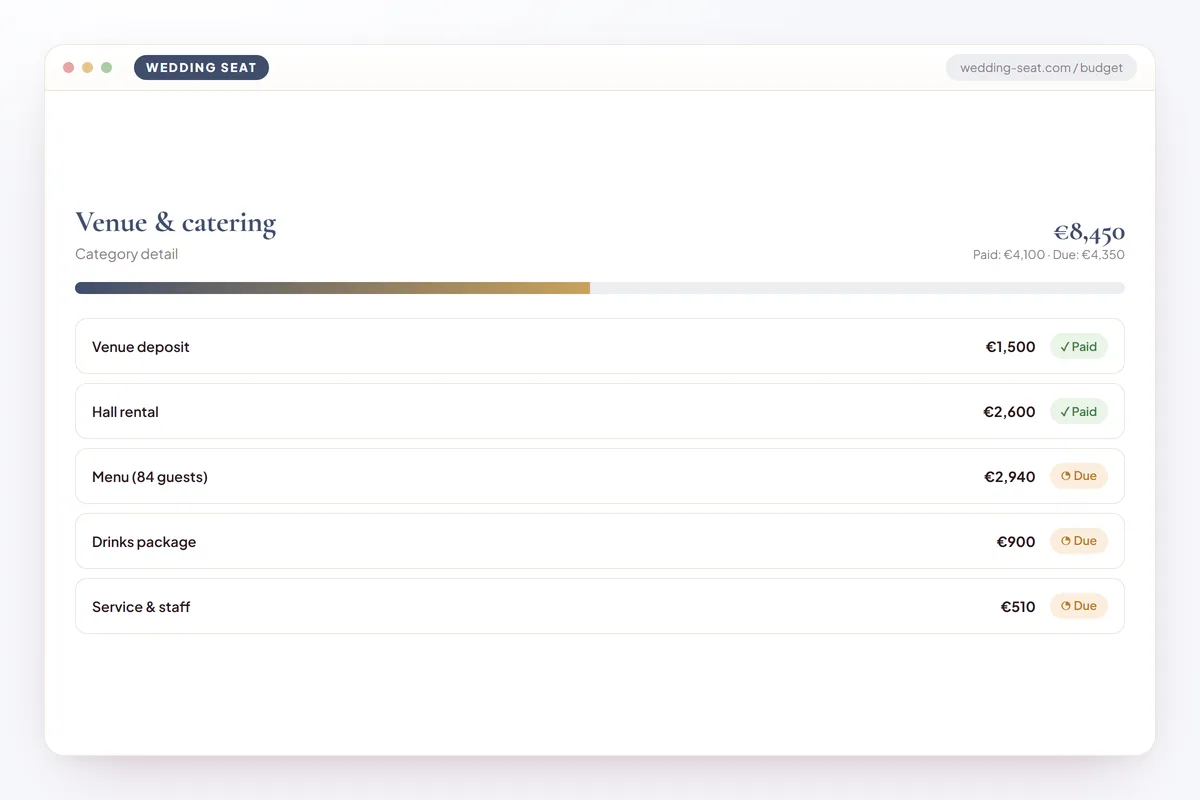
4.Venue & catering — Category detail · Dusk Blue 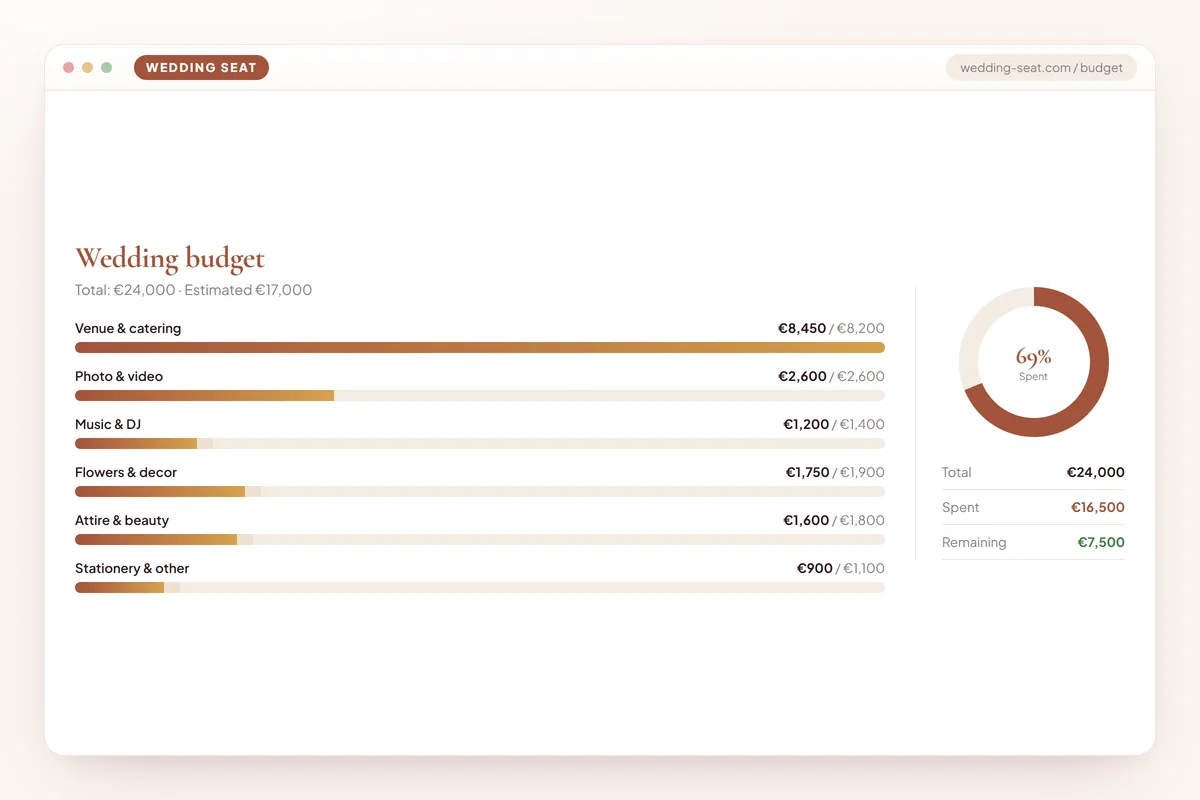
5.Wedding budget · Terracotta 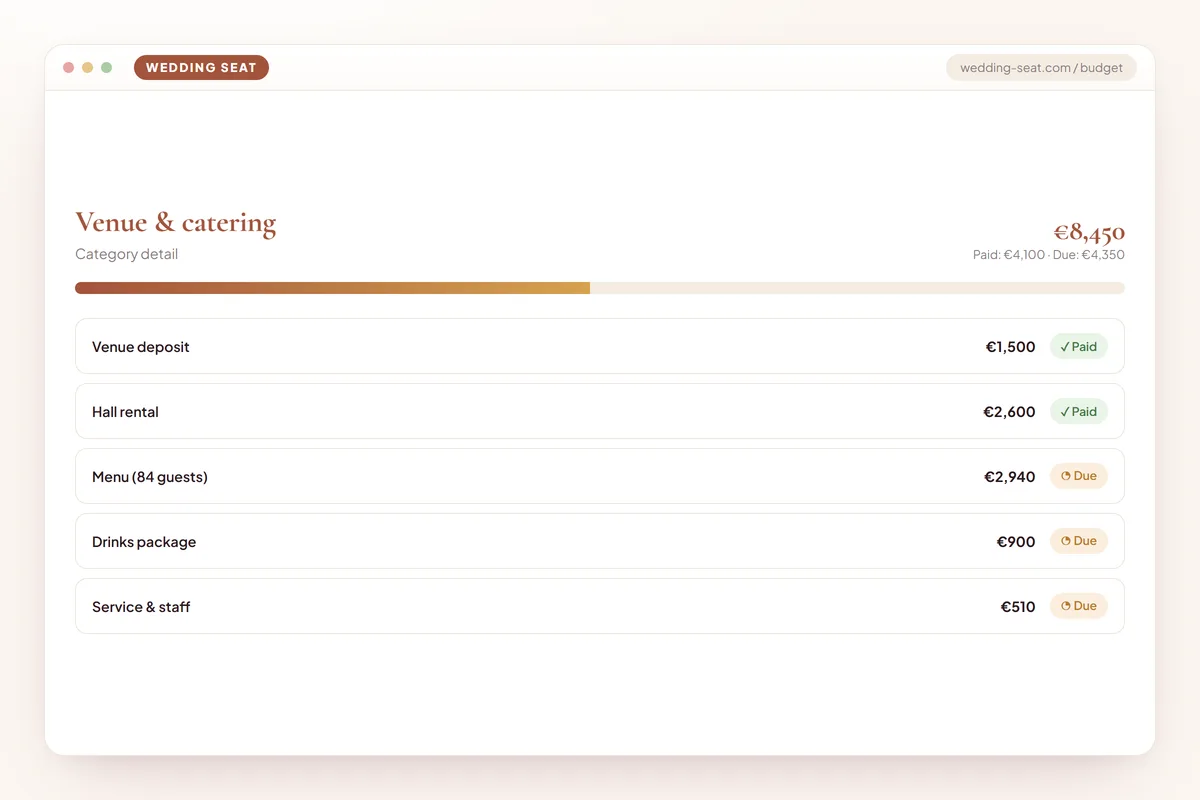
6.Venue & catering — Category detail · Terracotta
Frequently asked questions
What percentage of income should a wedding budget be?
There's no fixed rule tying wedding spend to income, and financial advisors generally caution against borrowing to fund a wedding regardless of income level. A more useful frame is savings-based: set your ceiling based on what you and any contributing family can pay in cash by the wedding date without touching emergency savings or taking on debt, then build your guest count and category allocations around that number rather than a percentage of salary.
How far in advance should we finalize our wedding budget?
Set your total ceiling and rough guest count as early as possible, ideally before touring any venues, since the venue is the hardest category to change later and easily dictates the rest of your budget if chosen first. Expect the category-by-category breakdown to stay flexible for the first two to three months as real vendor quotes replace estimates, then lock remaining categories around the four-month mark once major vendors are booked.
What's the biggest wedding budget mistake couples make?
Booking the venue before setting an overall ceiling. Once a venue is signed, its catering minimums, rental requirements, and preferred vendor list often absorb 45-50% or more of the total budget by default, leaving very little room to adjust later. Setting the ceiling and rough category percentages first, then shopping venues against that number, keeps the whole plan in your control instead of the venue's.
Should parents see the full wedding budget?
If parents are contributing financially, yes — full visibility into the budget they're helping fund prevents surprises and awkward conversations later, and most contributing parents appreciate being asked which specific category they'd like their contribution to cover. If parents aren't contributing, sharing the full budget is optional and up to the couple's comfort with financial privacy.
How much should we set aside for unexpected wedding costs?
Budget a contingency line of 5-10% of your total spend, held aside specifically for genuine surprises — final guest count increases, weather-related rental additions, vendor overtime, or last-minute fixes — and treat it as off-limits for anything else, including tempting upgrades. If it's largely untouched by the final month, that's a strong sign the rest of the budget was planned accurately.
Is a wedding planner worth it for staying on budget?
A good planner or even a day-of coordinator often pays for a meaningful portion of their own fee through vendor negotiation, avoiding overtime fees, and catching hidden costs before contracts are signed — particularly valuable for couples unfamiliar with typical vendor pricing in their area. For smaller or simpler weddings, a well-maintained budget tracker and a few hours of research can accomplish much of the same result without the added fee.
How do we budget for a wedding with a much smaller guest list?
Smaller guest counts shift the cost structure rather than simply shrinking every number proportionally — venue and photography costs don't scale down as steeply as catering and rentals do, so per-person spend often rises even as the total budget falls. Our wedding budget for 50 guests guide breaks down how the category percentages shift at a smaller scale so you're not applying a 150-guest split to a much smaller event.
Ready to put these numbers to work? Head back up to the wedding budget tool, plug in your guest count and ceiling, and let it build your first draft breakdown in minutes — free, editable together, and ready to update the moment your first real vendor quote lands.
Plan faster
Start your free wedding project in seconds.