
Wedding Timeline
Build your minute-by-minute wedding-day schedule in one place. Keep vendors and the wedding party on the same page.
- See the whole day at a glance
- Blocks for every moment and vendor
- Share updates with your team
- Clear order of the day
- Notes and owners for each block
- Times adjust as the plan shifts
- Works on mobile and desktop
Why wedding timelines slip
Most timelines fall apart the same way: buffers get skipped, vendors have different versions, and one delay pushes everything back.
How the wedding timeline works
Add your key moments, set times and owners, then share one schedule that everyone follows on the day.
1) Add your key moments
Start from a ready run of show and adjust it to your day.
2) Set times and who’s responsible
Assign each block to a vendor or member of the wedding party.
3) Share and update as plans change
Adjust times and everyone sees the latest schedule.
What you can schedule with a wedding timeline
A timeline covers the whole day — not just the ceremony start.
Wedding timeline: app vs spreadsheet
Spreadsheets work until times shift and vendors need the update. A live timeline keeps one version everyone trusts.
Spreadsheets
- Easy to create conflicting versions
- Times don’t shift together when one runs late
- Hard to see who owns each moment
- Updates get lost in group chats
Wedding Seat
- One source of truth
- One schedule everyone follows
- See owners for every block
- Share one private link
More wedding planning tools
Wedding Guest List
Track invitations, RSVPs, plus-ones, and families in one place.
Guest List Template
Use a live template instead of spreadsheets — always accurate.
Wedding Seating Chart
Build a visual seating plan and share for approvals.
Seating Chart Template
A live seating template that stays consistent as guests change.
Wedding Budget
Track costs, deposits, payments, and remaining totals.
Wedding Checklist
Stay on track with a checklist that adapts as you plan.
Wedding RSVP
Collect replies, meal choices, and plus-ones online.
Wedding Website
Publish a shareable site with details, RSVP, and registry.
Every memorable wedding day runs on an invisible spine: a timeline that tells everyone — the hairstylist, the officiant, the DJ, your maid of honor, your grandmother — exactly where to be and when. Get it wrong and you're rushing your vows, skipping golden-hour portraits, or standing around during an awkward gap; get it right and a hundred moving parts feel effortless. Use the tool above to draft your day-of schedule, then read on for the real math, etiquette, and worked examples that make a timeline actually hold up on the day.
What Couples Actually Call This Document
Ask five wedding professionals what this is called and you'll get five slightly different answers, and knowing the native vocabulary helps you talk to vendors without confusion. Planners and venues most often say 'wedding day timeline' or 'day-of timeline' when referring to the master document with times down to the minute. Photographers and videographers tend to say 'shot list schedule' or reference the 'photography timeline' as a subset of the bigger picture. DJs, bands, and event producers frequently use 'run of show,' a term borrowed from live event production, especially for the reception portion with entrances, toasts, and dances. Coordinators writing for the whole vendor team often call it the 'master timeline' or 'production schedule,' while the version handed to your wedding party and family is usually a simpler 'day-of schedule' or 'itinerary.' Guests, meanwhile, only ever see the 'ceremony program' or 'order of service,' which is just the ceremony section. None of these terms are wrong — they describe the same living document at different levels of detail, and using the right word with the right person (say 'run of show' to your DJ, 'day-of timeline' to your planner) signals you've done your homework.
- Wedding day timeline — the master, minute-by-minute document
- Day-of schedule — same thing, more casual phrasing
- Run of show — DJ/band/production term for reception flow
- Master timeline or production schedule — the full vendor-facing version
- Itinerary or order of service — the simplified guest/wedding-party version
How to Build Your Timeline in the Tool Above
1. Start with your ceremony time. Enter the date and the exact minute your ceremony begins — this single number becomes the anchor every other block of time is calculated from, both backward (getting ready, first look, transportation) and forward (cocktail hour, reception). 2. Add your getting-ready blocks. Input hair and makeup start times for the couple and wedding party; the tool will flag if your window is too tight based on typical per-person timing (allow 45–60 minutes per person for hair and makeup combined). 3. Drop in your photography preferences. Choose first look or no first look — this single choice reshapes the entire pre-ceremony half of the day, and the tool will rearrange portrait and family-photo blocks automatically. 4. Set your reception style. Select plated, buffet, or family-style dinner service and the tool adjusts the dinner block length accordingly, since these take noticeably different amounts of time. 5. Slot in your key reception moments — grand entrance, toasts, first dance, parent dances, cake cutting, and open dancing — and drag them into the order you actually want; the tool prevents obvious conflicts like toasts overlapping dinner service. 6. Review the auto-generated buffer blocks. The tool inserts small cushions between major transitions; don't delete these, they're what keeps the day from falling apart if hair and makeup run ten minutes long. 7. Export or share the finished timeline as a link or PDF to your planner, photographer, DJ, and wedding party so everyone is working from one identical document, not five different memories of a phone call.
Showcase: What Real Timelines Look Like
No two weddings run the same schedule, and seeing how different formats and cultural traditions rearrange the same basic blocks makes it much easier to build your own with confidence. Below are the kinds of layouts couples commonly generate in the tool above, spanning different ceremony types, reception lengths, and cultural traditions.
- A 5 PM church ceremony with a no-first-look portrait block squeezed into the 45-minute cocktail hour
- An all-day Hindu wedding timeline with baraat, mandap ceremony, and separate lunch and evening reception blocks
- A courthouse-to-backyard-party non-religious timeline with a 2 PM ceremony and open-ended evening
- A destination beach wedding with sunset ceremony timed to golden hour and a shortened, dinner-first reception
- A multicultural fusion timeline stacking two ceremony traditions back-to-back with a shared cocktail hour between them
Etiquette and the Mistakes That Sink a Schedule
The single most common mistake is building a timeline around what you want to happen rather than how long things actually take — fifteen minutes for family formal photos sounds fine on paper but rarely survives a family of six with three sets of divorced parents and a photographer trying to herd everyone. Pad every photo block by at least ten minutes more than feels necessary. The second mistake is scheduling toasts during dinner service instead of between courses; guests can't hear a maid of honor over clattering plates, and caterers hate being paused mid-plate. Etiquette-wise, keep your ceremony start time firm and communicate it clearly on invitations — starting fifteen minutes 'late for effect' is an outdated habit that now just frustrates guests and throws off vendor call times paid by the hour. Don't schedule the cake cutting so late that half your guests have already left; it's traditionally done before or right after dinner if you want it photographed with full energy in the room. Finally, always give your officiant, caterer, and DJ the finished timeline at least a week ahead, not the morning of — vendors coordinate with each other off this document, and a last-minute change to your grand entrance time can quietly break your caterer's plating schedule.
Never schedule anything you truly care about (first dance, cake cutting, bouquet toss) in the final 30 minutes of an open bar reception — that's when attention and sobriety both dip fastest.
Working Backward From Your Ceremony Time
The most reliable way to build a timeline is to treat your ceremony start time as fixed and work backward from there, rather than starting your morning schedule and hoping it lands on time. If your ceremony is at 4:00 PM, guests should be seated by 3:45, which means your wedding party and immediate family need to be in place and hidden from guest view by 3:30. Work back further: if there's a first look, that typically happens 90 minutes to two hours before the ceremony to leave room for couple portraits and wedding-party photos afterward. Hair and makeup, in turn, needs to wrap with enough cushion before the first look or ceremony to allow for a partial outfit change, steaming a dress, and simple contingency time. This backward-planning method is exactly what prevents the classic wedding-morning spiral where hair and makeup runs behind, which pushes the first look late, which eats into portrait time, which means the couple arrives at their own cocktail hour instead of enjoying it. Anchor the ceremony time first in the tool above, and let every earlier block calculate itself from that fixed point rather than adding times forward and hoping they land correctly.
- Ceremony time is the fixed anchor — never the last thing you decide
- Guests seated 15 minutes before start
- Wedding party hidden and ready 30 minutes before start
- First look 90 minutes–2 hours before ceremony if you're doing one
Getting Ready: Hair, Makeup, and the Real Clock
Hair and makeup is where more timelines go wrong than almost anywhere else, mostly because couples underestimate per-person timing. A realistic budget is 45 minutes for hair, 45 minutes for makeup per person if separate artists are working simultaneously on different people, or 60–90 minutes per person if one artist is doing both hair and makeup solo. The bride typically goes last or second-to-last in the chair so her look stays fresh longest, with the exception being if a first look is scheduled early, in which case she may need to go earlier alongside the rest of the timeline. Build in a genuine buffer, not an optimistic one: if your artists estimate five hours for eight people, block six. Factor in breakfast and a proper lunch built into this window too — brides and wedding parties running on coffee and nerves by 2 PM is a real and avoidable problem. Also confirm whether hairstyling includes trial-run touch-ups; a rushed artist working from a photo reference for the first time on the actual day takes longer than one repeating a trial. Finally, keep the space itself in mind — a getting-ready suite with good natural light near a window isn't just nicer for photos, it also keeps makeup artists working faster and more accurately than dim hotel lighting.
First Look or No First Look: The Timeline Fork
Whether you choose a first look changes almost every other block of your day, so decide this early, before you build the rest of your timeline. With a first look, couple portraits and most wedding-party and family photos happen before the ceremony, which means your cocktail hour becomes genuinely relaxing — you can actually attend it, eat an appetizer, and greet guests instead of being sequestered taking pictures. This structure suits couples who want a calmer, less rushed pre-ceremony photography block and don't mind seeing each other early. Without a first look, all portraits compress into the cocktail hour window, typically 45 minutes to an hour, which is genuinely tight if you also want family formals, wedding-party shots, and couple portraits in that same slot. Couples who skip the first look for tradition or emotional preference should budget a longer cocktail hour, 75–90 minutes, and consider having guests enjoy passed appetizers and a signature drink station while photos run slightly long, since guests rarely mind a longer cocktail hour but do mind waiting for a delayed reception entrance.
Photography Timeline and the Golden Hour Math
If outdoor portraits matter to you, the ceremony time should be chosen with sunset in mind, not the other way around. Golden hour — the soft, warm light roughly 60–90 minutes before actual sunset — is when most photographers want 20–30 minutes alone with the couple for portraits. Check the sunset time for your date and location, then count backward: for a sunset at 7:45 PM, you'd want couple portraits happening between roughly 6:45 and 7:15 PM, which usually means slotting them either right after the ceremony or briefly pulling the couple away during the reception. This is also why many photographers ask about a 'sunset portrait break' on your timeline — a planned 15-minute disappearance during the reception, usually right after dinner service winds down, specifically timed to the light rather than to convenience. If your wedding is entirely indoors or at night, this consideration disappears, but for any outdoor or partially-outdoor wedding, cross-reference your ceremony time against sunset for your actual date before finalizing anything else — a February wedding with a 5 PM sunset needs a completely different schedule than a June wedding with 8:30 PM light.
Ceremony Length by Type
Ceremony duration varies enormously depending on tradition, and this single block has a bigger ripple effect on your day than most couples expect. A civil or non-religious ceremony with a few readings, vows, and a ring exchange typically runs 15–20 minutes. A traditional Christian ceremony with hymns, scripture readings, and a full unity ritual often runs 30–45 minutes, while a full Catholic nuptial Mass can run a full hour or longer. Jewish ceremonies typically run 20–30 minutes but often include a receiving line or yichud (private time) immediately after that should be built into the timeline as its own block. Hindu ceremonies are frequently the longest, with the baraat procession, multiple rituals around the mandap, and the full ceremony sometimes spanning two to three hours or more. Confirm your exact expected length directly with your officiant or religious leader rather than guessing from a template, since even within the same faith tradition, individual clergy and family customs vary the length significantly. Whatever the length, build a 10-minute buffer immediately after the ceremony for photos with the officiant, congratulatory hugs, and the receiving line before guests are expected to move to cocktail hour.
Cocktail Hour: What's Actually Happening Off-Camera
Cocktail hour looks simple to guests — drinks, appetizers, mingling — but behind the scenes it's the busiest structural window of your whole day. This is when the reception space is often being flipped from ceremony seating (if it's the same venue), final table settings are completed, the band or DJ does a sound check, and the catering team preps for dinner service. It's also, as covered above, frequently when the couple is finishing photos if they skipped a first look. A true 'hour' is rarely exactly 60 minutes in practice — 45 minutes is common for couples who want a tighter, more energetic day, while 90 minutes suits couples doing extensive photography or a room flip. Whatever length you choose, make sure your caterer and bartender know it precisely, since bar staffing and appetizer pacing are built around this window specifically. One frequently missed detail: if the couple is off taking photos during cocktail hour, assign someone — a maid of honor, a parent, a wedding planner — to be the point person guests can find, since an event with no visible host for an hour can feel oddly directionless to out-of-town guests who don't know anyone else.
The Grand Entrance and Reception Opening
The reception's opening sequence sets the energy for the rest of the night, so its order matters more than couples often assume. The standard sequence is: guests seated, wedding party introduced individually or in pairs, parents introduced or already seated, and finally the newlyweds introduced last to the biggest reaction. Some couples skip individual wedding-party introductions entirely in favor of walking in together as a group, which shaves several minutes off this block and suits smaller or more casual weddings. Immediately after the entrance, couples typically choose between going straight into a first dance (getting the formal dance moment out of the way while energy is high) or moving directly into welcome remarks and the start of dinner service, saving the first dance for later. Neither order is more correct than the other, but whichever you choose, tell your DJ or bandleader explicitly, since this is the single most common point of on-the-day confusion between couples and entertainment vendors — many DJs default to 'entrance into first dance' unless told otherwise.
Toasts and Speeches: Timing Them Right
Speeches run long more often than any other reception element, so plan for realistic lengths, not aspirational ones. A best man or maid of honor toast should be budgeted at 3–5 minutes each; parent toasts run similarly. With a best man, maid of honor, and one set of parents speaking, budget a genuine 20 minutes including transitions, mic handoffs, and applause — not the 10 minutes it looks like on paper. The most guest-friendly placement is between courses rather than during dinner service or, worse, at the very start before anyone has a drink in hand — toasts land best once the room has settled with a plate and a glass. Avoid stacking every single toast back-to-back at one point in the evening; splitting them (family toasts before the meal, wedding-party toasts between courses) keeps energy from sagging. Always ask speakers in advance for a rough time estimate and gently cap anyone known for long stories — a wedding planner or emcee quietly signaling a 'wrap it up' cue from the side of the room is completely normal and expected, not rude.
Dinner Service Style and How Long It Really Takes
Your dinner format directly determines how much time to block, and this is one of the most underestimated line items on any timeline. Plated dinner service for 100–150 guests typically takes 60–75 minutes once everyone is seated, including course changes. Buffet service, despite sounding faster, often takes just as long or longer once you factor in table-by-table release to avoid a crowd rush — budget 75–90 minutes for a full buffet meal for a similar guest count. Family-style service, where shared platters are brought to each table, tends to land in between, around 60–80 minutes. Whichever format you choose, tell your caterer your desired toast placement in advance so they can build their course timing around it rather than the other way around — caterers can absolutely hold a course for five minutes if warned ahead but are far less able to accommodate a surprise pause mid-service. Also budget extra time if you have a plated meal with more than two entrée choices, since server confirmation at each table adds meaningfully to service time.
- Plated dinner: 60–75 minutes for 100–150 guests
- Buffet: 75–90 minutes including table-by-table release
- Family-style: 60–80 minutes
- Multiple entrée choices add meaningful service time
First Dance, Parent Dances, and Cake Cutting Order
There's no single correct order for these three moments, but there is a logical flow most couples and DJs settle on. A common sequence is: first dance immediately after dinner service wraps, followed directly by parent dances (mother-son, father-daughter) while the room's attention is still fully on the dance floor, then a brief transition into cake cutting before guests start drifting toward the bar or outside for air. Some couples prefer cutting the cake earlier, right after the reception entrance, specifically so it's captured while everyone is still seated and attentive rather than competing with open dancing later; this also lets catering staff start slicing and plating dessert service earlier in the evening. Whatever order you choose, keep these moments consecutive rather than scattered across the night — asking a room to stop dancing forty minutes in for a delayed cake cutting noticeably deflates the energy you just built. Tell your DJ the exact order and approximate timing so they can plan music transitions rather than guessing in the moment.
Open Dancing, Traditions, and Late-Night Pacing
Once the formal moments are complete, open dancing is typically where the bulk of remaining reception time goes, and pacing it well matters more than most couples realize while planning. If you're including a bouquet or garter toss, schedule it roughly 30–45 minutes into open dancing, once the floor is genuinely warm, rather than immediately, when half the room is still finishing dessert. Cultural or family traditions — a money dance, a horah, a shoe game — should be placed early in the dancing block while energy and guest attention are both highest, not saved for the very end when numbers thin out. Budget your final 30–45 minutes for a natural wind-down rather than an abrupt stop: many DJs slow the tempo slightly in the last stretch and cue a last song announcement to signal the close without an awkward silence. If you have a late-night snack station, timing its arrival around the two-thirds mark of open dancing (not right at the start) tends to give guests a second wind exactly when energy naturally starts to dip.
Vendor Arrival Times on the Master Timeline
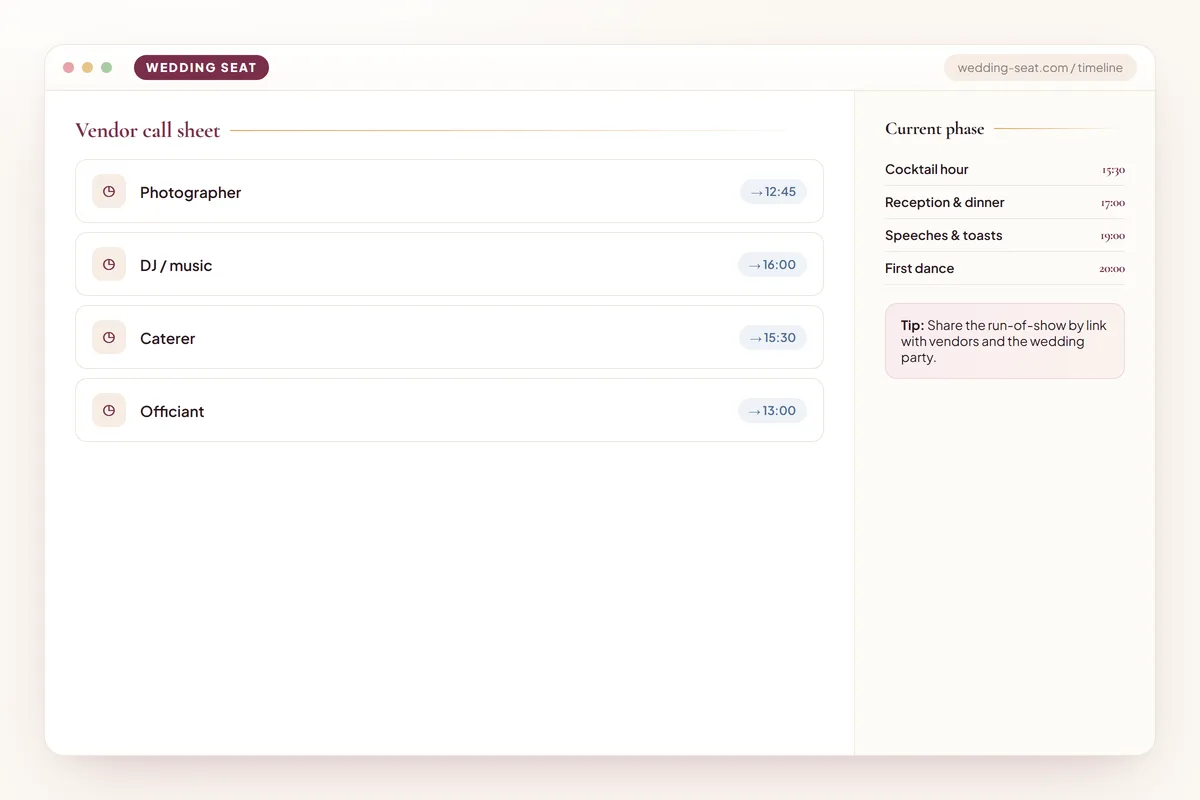
Your master timeline isn't just for you — it's the coordination document every paid vendor works from, and their arrival times need their own dedicated block, separate from your personal schedule. Florists typically arrive 3–4 hours before the ceremony to set up ceremony arrangements and centerpieces. Photographers and videographers usually arrive at the start of getting-ready coverage, often 6–8 hours before the reception ends. The DJ or band typically needs 2 hours for setup and sound check before the first guest arrives, and caterers often need kitchen or tent access 4–6 hours ahead depending on the complexity of the menu. List every vendor's arrival and departure time explicitly on the version of the timeline you send them, along with a single point of contact (usually your planner or a designated family member) they can reach directly if something runs behind — not the couple's personal phone number. This single detail prevents the extremely common scenario of a vendor calling the bride directly during hair and makeup because they can't find the loading dock.
Always confirm vendor arrival windows against the venue's own load-in rules — some venues restrict vendor access to specific hours regardless of what your contract with the vendor says.
Buffer Time: The Most Underrated Line Item
Every seasoned planner will tell you the same thing: the difference between a smooth wedding day and a stressful one is rarely the big decisions, it's whether buffer time was built in. A good rule of thumb is a 10–15 minute cushion after every major transition — after hair and makeup, after the first look, after the ceremony, after cocktail hour — not because you expect delays, but because something running even slightly long is close to guaranteed across an eight-plus-hour day. Don't treat buffer time as wasted time to be filled with more activities; its entire value is in being empty. A timeline with zero slack looks efficient on paper but collapses the moment one hairstylist runs 12 minutes over or one groomsman is late arriving. As a general guideline, build at least 60–90 total minutes of buffer distributed across your full day's timeline, concentrated most heavily around getting ready and photography, since those two blocks are statistically where delays originate most often.
Season, Sunset, and Daylight Considerations
The time of year you're marrying should directly shape your timeline structure, not just your décor choices. Winter weddings with a 5:00 PM sunset need ceremony and portrait timing pulled significantly earlier than a summer wedding with 8:30 PM light, or outdoor photography simply won't be possible. If you're marrying in late fall or winter and want any natural-light portraits, consider a ceremony start time as early as 2:00–3:00 PM rather than the traditional late-afternoon slot. Humidity and heat matter too — a July outdoor ceremony at 2 PM in a hot climate is genuinely uncomfortable for guests standing in direct sun, and many couples in warmer regions push ceremony times to 5 or 6 PM specifically to avoid peak heat, then shift photography and cocktail hour to make up the difference. Always check historical sunset times and average temperatures for your specific date and venue location before locking your ceremony time, rather than defaulting to a generic '4 PM ceremony' template that may not suit your actual climate or season.
Multi-Day and Destination Wedding Timelines
Destination and multi-day weddings need a timeline that spans more than just the wedding day itself, since welcome events, rehearsal dinners, and post-wedding brunches all have their own timing considerations that affect the main event. A typical structure includes a welcome party or dinner the evening guests arrive (often two days before the wedding), a rehearsal and rehearsal dinner the evening before, the wedding day itself, and a casual farewell brunch the following morning for guests staying an extra day. For destination weddings specifically, build in extra buffer around the ceremony and reception for weather and logistics that are harder to control abroad — vendor punctuality norms, transportation between venues, and even sunset times can vary from what you're used to at home. If your wedding involves guest travel across time zones, note both local and home time zones clearly on any shared itinerary to avoid confused early or late arrivals. Multi-day timelines are also where a simplified guest-facing itinerary (separate from your detailed vendor-facing master timeline) becomes especially important, since guests need clear, low-detail information across several days without vendor-level minutiae.
Sharing the Timeline With Vendors and Your Wedding Party
A timeline that only lives in your head or a single email thread is a timeline that will break down on the day. Once finalized, share it in three tiers: the full master timeline (down-to-the-minute, vendor arrival times included) goes to your planner, photographer, DJ, caterer, and venue coordinator; a slightly simplified version goes to your wedding party and immediate family, showing them where and when they need to be without vendor logistics; and a guest-facing itinerary, covering only ceremony time, reception start, and any multi-day events, goes out via your wedding website or welcome bag. Send the master version to vendors at least one to two weeks before the wedding, not the morning of, so they can flag conflicts while there's still time to fix them. Confirm receipt individually rather than assuming an email was read — a quick text the week before asking your DJ to confirm they have the final timeline is a five-minute task that prevents a genuinely common day-of miscommunication.
- Master timeline (full detail) — planner, photographer, DJ, caterer, venue
- Simplified schedule — wedding party and immediate family
- Guest itinerary (minimal) — wedding website or welcome bag
- Send final version 1–2 weeks ahead, confirm receipt individually
Building a Rain Plan Into Your Timeline
If any part of your day is outdoors, your timeline needs a documented rain-plan trigger point, not just a vague backup venue mentioned once in passing. Decide in advance who makes the call (usually your planner or venue coordinator, not the couple) and by what time — a common standard is a decision made 2 hours before the ceremony based on the latest forecast, giving staff enough time to flip an indoor space if needed. Build the indoor alternative into your actual timeline document as a labeled 'Plan B' column or note, including how much extra setup time the indoor flip requires, since moving chairs, arch, and audio equipment indoors under time pressure takes longer than most couples expect. Tell your wedding party this trigger time too, so nobody is blindsided by a last-minute venue change — a bridesmaid who finds out about an indoor ceremony switch by seeing chairs being moved, rather than by being told directly, is a small but very avoidable stress point on the day.
Worked Example: A Classic 5 PM Ceremony Wedding
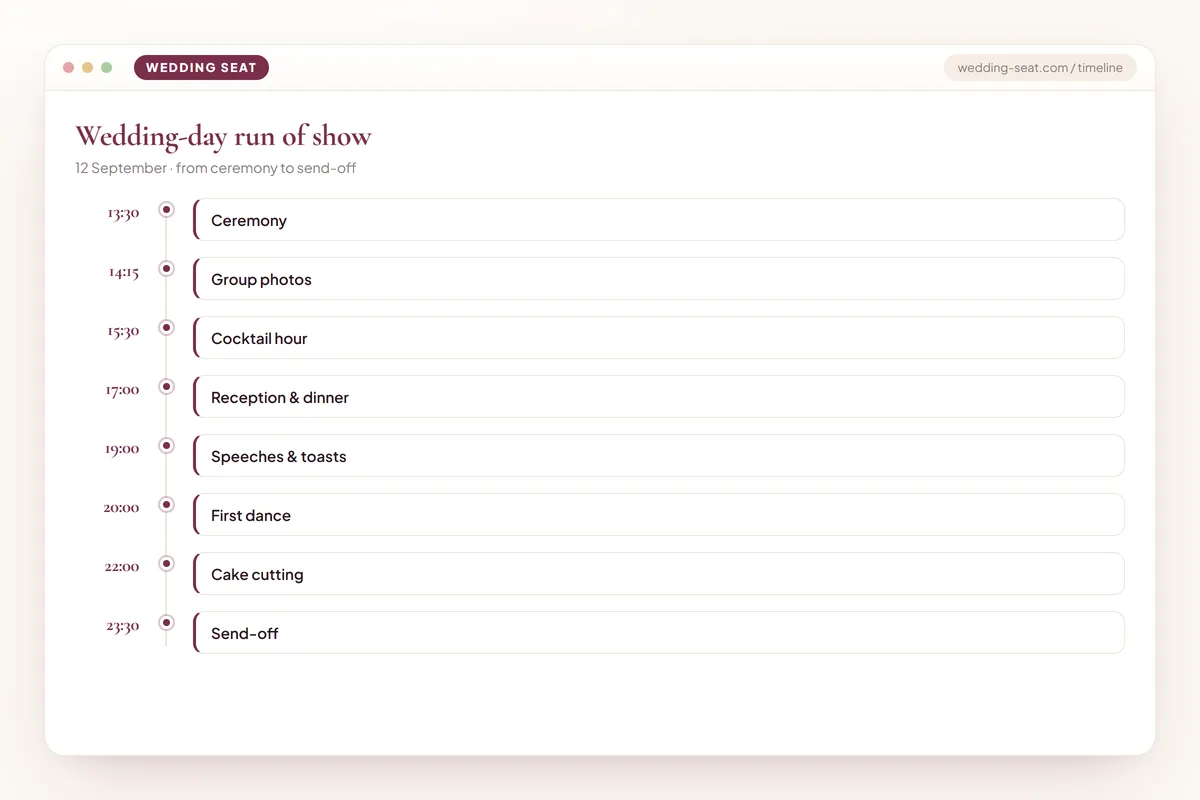
Here's how a full day comes together for a common format — a 5:00 PM outdoor ceremony with a first look, plated dinner, and a 10 PM send-off. 9:00 AM hair and makeup begins for the wedding party; 12:30 PM the couple's hair and makeup wraps; 1:00 PM the photographer arrives for detail and getting-ready shots; 2:30 PM first look and couple portraits; 3:15 PM wedding-party photos; 3:45 PM family formal photos; 4:15 PM hidden buffer before ceremony; 4:45 PM guests seated; 5:00 PM ceremony begins (20 minutes); 5:20 PM receiving line and photos with officiant; 5:30 PM cocktail hour begins; 6:30 PM guests seated for reception, wedding party introduced, couple enters; 6:40 PM welcome toast and dinner service begins; 7:20 PM parent toasts between courses; 7:50 PM dinner service concludes; 8:00 PM first dance; 8:05 PM parent dances; 8:15 PM cake cutting; 8:25 PM open dancing begins; 9:10 PM bouquet and garter toss; 10:00 PM last song and send-off. Notice the buffer at 4:15 and the deliberate spacing between toasts and dinner courses — both are what keep this specific schedule realistic rather than aspirational.
Worked Example: A Daytime or Morning Wedding
Daytime weddings compress differently, and the tool above handles this shift automatically once you set an earlier ceremony time. For an 11:00 AM ceremony with a brunch reception ending by 3:00 PM: 6:30 AM hair and makeup begins; 9:00 AM couple's hair and makeup wraps; 9:15 AM first look and portraits (soft morning light works beautifully here); 10:00 AM wedding-party and family photos; 10:45 AM guests seated; 11:00 AM ceremony (20–30 minutes); 11:30 AM receiving line; 11:45 AM cocktail hour with brunch-style passed bites; 12:30 PM reception entrance and seated brunch service begins; 12:40 PM toasts between courses; 1:15 PM first dance and parent dances; 1:30 PM cake cutting; 1:45 PM open dancing (a shorter window given the earlier end time); 2:45 PM last song; 3:00 PM send-off. Morning weddings like this one need noticeably earlier vendor call times — florists and caterers arriving well before sunrise — so confirm those hours explicitly rather than assuming standard afternoon arrival windows will still apply.
Examples in every theme
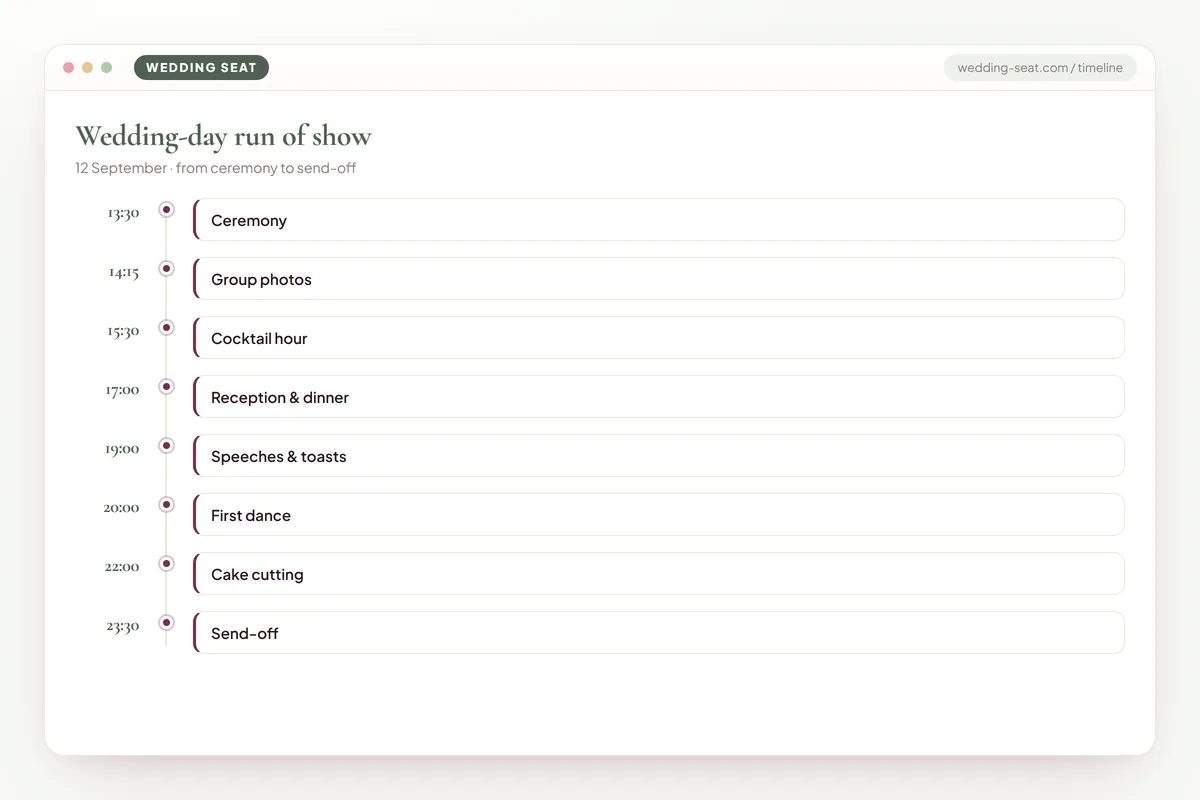
1.Wedding-day run of show · Sage & Olive 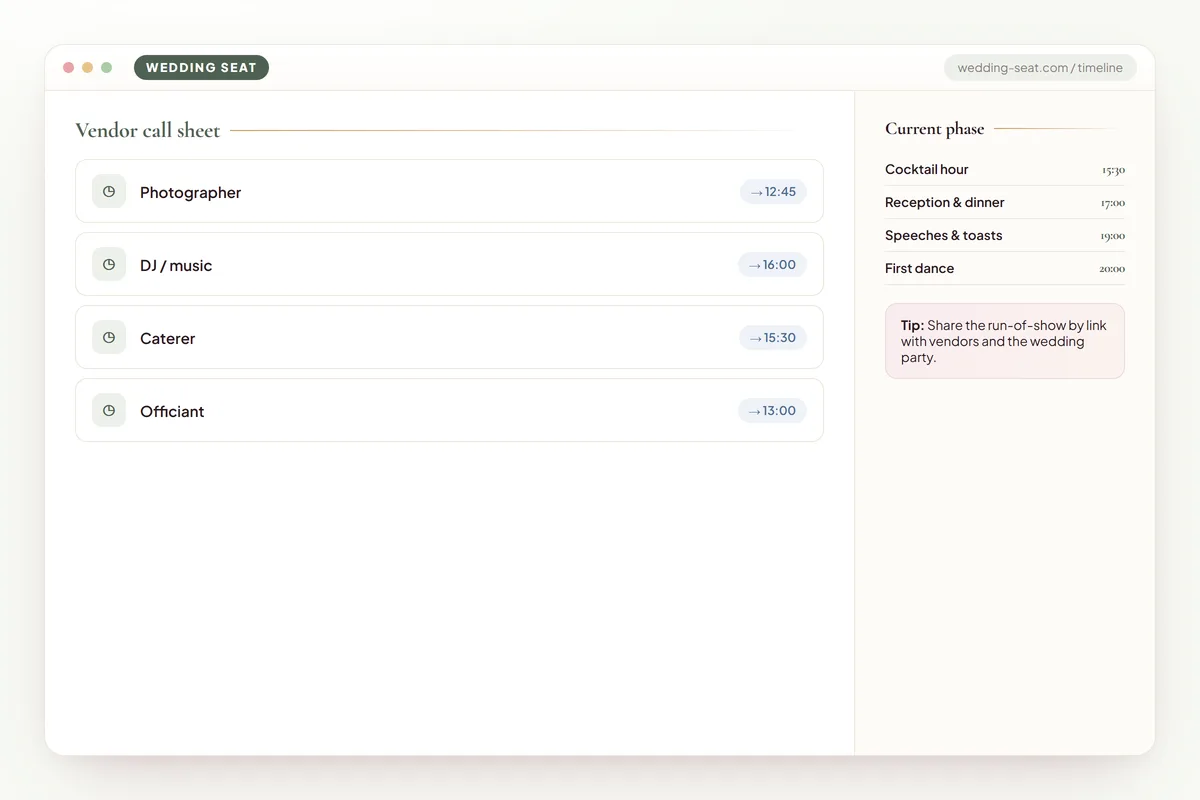
2.Vendor call sheet · Sage & Olive 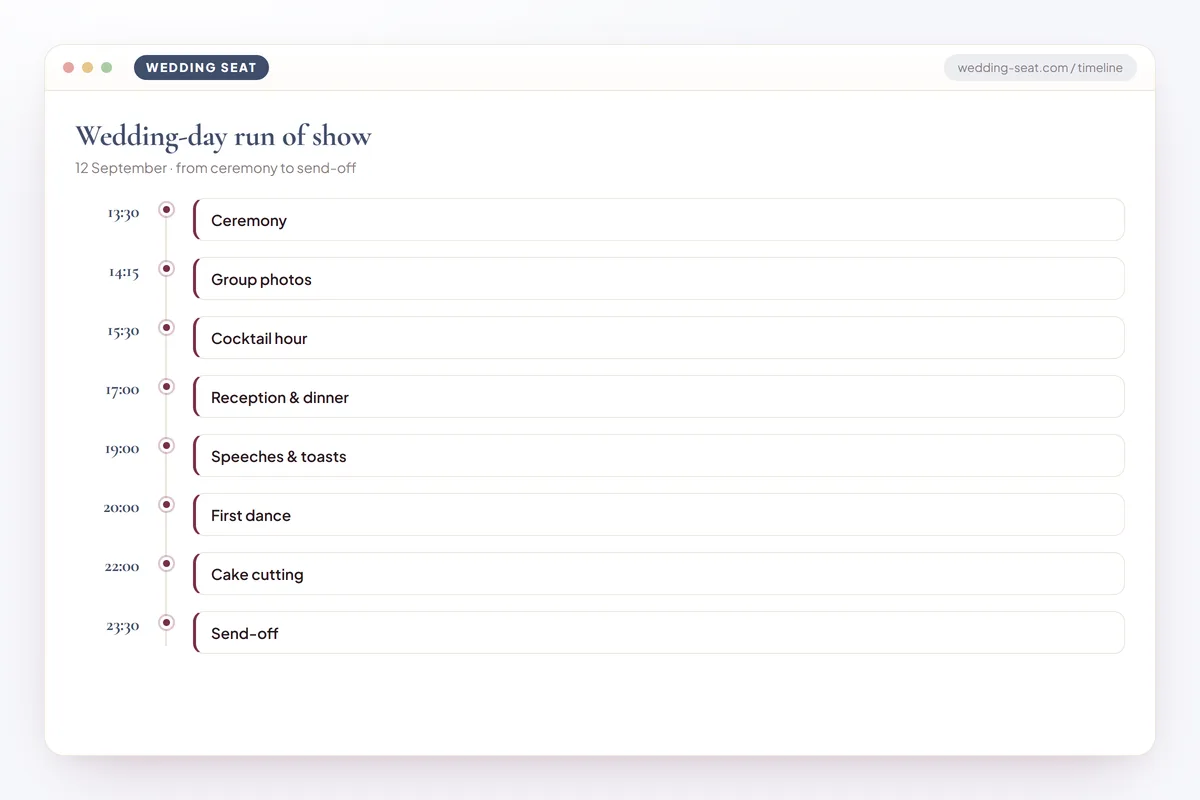
3.Wedding-day run of show · Dusk Blue 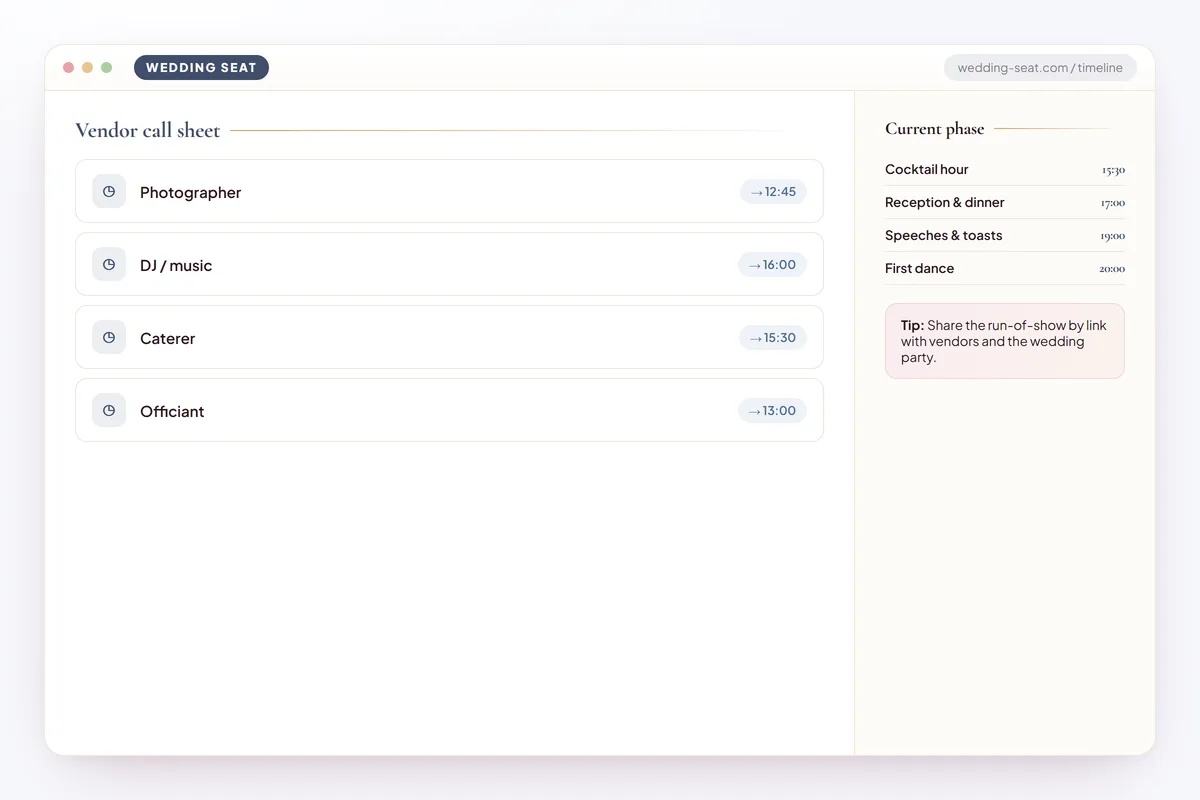
4.Vendor call sheet · Dusk Blue 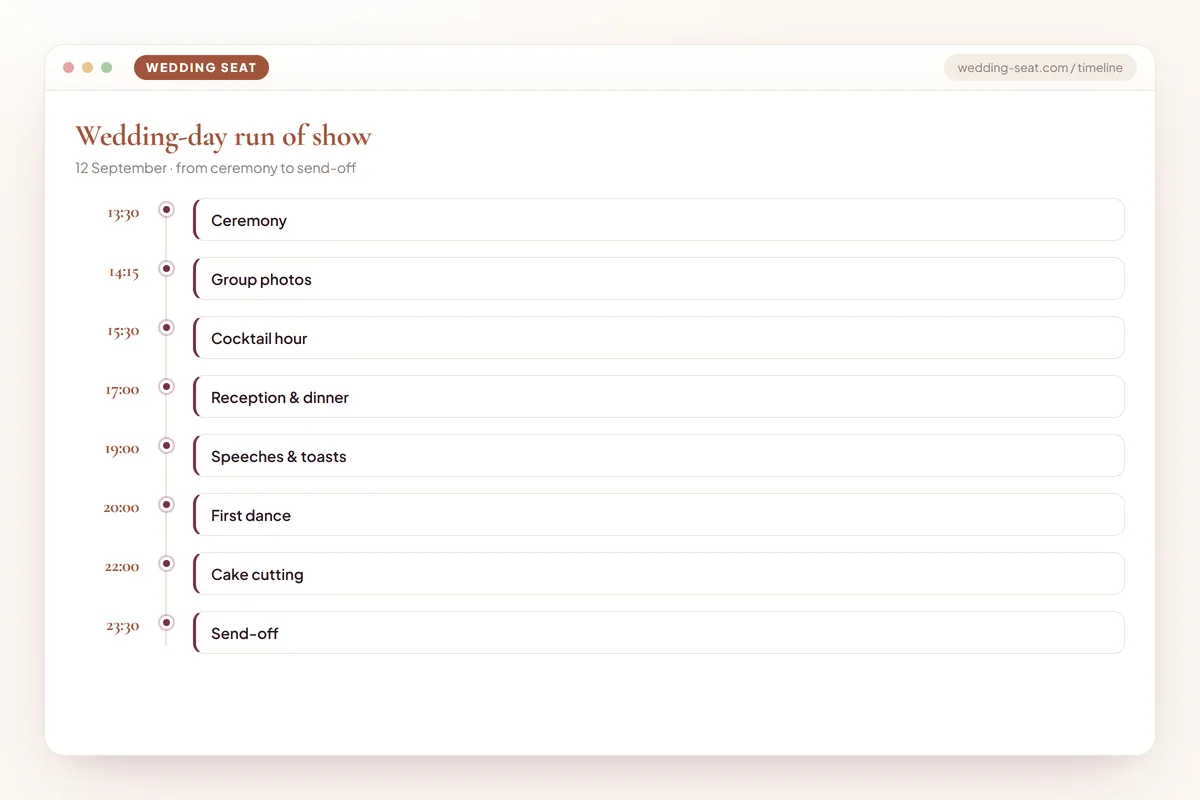
5.Wedding-day run of show · Terracotta 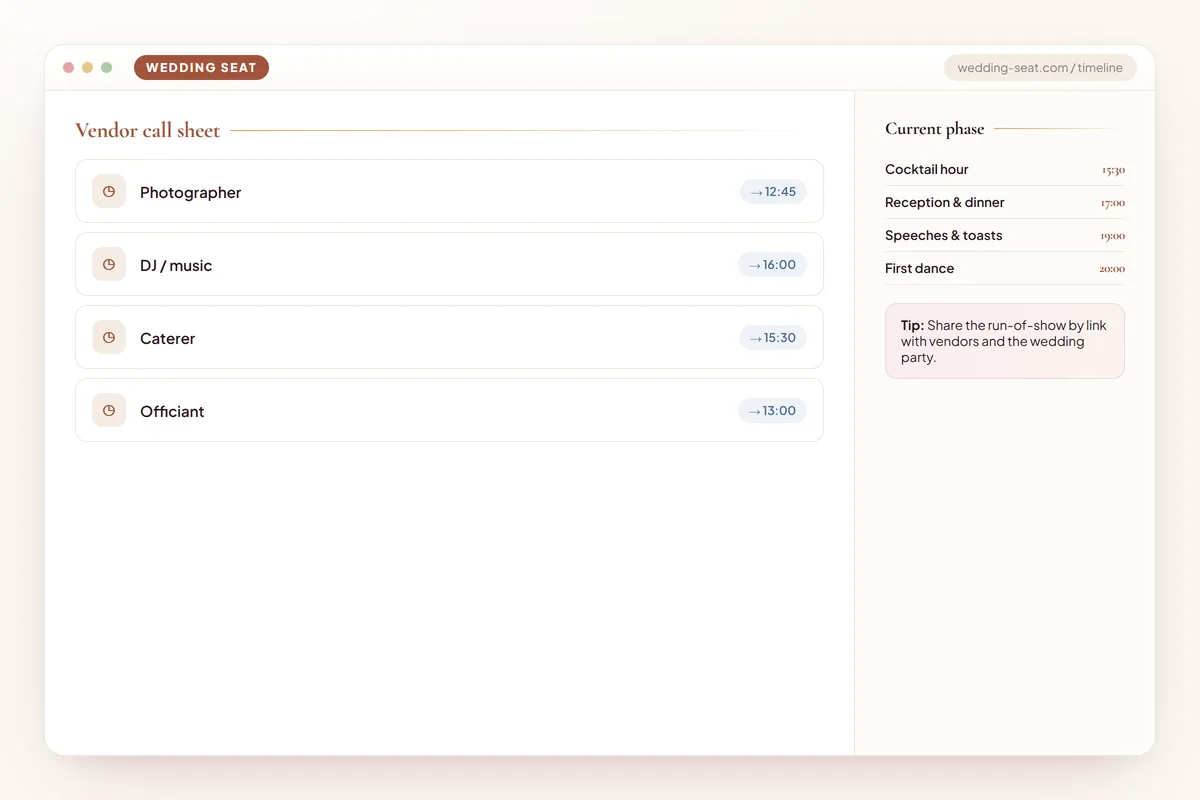
6.Vendor call sheet · Terracotta
Frequently asked questions
How far in advance should our wedding day timeline be finalized?
Aim to have a solid draft two to three months out and a fully finalized version two weeks before the wedding. The early draft lets you confirm ceremony length with your officiant, dinner-service timing with your caterer, and photography needs with your photographer while there's still room to adjust. The final version, locked two weeks out, is what actually gets sent to every vendor and your wedding party, and it should only change after that point for genuine emergencies, not preference tweaks.
What's a realistic total length for a wedding day, start to finish?
Most full wedding days, from the start of hair and makeup to the final send-off, run 12 to 15 hours when you include getting ready. The ceremony-to-send-off portion that guests actually experience is usually 6 to 7 hours: roughly 20–30 minutes of ceremony, 45–90 minutes of cocktail hour, and 4–5 hours of reception. Daytime or brunch weddings compress this to closer to 4 hours total for guests, while multi-day or destination weddings extend the overall arc across several days even though any single day's guest experience stays similar in length.
Who should actually be in charge of keeping the timeline on track during the wedding?
Ideally a hired day-of or month-of coordinator, since this frees the couple, parents, and wedding party from watching the clock. If you don't have a coordinator, designate one trusted, organized person — often the maid of honor, a planner-adjacent family friend, or the venue's own staff coordinator if one is included — as the single point of contact vendors can reach with questions, rather than leaving multiple people to informally manage timing.
How much time should we really budget for family formal photos?
Budget 2–3 minutes per photo combination and make a written shot list in advance with a designated family member who knows everyone by sight to help gather people quickly. For a typical list of 10–15 combinations, that's 25–40 minutes minimum, not the 15 minutes many couples initially assume. Photographing large, complex family combinations first (whole extended family, then splitting into smaller groups) is faster than working the other direction.
Should the timeline include time for the couple to actually eat?
Yes, and this is one of the most commonly forgotten blocks. Build in a genuine window during dinner service for the couple to sit and eat, not just be photographed near a plate. Some couples also request a private 10–15 minute 'sweetheart moment' right after the ceremony or during cocktail hour, just the two of them with a drink and an appetizer, before the whirlwind of the reception begins.
What happens if something on the timeline runs late — how do we adjust?
A well-built timeline has enough buffer that a 10–15 minute delay in one block doesn't cascade into every later block, which is exactly why buffer time matters so much. If a delay exceeds the built-in cushion, your coordinator or point-of-contact should compress the least emotionally important block first, typically shortening open dancing or a photo session, rather than rushing the ceremony, toasts, or first dance, which are the moments couples most regret having cut short.
Do we need different timelines for different vendors, or one shared document?
One shared master timeline is best for consistency, but different vendors need different levels of detail from it. Send the full, minute-by-minute master version to your planner, photographer, DJ, and caterer, since they coordinate directly with each other off this document. Your wedding party and family need a simplified version without vendor arrival times or setup logistics, and guests only need a brief itinerary covering ceremony and reception start times.
Ready to see your own day laid out minute by minute? Head back up to the wedding day timeline tool, plug in your ceremony time and style choices, and let it build a shareable schedule you can hand straight to your planner, photographer, and wedding party today.
Plan faster
Start your free wedding project in seconds.