
Wedding Checklist
Use a wedding checklist that updates as you plan. Keep tasks organized, avoid last-minute chaos, and stay in control.
- No account required to start
- Organized by timeline and priorities
- Works with your guest list and seating plan
- Key milestones (venue, catering, music)
- Tasks for couples and families
- Progress tracking
- Everything stays in one place

Why wedding checklists fail
Most checklists fail because tasks live in too many places — notes, chats, and half-finished docs. A single live checklist keeps priorities clear.
How the wedding checklist works
Start with a ready structure, then adapt it to your wedding. Mark progress, add notes, and keep everything in one place.
1) Start with a ready timeline
A clear structure from engagement to wedding day — customize anytime.
2) Focus on priorities
Keep the next actions obvious: what’s due soon and what can wait.
3) Track progress in one place
Update tasks as you go so you always know what’s done and what’s next.
4) Use it with your guest list and seating plan
Your checklist stays connected to the rest of your planning workflow.
Wedding checklist: app vs spreadsheet
Spreadsheets work until tasks and updates start moving fast. A live checklist stays consistent as plans evolve.
Spreadsheets
- Conflicting versions get shared around
- Hard to keep deadlines and notes consistent
- Progress tracking becomes manual
- Updates get lost between people
Wedding Seat
- One checklist for everyone
- Clear priorities and progress
- Notes stay attached to tasks
- Works with guest list and seating
More wedding planning tools
Wedding Guest List
Track invitations, RSVPs, plus-ones, and families in one place.
Guest List Template
Use a live template instead of spreadsheets — always accurate.
Wedding Seating Chart
Build a visual seating plan and share for approvals.
Seating Chart Template
A live seating template that stays consistent as guests change.
Wedding Budget
Track costs, deposits, payments, and remaining totals.
Wedding RSVP
Collect replies, meal choices, and plus-ones online.
Wedding Timeline
Build the wedding-day schedule and share it with vendors.
Wedding Website
Publish a shareable site with details, RSVP, and registry.
A wedding checklist is the single tool that turns a vague dream wedding into a manageable series of decisions, deposits, and deadlines. Below, you'll find a locale-accurate, month-by-month breakdown of exactly what to do, when to do it, and how to avoid the mistakes that cause most of the stress — everything the interactive checklist above is built to track for you.
What a Wedding Checklist Actually Does For You
A wedding checklist isn't just a list of pretty tasks — it's a risk-management document. Weddings involve dozens of vendors, deposits, legal steps, and deadlines that don't forgive procrastination: a popular photographer might book out 12-18 months ahead, while a marriage license might only be valid for 60-90 days. Without a structured checklist, couples default to whichever task feels most urgent that week, which is exactly how people end up choosing a cake three weeks before the wedding and forgetting to order it in time. The real value of a checklist is sequencing. Booking a venue before you know your guest count, or ordering invitations before your ceremony start time is finalized, creates expensive rework. A good checklist enforces the order: budget and guest count first, venue and date second, then vendors in order of how far ahead they book. It also gives two partners (and sometimes families) one shared source of truth instead of three people assuming someone else called the florist. That shared visibility is the single biggest stress-reducer in the entire planning process.
Native Terminology: What Couples Actually Call This List
English-speaking couples use several overlapping terms for this document, and it helps to know them because vendors, apps, and bridal magazines mix them freely. "Wedding checklist" is the most common everyday term — casual, task-oriented, usually with checkboxes. "Wedding planning checklist" is the more formal version, often used by planners and venues to describe a comprehensive, timeline-based document. "Wedding to-do list" is the conversational version couples use when talking to friends ("I still have so much on my wedding to-do list"). "Wedding timeline" technically refers to the schedule of when things happen, but in casual use it often blends with the checklist itself. Older or more traditional sources sometimes say "bridal checklist" or "bride's checklist," a holdover from when wedding planning was assumed to be the bride's sole responsibility — most modern couples and planners avoid this phrasing in favor of gender-neutral terms. Wedding industry professionals also use "master wedding list" or "wedding planner checklist" to describe the master document a professional planner keeps, distinct from the couple's own simplified version. Knowing these variants helps when searching for templates or communicating with vendors about what stage of planning you're in.
- Wedding checklist - everyday, task-based term
- Wedding planning checklist - formal, timeline-based version
- Wedding to-do list - casual conversational phrase
- Wedding timeline - schedule-focused, often used interchangeably
- Master wedding list / wedding planner checklist - professional planner's version
How to Build Your Checklist in the Tool Above
1. Enter your wedding date first. Every deadline in the tool — vendor booking windows, invitation mailing dates, final headcount cutoffs — is calculated backward from this single date, so accuracy here matters more than any other input. 2. Choose a starting template that matches your wedding style (traditional, destination, elopement, or DIY). This adjusts which task categories appear — a destination template adds passport and travel-block tasks, while an elopement template strips out reception-heavy items. 3. Set your guest count estimate. This unlocks realistic budget suggestions and catering/rental quantities further down the list. 4. Work through the categories in the order they appear on screen — budget, venue, vendors, attire, stationery, logistics — rather than jumping around, since later categories depend on decisions made in earlier ones. 5. Check off tasks as you complete them and adjust due dates when a vendor gives you a different timeline than the default. 6. Assign tasks to yourself, your partner, or a parent using the assignment field so nothing depends on memory alone. 7. Filter the view by "this month" or "next 30 days" whenever the full list feels overwhelming — you never need to look at all 150+ tasks at once. 8. Export or share the list so vendors, parents, or your wedding party can see relevant sections without needing full access.
The 12-Month Overview: Big Picture First
Before diving into monthly detail, it helps to see the whole arc. In a standard 12-month engagement, the first three months are about foundations: budget, guest count, venue, and date. Months four through eight are the vendor-booking heavy lift — photographer, caterer, florist, band or DJ, and attire. Months nine through eleven shift to paperwork and design: invitations go out, favors and decor get finalized, and the marriage license process begins. The final month is pure logistics — confirmations, seating charts, final payments, and packing. Not every couple has 12 months, and that's fine — the same tasks simply compress. A 6-month timeline doubles up on the early phases, while a 3-month or shorter engagement requires prioritizing venue and legally-required paperwork first and treating everything else as negotiable. For a full week-by-week breakdown at any timeline length, the 12-Month Wedding Planning Timeline guide walks through the complete sequence, and the 6-Month Wedding Planning Timeline and 3-Month Wedding Checklist guides show how the same tasks compress when you're working with less runway.
9-12 Months Out: Foundational Tasks
This phase is about decisions that constrain everything downstream, so resist the urge to jump to fun tasks like tasting cakes before these are locked. Set the total budget first, including who is contributing what — this conversation is uncomfortable but prevents far worse conflict later. Draft a rough guest list (even a range like "120-150") because venue capacity and catering minimums depend on it. Book your ceremony and reception venue, since availability on your preferred date is the tightest constraint in the entire process — popular Saturday dates in peak season (typically May through October in most of the US) can book 10-12 months ahead. Choose your wedding party and ask them formally. Start a wedding website if you're using one, and block hotel rooms for out-of-town guests if you expect a significant number. If you're planning to marry away from home, this is also the point to start the guest list and travel logistics that a Destination Wedding Guest List Planning guide covers in detail, since travel-dependent guests need far more lead time than local ones.
6-9 Months Out: Vendor Lock-In Phase
This is the busiest booking window. Photographers and videographers, especially in-demand ones, are often booked 9-12 months ahead, so this is close to the last comfortable window to secure them. Book your caterer (if not included with the venue), your florist, your band or DJ, and your officiant. Order or begin shopping for the wedding dress or suit now — bridal gowns in particular often take 4-6 months to arrive from the designer, before alterations even begin. Send save-the-dates around 6-8 months out, earlier if it's a destination wedding or falls on a holiday weekend. Begin cake tastings and finalize your menu structure (plated, buffet, or family-style) since this affects both budget and staffing needs. If you're planning a rehearsal dinner, this is a reasonable point to start a loose guest list for it, even though the formal invitations come later. Every vendor booked in this window should get a written contract — never a verbal agreement — covering date, deliverables, payment schedule, and cancellation terms.
4-6 Months Out: Details and Design
With major vendors locked in, this phase is about the visual and experiential details. Finalize your flowers, decor concept, and rental order (linens, chairs, tenting if needed). Choose and order invitations, allowing 6-8 weeks for printing before you need to mail them. Schedule dress and suit fittings, and if bridesmaids or groomsmen need alterations, get their measurements started now rather than the week before. Book transportation for the wedding party if you're using a car service, and confirm hotel room blocks are still active. This is also the point to finalize your ceremony structure — vows, readings, processional order — and if you want a worked example of how timing flows on the day itself, the Wedding Ceremony Timeline Example guide shows a realistic minute-by-minute structure. Register for gifts if that's part of your tradition, since guests will start asking where you're registered as soon as save-the-dates go out. Plan your honeymoon logistics broadly now, even if you don't book flights yet, so passport renewals or visa applications have enough lead time.
2-3 Months Out: Paperwork and Confirmations
Mail formal invitations 6-8 weeks before the wedding, with an RSVP deadline set 3-4 weeks before the event so you have time to chase non-responders and finalize headcounts. Confirm final details with every booked vendor: arrival times, final menu, floor plan, and payment balances. Write your vows if you're writing your own, and finalize readings or rituals with your officiant. Buy or finalize wedding bands, and confirm alteration timelines land comfortably before the wedding, with a buffer for a final fitting. Start seating chart planning as RSVPs come in — this is where a shared visual tool becomes essential, since seating decisions depend on family dynamics, dietary needs, and table sizes that change until the very last RSVP arrives. Check your state or country's marriage license requirements now, since processing and waiting periods vary widely and some jurisdictions require in-person appointments weeks in advance. The 3-Month Wedding Checklist guide breaks this window down task-by-task if you want the full detail.
1 Month Out: Final Countdown Tasks
Final headcount is due to your caterer and venue, typically 1-2 weeks before the wedding — get this number as accurate as possible since most venues charge for the confirmed count regardless of no-shows. Finalize and print your seating chart, floor plan, and any signage. Confirm final timelines with photographer, officiant, DJ or band, and venue coordinator, ideally sharing one single timeline document with everyone rather than repeating details separately to each vendor. Pick up your marriage license within the valid window (many US states require it be obtained within a specific number of days before the ceremony — check yours specifically). Break in your wedding shoes, finish alterations, and pack for the honeymoon. Assign a point person (not the couple) to handle vendor payments and last-minute questions on the day itself. The 1-Month Before Wedding Checklist guide is worth reviewing in full here, since this final stretch has the highest number of small, easy-to-forget legal and logistical tasks packed into the shortest window of the entire timeline.
Wedding Week Checklist
Wedding week is about execution and delegation, not decision-making — if you're still making major decisions this week, something upstream went wrong. Confirm arrival times and delivery windows with every vendor one final time, in writing. Prepare final payments and tip envelopes, since gratuities for vendors like drivers, catering staff, and hair and makeup artists are typically handled in cash on the day itself in most of the US. Pack an emergency kit (stain remover, safety pins, pain relievers, sewing kit) and hand it to a bridesmaid or a designated helper rather than carrying it yourself. Confirm rehearsal dinner details and timing with both families. Do a final walkthrough of your seating chart and floor plan with your venue coordinator. Get enough sleep the two nights before — sleep debt is the most underrated wedding-week mistake couples make.
- Confirm every vendor arrival time in writing, one final time
- Prepare cash tip envelopes for applicable vendors
- Delegate the emergency kit to a helper, not yourself
- Finalize seating chart with the venue coordinator
- Protect sleep in the final 48 hours
Day-Of Checklist for the Couple
On the wedding day itself, neither partner should be managing logistics — that's what a day-of coordinator, wedding party lead, or trusted family member is for. Your only jobs are getting ready, being present, and following the timeline someone else is now enforcing. Before the ceremony, confirm the marriage license is physically with the officiant (not left at home), and that rings are with the best man or maid of honor, not still in a drawer. Eat something substantial before the ceremony — skipping meals during a long getting-ready block is one of the most common day-of regrets couples report. Have your point person confirm vendor arrivals (florist, photographer, officiant) as they happen rather than assuming silence means everything's on schedule. After the ceremony, make sure someone is responsible for gathering gifts, cards, and any rented items (arch, signage) at the end of the night, since these are easy to leave behind in the venue's post-event cleanup.
Budget Checklist: Where the Money Actually Goes
A useful budget checklist assigns realistic proportions before you assign dollar amounts. As a rough US-wide guide, venue and catering typically consume 40-50% of the total budget, photography and videography 10-15%, attire 5-10%, flowers and decor 8-10%, music and entertainment 8-10%, and stationery, favors, and miscellaneous the remainder. These proportions shift for destination weddings, where travel and accommodation take a bigger share, and for smaller weddings, where fixed costs like photography represent a larger percentage of a smaller total. Build in a contingency line of 5-10% of the total budget for unplanned costs — an extra rental, last-minute alteration, or a vendor overtime fee are nearly universal in weddings, so budgeting for them upfront prevents panic later. Track every deposit against its due date, not just its amount, since missed deposit deadlines can forfeit your date with some vendors. A checklist tool that lets you tag each task with a cost and a due date, rather than tracking budget in a separate spreadsheet, keeps the two views in sync instead of drifting apart as plans change.
Guest List and RSVP Tracking
Your guest list checklist should track more than names — capture address, RSVP status, meal choice, plus-one status, and any dietary or accessibility needs in one place, because your caterer and venue will ask for all of this within weeks of each other and you don't want to be reconstructing it from memory. Send invitations with a clear RSVP deadline 3-4 weeks before the wedding, and build in a follow-up week for chasing non-responders by phone or text — assume 10-15% of invitees will need a personal nudge. A common etiquette mistake is inviting people "and family" without specifying names, which creates confusion about who's actually included — always address invitations to the specific people invited. Track plus-ones as a deliberate policy decision (all guests, only those in serious relationships, or none for a very tight budget) applied consistently, since inconsistent plus-one rules cause more hurt feelings than almost any other guest list decision.
Set your RSVP deadline at least a full week before your caterer's final headcount deadline, not the same date — you'll need that buffer to chase stragglers.
Vendor Booking Order: Who to Hire First
Booking order matters because lead times vary enormously by vendor type, and booking out of order causes date conflicts you can't undo. Venue comes first, always, since it locks your date. After that, book vendors roughly in order of scarcity: photographers and videographers next (often 9-12 months out for in-demand ones), then caterers if not included with the venue, then florists and bands or DJs, then hair and makeup artists, and finally rental companies and transportation, which typically have the most flexible availability closest to the date. A practical rule: get at least three quotes for any vendor category over a meaningful budget line, and never pay a full deposit before receiving a signed contract specifying exactly what's included. Vendors booked too early without a firm guest count or venue (like ordering a cake before knowing your final headcount) frequently need costly revisions later.
- Venue first - it locks the date
- Photographer and videographer next - longest lead times
- Caterer, florist, band/DJ mid-timeline
- Hair, makeup, and transportation closer to the date
- Never pay a deposit without a signed contract
Vendor Contract Checklist: What to Verify Before Signing
Every vendor contract should specify five things clearly: exact date and arrival/departure times, itemized deliverables (not vague phrases like "full coverage"), total cost with a payment schedule and due dates, cancellation and rescheduling terms, and what happens in case of vendor illness or emergency (who is the backup). Missing any of these five is a red flag worth asking about before signing, not after. For photography and videography specifically, confirm how many hours are covered, how many edited photos or how long the final video will be, and the delivery timeline for final files — some photographers take 8-12 weeks to deliver a full gallery, which surprises couples expecting photos within days. For catering, confirm whether service staff, linens, and cake-cutting fees are included or billed separately, since these add-ons are a common source of final-invoice surprises. Always keep signed contracts and payment receipts in one folder (physical or digital) rather than scattered across email threads, so you can reference them quickly if a dispute arises.
Attire Timeline Checklist: Dress, Suit, and Alterations
Wedding attire has one of the longest and least flexible timelines in the entire planning process, so start earlier than feels necessary. Bridal gowns ordered from a designer typically take 4-6 months to arrive, and that's before alterations, which themselves need 2-3 fittings spread across 6-8 weeks. That means dress shopping realistically needs to start 8-10 months before the wedding for a made-to-order gown, or 4-5 months for off-the-rack options. Suits and tuxedos have shorter lead times but still need a final fitting 2-3 weeks before the wedding, not the week itself, in case final adjustments are needed. Bridesmaids' and groomsmen's attire should be ordered together as a group where possible, since matching dye lots and consistent sizing across a group order is harder to guarantee with separate individual orders placed months apart. Shoes should be broken in well before the wedding day — buying them the week before is one of the most common and easily avoidable day-of discomfort complaints.
Invitations and Stationery Checklist
Stationery has its own internal sequence: save-the-dates go out first (6-8 months before, earlier for destination weddings), followed by formal invitations 6-8 weeks before the wedding, which need to be ordered from the printer 2-3 months earlier to allow for design, proofing, and printing time. Build in an extra week for addressing envelopes by hand or calligraphy if you're using that style, since it takes longer than most couples expect. Your invitation suite should include the RSVP card with a clear deadline, any details card for hotel blocks or transportation, and — for destination or multi-day weddings — a simple itinerary insert. Proofread every piece of stationery at least twice, and have someone outside your immediate planning circle check names, dates, and addresses one final time before printing, since typos in dates or venue addresses are far more common than couples expect and expensive to reprint under time pressure.
Photography and Videography Checklist
Beyond booking early, build a specific shot list checklist with your photographer 4-6 weeks before the wedding covering must-have family combinations, since this is the detail couples most often forget until the day itself, when it's too late to coordinate calmly. Name every family member or group you want photographed together explicitly (not "family photos" as a single line) to avoid missing a grandparent or sibling combination on the day. Confirm the photography timeline against your overall day-of schedule — first look versus traditional ceremony-first reveals change how much time is needed before the ceremony, and getting-ready photos need a realistic buffer that doesn't cut into hair and makeup time. If you're hiring separate photo and video teams, confirm they've worked together before or introduce them ahead of time, since two teams working the same moments without coordination can visibly get in each other's shots.
Catering, Cake, and Bar Checklist
Finalize your menu structure and any dietary accommodations (vegetarian, vegan, gluten-free, allergies) at least 6-8 weeks before the wedding, and collect this information from guests directly on the RSVP card rather than guessing. Schedule a tasting before finalizing, and confirm exactly what's included in the catering price — service staff, linens, china rental, and cake-cutting fees are frequently billed separately and are a common source of final-bill surprises. Order your cake separately if it's not included with catering, confirming size against your final guest count (a common rule of thumb is one slice per adult guest, with a slightly smaller cutting cake if you also want a display cake). For the bar, decide between an open bar, a limited/beer-and-wine bar, or a cash bar (note that cash bars are considered poor etiquette at most US weddings), and confirm with your venue whether outside alcohol is permitted or must go through their license.
Music, Flowers, and Decor Checklist
For music, confirm with your band or DJ the specific must-play and do-not-play lists, key moment songs (first dance, parent dances, cake cutting), and whether they provide microphones and speakers for toasts and the ceremony itself — sound equipment gaps are a common oversight for outdoor or non-traditional ceremony venues. Confirm load-in time and any venue sound restrictions (some venues enforce curfews or volume limits, especially in residential areas). For flowers and decor, finalize your color palette and must-have elements (bouquets, centerpieces, ceremony arch) 3-4 months out, and confirm what the venue already provides (some include centerpiece vases, arches, or draping) so you're not paying twice for the same item. Order or confirm any rented decor items — arches, lounge furniture, specialty lighting — with enough lead time that a substitution is possible if an item becomes unavailable close to the date.
Transportation and Logistics Checklist
Book transportation for the wedding party and immediate family 2-3 months out if you're using a car service, confirming pickup times, locations, and a buffer for traffic, especially in unfamiliar or high-traffic areas around the venue. If guests need transportation between a hotel block and the venue, arrange a shuttle and communicate the schedule clearly on your wedding website or a details card, since guests without cars will otherwise default to asking you directly on the day. Confirm parking availability at both ceremony and reception venues, and whether valet is included or needs separate booking. If your venue has any access restrictions — narrow driveways, no elevator, load-in time limits — communicate these to your florist, caterer, and rental company in advance so no one arrives to discover a delivery problem an hour before guests do.
Wedding Party Duties Checklist
Once you've asked your wedding party, give each role a clear, written list of responsibilities rather than assuming they know what's expected — most people have never been in a wedding party before and appreciate explicit guidance. Maid of honor or best man responsibilities typically include organizing the bridal shower or bachelor/bachelorette event, giving a toast, and helping manage the emergency kit and small logistics on the day. Bridesmaids and groomsmen typically handle their own attire purchase (communicate a budget range early, since costs can be a genuine burden for some), attend fittings on a set timeline, and help with any pre-wedding tasks like invitation assembly if asked. Set a clear deadline for attire orders and fittings, and keep a group communication channel (text thread or shared app) so questions don't get lost across five different conversations.
Marriage License and Legal Checklist
Legal requirements vary significantly by US state and country, so verify your specific jurisdiction's rules rather than assuming a general timeline. Most US states require both partners to apply in person at a county clerk's office, some require a waiting period (commonly 24-72 hours) between application and ceremony, and licenses are typically only valid for a limited window (often 30-90 days) after issuance — apply too early and it can expire before your wedding. Confirm what identification is required (government ID, sometimes a certified birth certificate), whether both partners must be present to apply, and any fee. If either partner has been previously married, most jurisdictions require proof of divorce or the previous spouse's death certificate. For destination weddings, check whether a marriage performed abroad is automatically recognized at home or requires additional registration — this single step is the most commonly overlooked legal detail in destination wedding planning.
Call your specific county clerk's office directly rather than relying on general online guidance — requirements and waiting periods vary even between neighboring counties in the same state.
Honeymoon Planning Checklist
Start honeymoon planning in parallel with the wedding itself, not after — flights and popular accommodations for peak travel seasons can book up just as fast as wedding venues. Confirm passport validity for both partners at least 6 months out, since many countries require passports valid well beyond your travel dates, and renewals can take weeks longer than expected during busy periods. Check visa requirements for your destination specifically for your nationality, and research any vaccination recommendations if traveling somewhere with specific health guidance. Book time off work early, especially if either partner has limited vacation days, and build in at least one buffer day after the wedding before departure — traveling directly from a late reception to an early flight is a common and avoidable source of honeymoon exhaustion.
Post-Wedding Checklist: Thank-Yous and Name Change
Thank-you notes are the most commonly delayed post-wedding task, and etiquette generally allows up to 2-3 months after the wedding to send them — but sending them within the first few weeks, while gift details are still fresh, produces noticeably more personal notes. Track gifts and their senders on your original checklist tool as they arrive, rather than trying to reconstruct the list from memory afterward. If either partner is changing their legal name, start the paperwork within the first few weeks: update your Social Security card first (in the US), then driver's license, passport, bank accounts, and employer records, in that order, since each subsequent step typically requires the previous document as proof. Return or exchange any rented attire, settle final vendor balances and any outstanding tips, and leave reviews for vendors you'd recommend — this is a small task that genuinely helps future couples and often gets forgotten entirely once the wedding itself is over.
Destination Wedding Checklist Differences
A destination wedding checklist carries everything from a local wedding plus an entirely separate travel-logistics layer. Save-the-dates need to go out 8-10 months ahead instead of 6-8, since guests need extra time to arrange flights, time off work, and sometimes visas. Passport validity checks apply not just to the couple but to every traveling guest, and it's worth including a reminder on your wedding website rather than assuming guests will check this themselves. Legal recognition of the marriage is the biggest differentiator — confirm whether your destination requires residency time before you can legally marry there (some countries require several days or weeks in-country first), and whether you'll need to separately register the marriage at home afterward. Many couples choose to have a small legal ceremony at home before or after the destination celebration specifically to sidestep this complexity. For the guest-list side of this planning, the Destination Wedding Guest List Planning guide covers travel-dependent RSVP tracking and realistic attendance estimates in detail.
Showcase: Real Checklist Layouts by Wedding Style
Different wedding styles genuinely need different checklists, not just different decor — the task list itself should look different depending on scale, culture, and format. A traditional full-length wedding checklist spans the complete 12-month arc with 120-150+ tasks across every category from venue to thank-you notes. A destination wedding checklist adds a dedicated travel and passport-tracking category and compresses the RSVP window differently to account for flight bookings. A multi-day cultural wedding checklist — common in South Asian, Middle Eastern, and many African wedding traditions — breaks tasks out by individual event (engagement ceremony, henna or mehndi night, main ceremony, reception), each with its own guest list, attire, and vendor needs. An elopement or courthouse checklist condenses everything down to perhaps 15-20 essential legal and logistical tasks, cutting out anything reception-related entirely. A DIY or backyard wedding checklist adds a rentals and volunteer-coordination layer that a fully vendor-managed wedding wouldn't need, tracking who's borrowing what and returning it when. Seeing your own wedding style reflected in the checklist structure — rather than forcing a generic template to fit — is what separates a checklist you'll actually use from one you abandon by month three.
- Traditional full-length wedding - complete 12-month, 120-150+ task arc
- Destination wedding - dedicated travel and passport-tracking category
- Multi-day cultural wedding - separate task sets per individual event
- Elopement/courthouse wedding - condensed 15-20 essential legal tasks
- DIY/backyard wedding - added rentals and volunteer-coordination layer
Etiquette and Common Checklist Mistakes
The single most common mistake is one partner owning the entire checklist alone, which quietly builds resentment and guarantees things fall through when that person gets busy or overwhelmed — assign clear ownership of specific categories to each partner from the start. A close second is booking vendors before finalizing a guest count or budget, which routinely forces expensive downstream changes, like discovering the venue's catering minimum exceeds your actual budget after the deposit is already paid. On etiquette specifically: always invite guests by name rather than "and family," apply plus-one policy consistently across your entire guest list rather than case-by-case, and avoid cash bars, which are widely considered a breach of hosting etiquette in the US regardless of budget constraints — a limited beer-and-wine bar is the accepted lower-cost alternative. Send thank-you notes within a reasonable window (ideally weeks, not months) rather than treating them as optional. Finally, don't skip the written contract for smaller or friend-referred vendors just because the relationship feels informal — verbal agreements are the single most common source of wedding-day disputes, regardless of how well you know the vendor personally.
Digital vs. Paper: Why a Shared Tool Works Better
A paper or single-spreadsheet checklist works fine for a very small, simple wedding, but it breaks down the moment two people, a vendor, or a parent all need to see and update the same information. Paper lists can't send you a reminder when a deposit deadline approaches, can't automatically recalculate downstream dates when you move your wedding date, and exist in exactly one physical location, which is a problem the moment your partner needs to check something while you're at work. A shared digital checklist — like the one above — solves all three problems at once: both partners see the same live list, due dates recalculate automatically from your actual wedding date, and specific sections can be shared with vendors, parents, or your wedding party without giving them access to your budget numbers. The practical result is fewer dropped tasks, fewer duplicate purchases (both partners calling the same florist unaware the other already did), and a genuinely lower mental load in the final stressful weeks before the wedding.
Examples in every theme
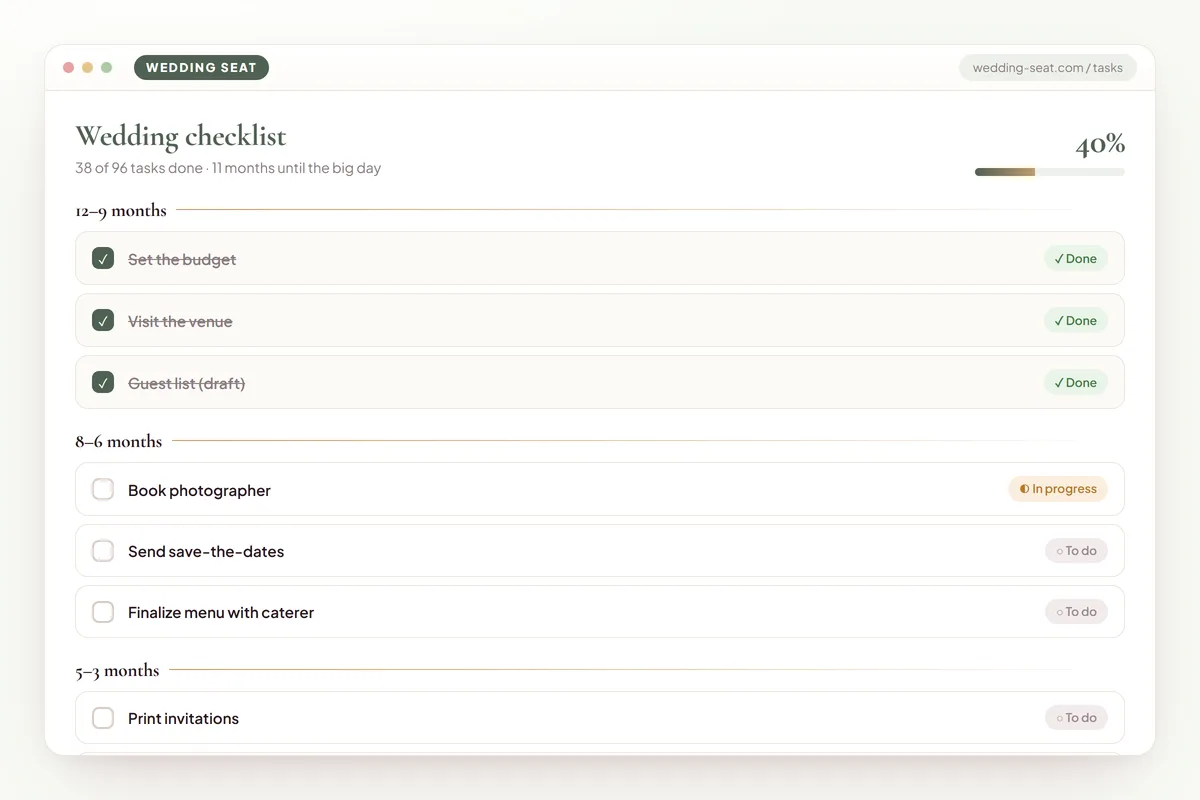
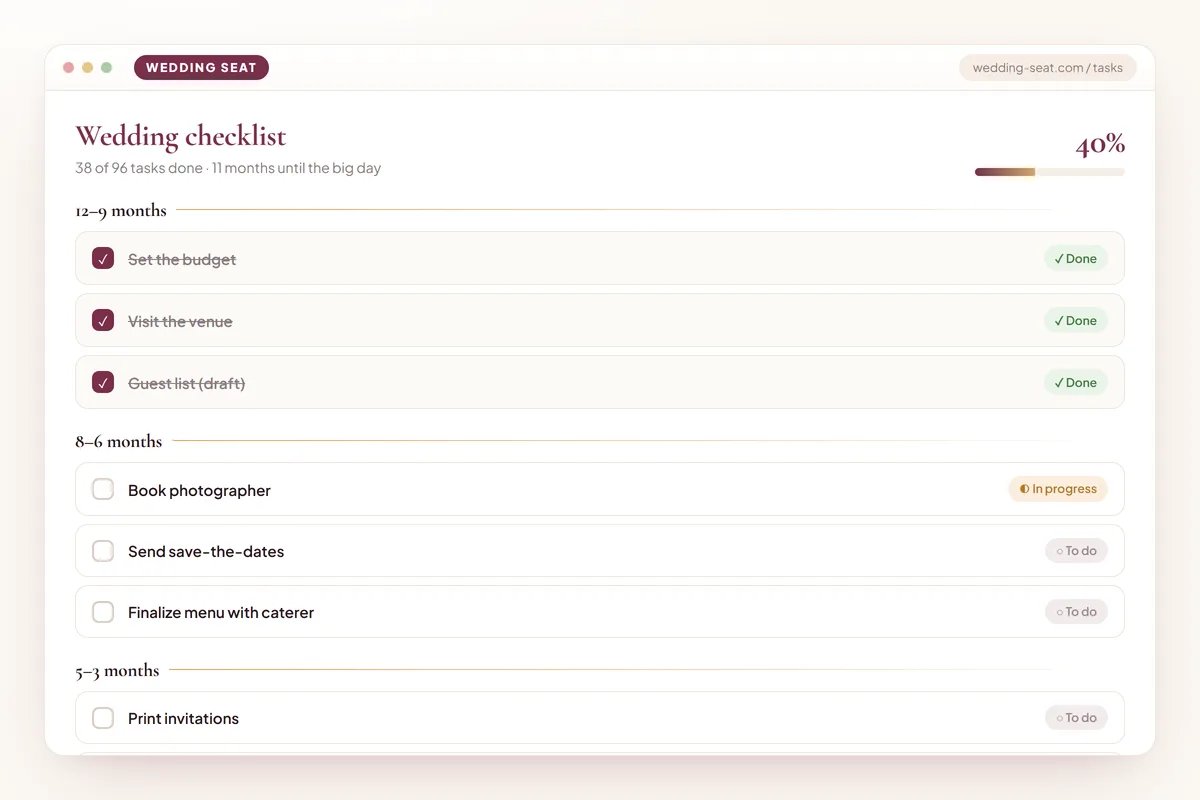
1.Wedding checklist · Sage & Olive 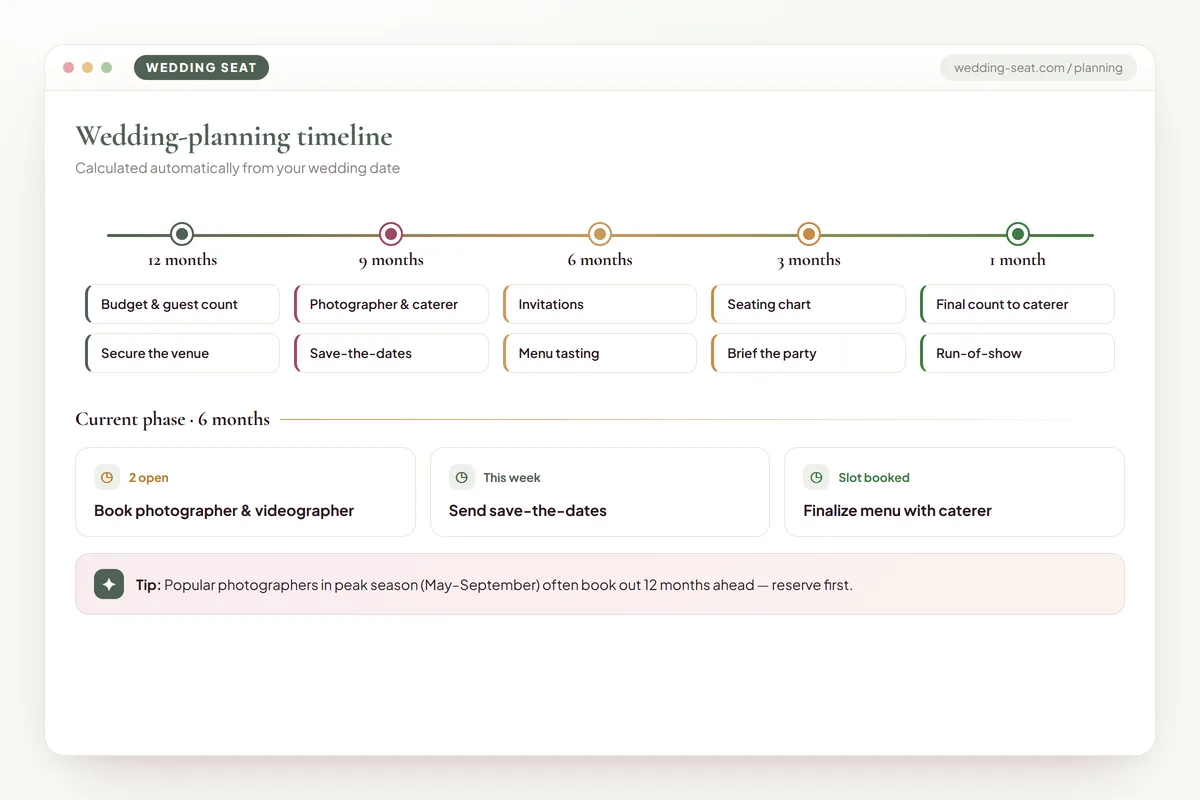
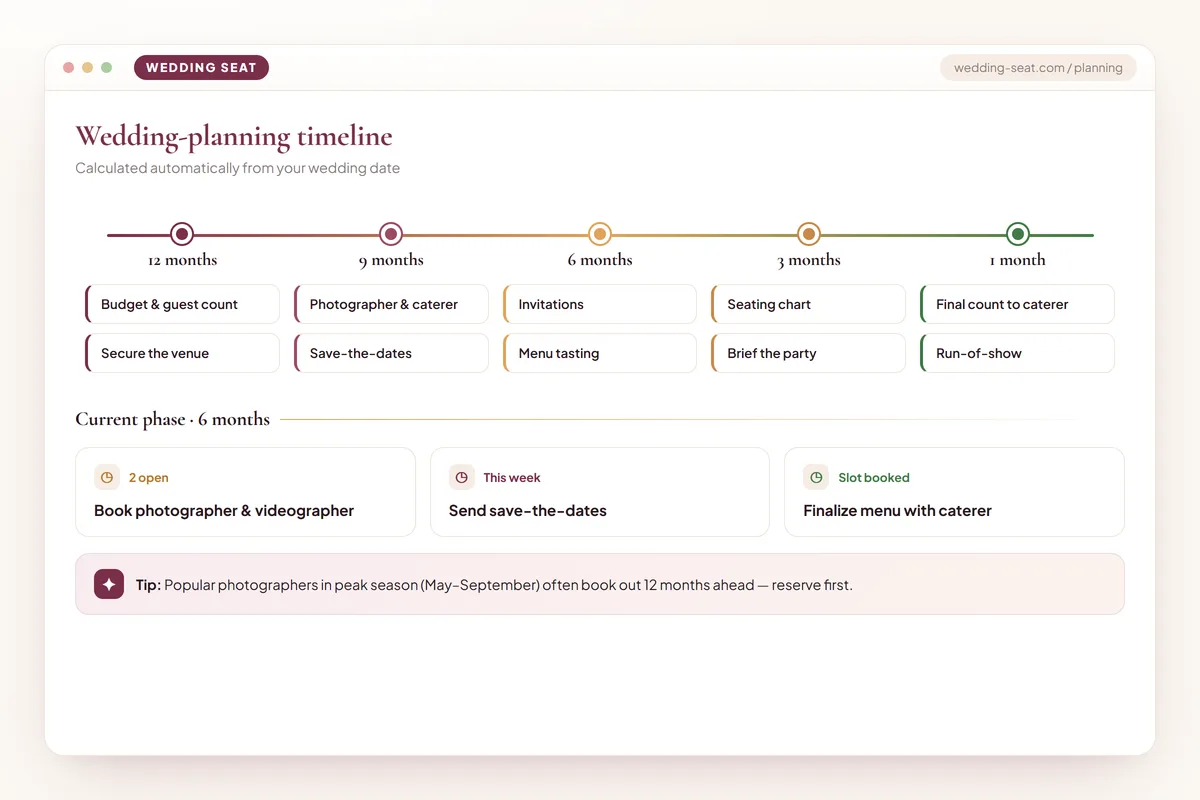
2.Wedding-planning timeline · Sage & Olive 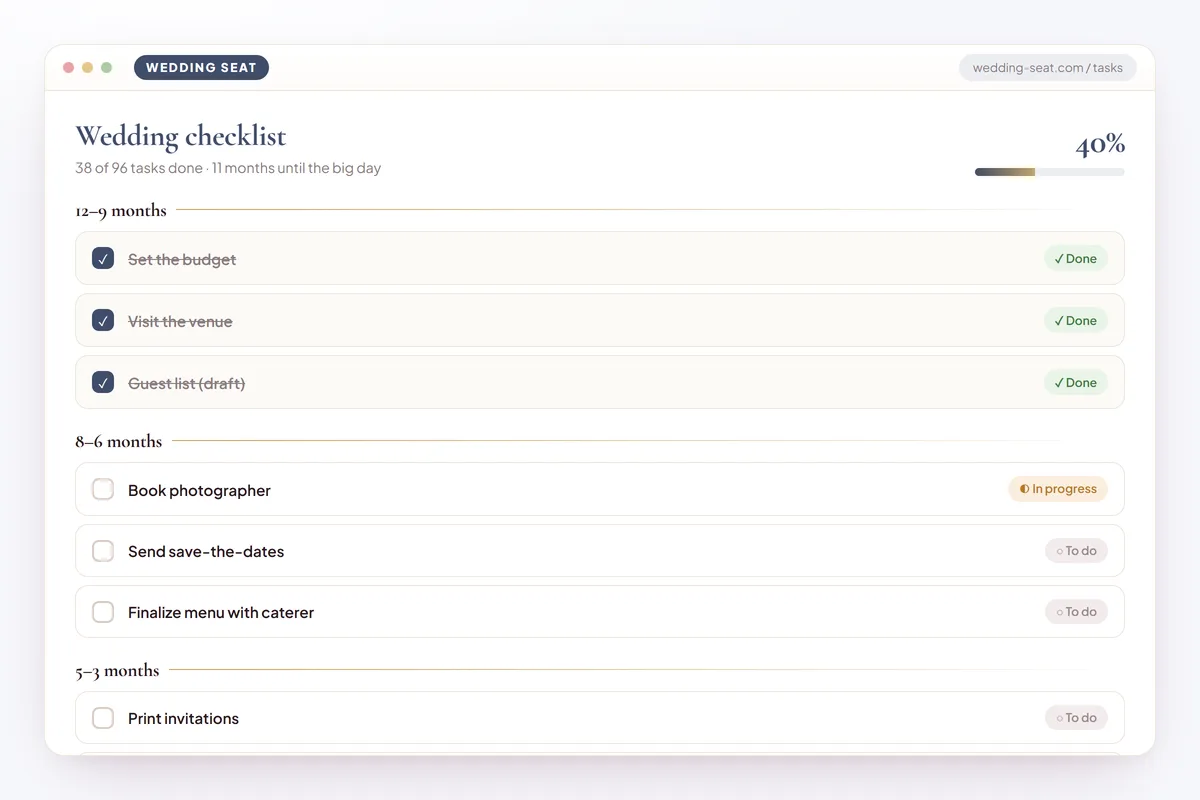
3.Wedding checklist · Dusk Blue 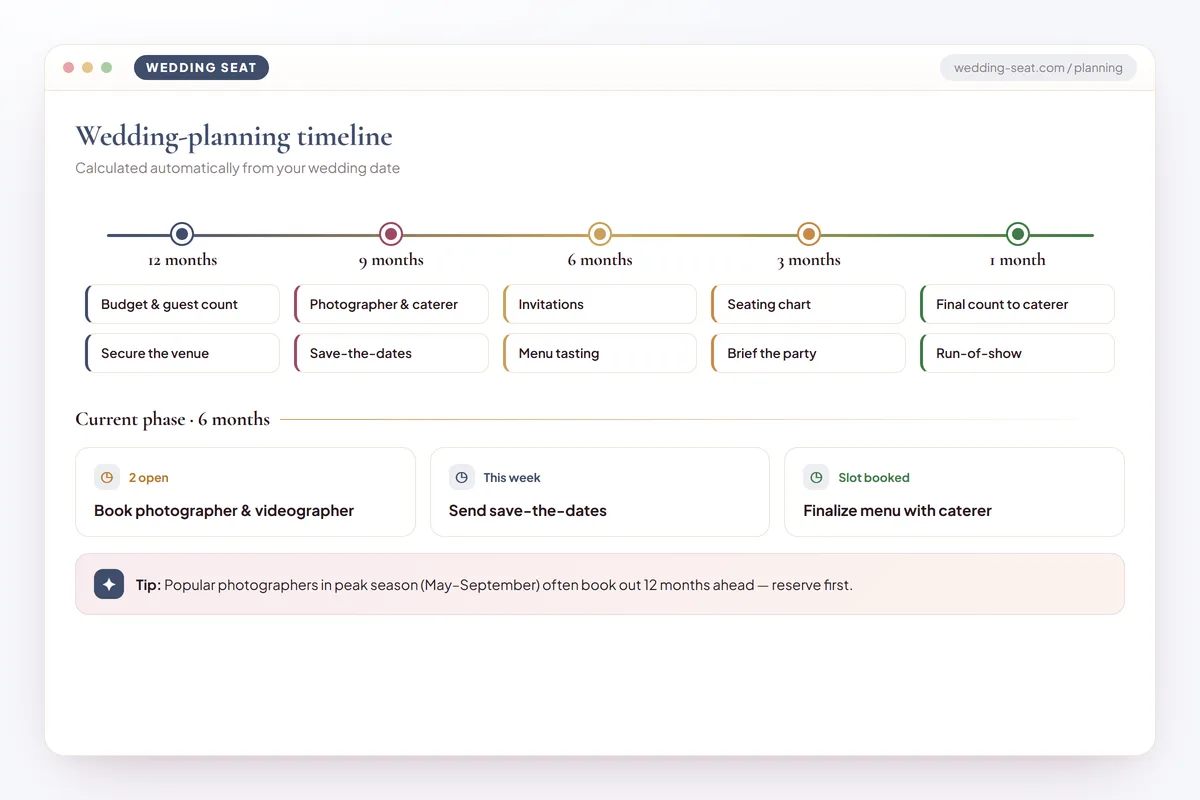
4.Wedding-planning timeline · Dusk Blue 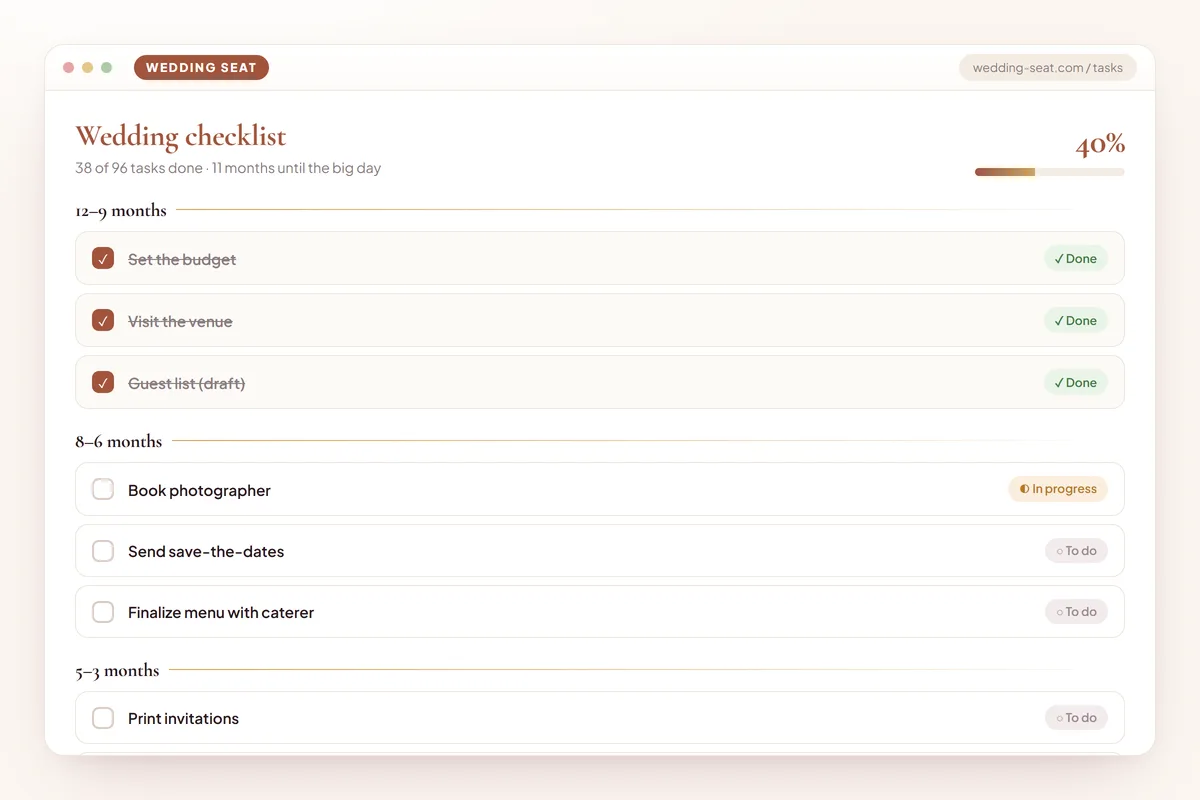
5.Wedding checklist · Terracotta 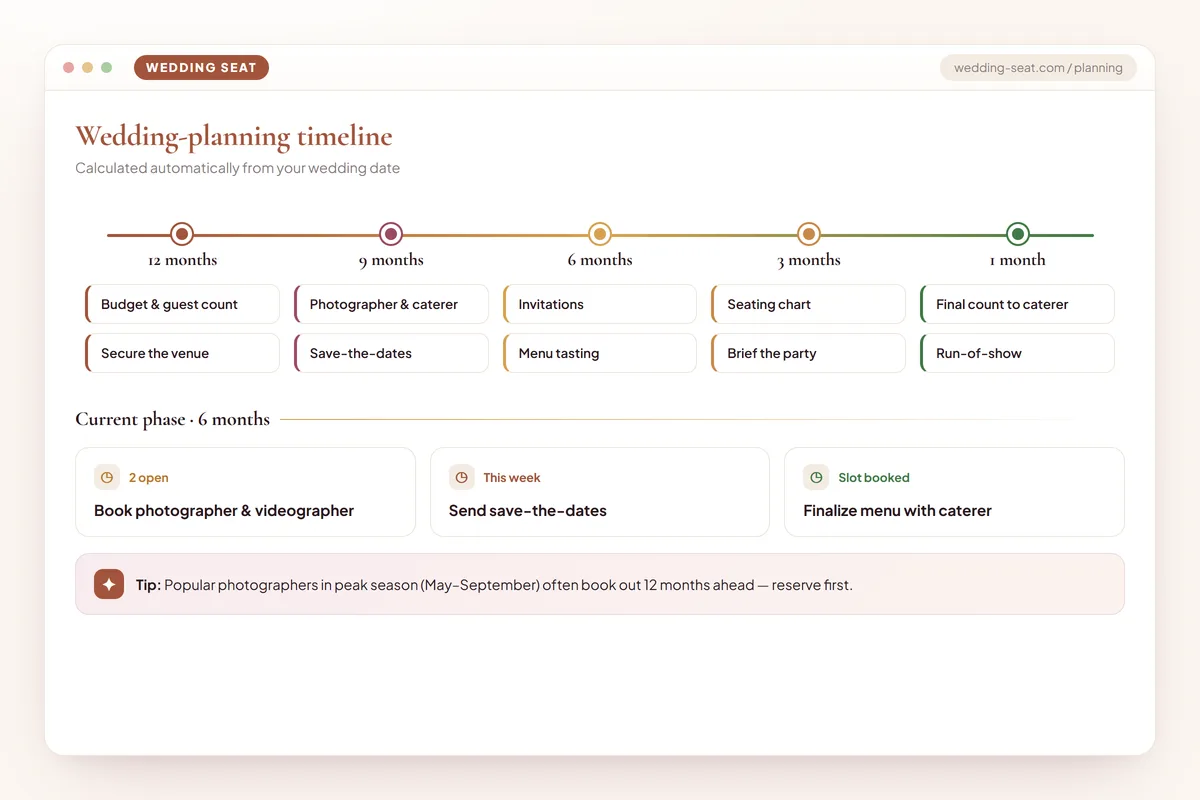
6.Wedding-planning timeline · Terracotta
Frequently asked questions
How far in advance should we start our wedding checklist?
Start as soon as you're engaged and have a rough wedding date in mind, even if it's a year or more away — the earliest tasks (setting a budget, drafting a guest list range, and researching venues) don't require a firm date and benefit enormously from a long runway. If you're working with a shorter timeline, such as 6 months or 3 months, the same categories still apply; you simply compress the research phase and prioritize venue booking and legally required paperwork immediately, treating everything else as flexible.
What's the very first thing that should be on a wedding checklist?
Budget and guest count, in that order, before venue research even begins. Every other decision — venue capacity, catering cost per head, invitation quantity — depends on having at least a rough range for both. Couples who skip this step and start venue-shopping first frequently fall in love with a space that turns out to be financially or logistically mismatched to their actual wedding.
How many tasks does a typical wedding checklist have?
A full 12-month wedding checklist for a traditional wedding typically runs 120 to 150+ individual tasks once you break categories down to a granular level (each vendor booking, each fitting, each paperwork step counted separately). That number sounds overwhelming as a single list, which is exactly why filtering by timeframe — looking only at this month's or this week's tasks — matters more than trying to view the whole list at once.
Should each partner have their own checklist or share one?
Share one checklist with clearly assigned ownership per category, rather than each partner keeping a separate list. Separate lists inevitably drift out of sync — one partner marks a task done that the other didn't know was even assigned to them, or both partners independently contact the same vendor. A shared, assignable checklist keeps both partners aligned without requiring constant verbal check-ins about who did what.
What should be done differently for a destination wedding checklist?
Add a dedicated travel-logistics layer on top of the standard checklist: passport validity checks for the couple and ideally a reminder to guests, visa research for your specific destination and nationality, save-the-dates sent 8-10 months out instead of 6-8, and a legal-recognition check for whether the marriage needs to be separately registered at home. Guest list planning also changes meaningfully, since travel-dependent guests need far more lead time and a realistic attendance estimate typically runs lower than a local wedding of the same invited size.
How do we handle a wedding checklist when parents are paying and want input?
Add parents as collaborators on the specific categories they're funding or have a stake in, rather than giving them access to the entire checklist or excluding them entirely. If parents are contributing to the budget, have an early, direct conversation about which categories their contribution covers and whether it comes with expectations about guest list additions or style choices — this conversation is far easier before vendors are booked than after a disagreement surfaces mid-planning.
What's the biggest mistake couples make with wedding checklists?
Booking vendors out of order — most commonly, choosing a venue or ordering stationery before the guest count and budget are settled, which then forces expensive revisions. The second most common mistake is one partner carrying the entire checklist alone instead of sharing ownership, which both overloads that person and leaves the other partner unable to help even when they want to, simply because they don't have visibility into what's already been done.
Ready to stop juggling this in your head? Use the free wedding checklist tool above to build your own timeline in minutes — enter your date, pick your style, and let it map out exactly what to do next.
Plan faster
Start your free wedding project in seconds.