
Wedding Guest List
Plan your wedding guest list without spreadsheets. Track invitations, RSVPs, plus-ones, and families in one place.
- No account required to start
- Track RSVPs and plus-ones
- Ready for seating chart when you are
- Unlimited guests
- Families and groups
- RSVP status tracking
- Instant seating chart later

Why wedding guest lists get complicated
A guest list looks simple at first — until details start changing. A structured list saves you hours later and reduces planning stress today.
How to build a wedding guest list (that stays sane)
Start with structure, then refine as RSVPs arrive. The goal is clarity: who is invited, who is confirmed, and what constraints matter for seating.
1) Capture the right columns
At minimum: name, side (Side A / Side B), group/household, RSVP status, plus-one, and notes (dietary, kids, accessibility).
2) Group families early
Grouping prevents duplicates and helps you keep households together. It also makes seating decisions much faster later.
3) Track RSVP status in one place
RSVPs come from texts, calls, and family chats. Central tracking keeps your counts accurate and reduces last-minute surprises.
4) Use the list to drive seating
Once you know who is attending, your seating plan becomes a simple visual task — not a spreadsheet nightmare.
Common guest list scenarios
Every wedding has edge cases. A good list is built to handle them without rework.
Wedding guest list: app vs spreadsheet
Spreadsheets work for static lists. Weddings are not static. A dedicated guest list keeps everything consistent as your plans evolve.
Spreadsheets
- Versions split between people
- Hard to keep counts accurate
- Easy to break formatting or formulas
- No direct path into seating planning
Wedding Seat
- Single source of truth
- Clear RSVP status tracking
- Groups and households stay organized
- Seating chart is ready when you are
More wedding planning tools
Guest List Template
Use a live template instead of spreadsheets — always accurate.
Wedding Seating Chart
Build a visual seating plan and share for approvals.
Seating Chart Template
A live seating template that stays consistent as guests change.
Wedding Budget
Track costs, deposits, payments, and remaining totals.
Wedding Checklist
Stay on track with a checklist that adapts as you plan.
Wedding RSVP
Collect replies, meal choices, and plus-ones online.
Wedding Timeline
Build the wedding-day schedule and share it with vendors.
Wedding Website
Publish a shareable site with details, RSVP, and registry.
Before you can seat anyone, mail anything, or tell your caterer a final number, you need one living document that everyone in the family agrees on. This guide walks through exactly how American couples build, organize, and manage that list — using the tool above — from the very first brainstorm to the headcount you hand your caterer the week of the wedding.
What Couples Actually Call This List
Americans use several interchangeable names for the same document, and knowing them helps when you're talking to parents, planners, or stationers. Most couples just say ‘guest list’ or ‘invite list,’ but you'll also hear ‘master list’ (the full, unfiltered version before cuts), ‘A-list’ and ‘B-list’ (the tiered version used when a venue caps capacity), and ‘guest tracker’ or ‘RSVP tracker’ once responses start coming in. Wedding planners often say ‘the count’ when referring to the working number of confirmed attendees. Stationers and caterers use ‘final headcount’ specifically for the number that goes to the kitchen. None of these are wrong — they're just different stages of the same spreadsheet. A ‘guest list template’ or ‘guest list spreadsheet’ typically refers to the blank starting structure, with columns for name, household, address, RSVP status, and meal choice. A ‘printable guest list’ is simply that same data exported to paper for a planning binder or for addressing invitations by hand. Couples juggling two families sometimes call the split version ‘his side / her side’ or ‘each family's allotment.’ Whatever you call it, keep one single source of truth — duplicate spreadsheets in different inboxes are the number one cause of double invites and missed RSVPs.
- Master list = every name before any cuts
- A-list/B-list = tiered invites for capped venues
- Guest tracker = the list once RSVPs start arriving
- Final headcount = the number sent to catering
- Printable guest list = paper version for addressing envelopes
Lay the Foundation Before You Add a Single Name
Before typing anyone into the tool above, agree on three numbers as a couple: your realistic budget, your venue's hard capacity, and your ideal guest count. These three constrain each other — a $15,000 budget and a 150-person dream list don't coexist, so decide early which lever you're willing to pull: bigger budget, smaller venue, or fewer guests. Most American weddings land somewhere between 80 and 150 guests, though intimate weddings of 25–50 and large weddings of 200+ are both common depending on region and family size. Next, decide who gets an allotment. The traditional model splits invites three ways: one-third from the couple's friends, one-third from the bride's family, one-third from the groom's family — but this is a starting point, not a rule. If parents are contributing financially, they typically expect a proportional say in the count. If the couple is self-funding, they usually control the whole list. Have this conversation explicitly and in writing before anyone starts adding names, because unspoken assumptions about ‘who gets how many’ are the single biggest source of guest-list conflict.
Write down the budget-per-guest number first — it makes every later ‘can we invite them’ conversation faster and less emotional.
Step-by-Step: Building Your List in the Tool Above
1. Start a new list and name it clearly (e.g., ‘Smith-Johnson Wedding 2025’) so it's easy to find later and share with parents. 2. Add your venue capacity and target guest count at the top — this becomes your reference ceiling as you build. 3. Brainstorm without filtering. Add every name you can think of across categories: immediate family, extended family, close friends, work friends, childhood friends, parents' friends, plus-ones. Don't rank yet — just capture. 4. Group entries by household using the household field, not individual rows. A married couple, their kids, and any live-in partner should sit under one household so your headcount and mailing count stay accurate. 5. Tag each entry with a category (Bride's Family, Groom's Family, Couple's Friends, Work, Plus-One) so you can filter and see the balance across sides. 6. Mark your must-invite core — immediate family and closest friends — as confirmed A-list entries. 7. Move everyone else into a tiered or B-list view if your venue has a cap; the tool lets you reorder without deleting anyone. 8. Add mailing addresses as you collect them, using the address field so you can export a clean list for invitations later. 9. As responses come in, update RSVP status per household so your live count is always accurate. 10. Export the printable version once your list is stable, for save-the-dates, invitations, and your final catering count.
How Many Guests Should You Actually Invite
There's no universal right number — the right size is whatever fits your venue, budget, and the kind of day you actually want. A backyard or intimate restaurant wedding often works best around 30–60 guests, allowing a real conversation with everyone present. Mid-size weddings of 80–120 are the most common format in the U.S., large enough for extended family but still manageable for seating and budget. Weddings above 150 usually happen when both families are large or the couple wants an all-out celebration, and they require earlier venue booking and a bigger catering deposit. A practical way to land on a number: divide your total budget by your target per-guest cost (typically $100–$250 per person depending on region and style) and see what count that produces. If the resulting number is smaller than your dream list, you have three honest options — raise the budget, choose a cheaper per-guest format like a brunch or buffet, or cut the list using the A/B method described later. Couples who skip this math often end up either over budget or forced into painful last-minute cuts a month before the wedding, which is far more stressful than deciding early.
Organizing Guests by Household, Not Headcount
One of the most common early mistakes is building a list of individual names instead of households. This inflates your perceived total, complicates addressing invitations, and makes RSVP tracking messy — you end up chasing five separate replies from one family instead of one household RSVP that covers everyone. In the tool above, group every guest under a household: a married couple and their children under one entry, an engaged couple under one entry, a single guest with a plus-one under one entry. Household grouping also makes budgeting far more accurate, since caterers, rentals, and invitation counts are billed per person but organized per household for mailing. It's the difference between ‘142 names’ and ‘the Millers, plus four kids, RSVP pending’ — the second version is what your caterer, your calligrapher, and your seating chart actually need. It also prevents the awkward scenario of accidentally inviting a couple's children separately or forgetting a live-in partner because they weren't listed under the same address.
- Group married or cohabiting couples as one household
- List children under their parents' household, not separately
- One household = one invitation and one RSVP
- Prevents double-counting when calculating your final number
- Makes address collection and mailing far simpler
The A-List/B-List Strategy Done Right
When your dream list exceeds your venue's capacity or your budget, tiering is the standard American solution — not a taboo shortcut. The A-list is your must-invite core: immediate family, closest friends, and anyone whose absence would genuinely change how the day feels. The B-list is everyone else you'd love to have if space allows: extended family, work colleagues, plus-ones of guests you don't know well, and friends-of-friends. The key to doing this gracefully is timing. Send A-list invitations 8–10 weeks before the wedding with a firm RSVP deadline. As declines come in, send B-list invitations from that freed-up capacity — but only up until roughly 4–5 weeks before the wedding, after which it starts to look like an obvious afterthought. Never send B-list invitations noticeably later with the same RSVP deadline as the A-list, since guests compare notes and the gap becomes conspicuous. In the tool above, tag entries as Tier 1 or Tier 2 so you can filter and release invitations in batches without losing track of who's been sent what.
Plus-One Etiquette in America
American plus-one etiquette has loosened over the last decade, but a few conventions still hold. Married or engaged guests, and anyone in a long-term cohabiting relationship, should always receive a plus-one — this is non-negotiable etiquette, not a courtesy. For single guests, plus-ones are more discretionary: many couples offer them to guests who won't know anyone else at the wedding, and skip them for guests attending with a built-in friend group. A blanket ‘everyone gets a plus-one’ policy is the fastest way to blow a tight budget, since it can add 15–30% to your headcount. If you're limiting plus-ones, apply the rule consistently across both families — exceptions for the groom's college roommate but not the bride's coworker will be noticed and will cause hurt feelings. In the tool above, add a dedicated plus-one field per guest so you can see at a glance who has one, who doesn't, and what that adds to your total before invitations go out.
Navigating Divorced or Blended Parents' Guest Lists
When parents are divorced or remarried, the guest list needs an explicit, negotiated structure rather than an assumed default. Decide early whether each parent gets an equal allotment, and clarify whether stepparents, new partners, and half-siblings are included as part of that parent's count or as separate additions. It's common for tension to arise not from the guest list itself but from unspoken expectations about where a parent's new spouse sits or whether an ex-in-law is invited at all. A workable approach: give each parent (and their household, if remarried) a set number of invites to allocate themselves, rather than the couple guessing who each parent wants included. This keeps the couple out of the middle of old family conflicts. In the tool above, tag entries by ‘allocated by’ (Mom, Dad, Stepmom, Couple) so it's clear whose invite each name represents, which is invaluable if a difficult conversation about cutting names comes up later.
Get each parent's list in writing early — verbal promises about ‘who's invited’ are the most common source of last-minute guest-list disputes.
Collecting Addresses Without the Awkward Group Text
The most efficient way to collect mailing addresses is a single shared request rather than dozens of individual texts. Many couples send one group email or a short online form (often built into their wedding website) asking everyone to confirm their current mailing address, ideally 3–4 months before invitations go out. This also naturally catches recent moves, new last names, and updated household details like a new baby or partner. For harder-to-reach relatives — distant cousins, parents' old friends — ask the connecting family member to collect that address rather than reaching out cold. In the tool above, the address field accepts full mailing addresses per household, and you can filter for ‘address missing’ to see exactly who still needs to be chased before your invitation mailing deadline. Keep this data updated even after invitations go out — you'll need current addresses again for thank-you notes, so don't delete the field once mailing is done.
Tracking RSVPs So Nothing Falls Through the Cracks
Once invitations are out, your guest list shifts from a planning document to a live tracker. Update each household's status as responses arrive: Invited, Attending, Declined, or No Response. Set a firm RSVP deadline — typically 3–4 weeks before the wedding — and build in a follow-up plan for stragglers, since a portion of guests will inevitably miss the deadline regardless of how clear it was. Two weeks before your RSVP cutoff, filter the list for anyone still marked ‘No Response’ and follow up personally by text or phone rather than assuming a non-reply means a no. In the tool above, the RSVP status column updates your live attending count automatically, so you always know where you stand relative to your target number without manually recounting a spreadsheet. This running total is also what tells you, in real time, whether any B-list invitations can go out from declines.
How to Cut Names Without Losing Friends
If your list still exceeds capacity after the first draft, cut using clear categories rather than emotion in the moment. Start with the lowest-attachment tiers first: coworkers you don't socialize with outside work, distant relatives you haven't seen in years, childhood friends you've lost touch with, and plus-ones for single guests who'll know others at the wedding. Apply these cuts evenly across both families so no side feels singled out. A useful filter: would you make an effort to see this person if the wedding weren't happening? If not, they're a reasonable candidate to move to the B-list or cut entirely. Avoid cutting based on whether someone invited you to their wedding — obligation-based invites are one of the fastest ways to bloat a list past your real budget. In the tool above, sort by category and tier so you can review each group together rather than making one-off decisions that feel arbitrary later.
- Cut lowest-attachment categories first: distant coworkers, lapsed friendships
- Apply cuts evenly across both families
- Ask: would we see this person without the wedding as a reason
- Avoid obligation invites based on past wedding attendance
- Review by category, not name-by-name, to stay consistent
Locking In Your Final Headcount for Catering
Your final headcount is the number you commit to your caterer, and it's typically due 1–2 weeks before the wedding — check your contract, since some venues require it as early as 3 weeks out. This number should come directly from your RSVP tracker's confirmed attending count, not your original invite list, and should include vendors who need a meal (photographer, band, planner) if your contract requires you to feed them. Build in a small buffer only if your caterer allows adjustments close to the date; otherwise, treat this number as final, since most contracts charge for the guaranteed minimum regardless of no-shows. In the tool above, filter for ‘Attending’ status and export that count directly — this is the number you send, not a manual recount from memory, which is where headcount errors most often creep in.
Kids at the Wedding: Yes, No, or Some
Deciding on children is really a budget and atmosphere decision dressed up as an etiquette question. An adults-only wedding is completely acceptable in American etiquette as long as it's communicated clearly and consistently — invite envelopes should only list the names of invited adults, with no ‘and family’ language that implies otherwise. If you're including some children (say, immediate family only) but not others, expect some pushback, and be ready to hold the line evenly rather than making case-by-case exceptions. If you go child-inclusive, budget for it explicitly — kids under a certain age (often under 3) are usually free, while others are charged a reduced kids' meal rate by the caterer. In the tool above, tag child guests separately from adults in each household so your headcount for catering reflects adult and child meal pricing accurately, rather than one flat per-person rate that overstates your food budget.
Showcase: What Real Guest Lists Look Like
Different wedding styles produce noticeably different list structures, and seeing a few side by side helps couples calibrate their own. An intimate 30-guest backyard wedding list is almost entirely immediate family and closest friends, with no B-list tier needed at all. A traditional 150-guest list usually shows a clean three-way split between both families and the couple's friends, with a visible A/B tier for the last 20–30 spots. A multicultural or multi-generational wedding often includes a larger ‘parents' friends and elders’ category, reflecting extended family obligations common in many traditions. A destination wedding list, by contrast, is typically much shorter — often 40–60 guests — since travel cost naturally self-selects attendees, and it includes a travel-status column tracking flights and hotel blocks.
- 30-guest backyard list: no B-list tier, mostly immediate family
- 150-guest traditional list: even three-way split with A/B tiering visible
- Multicultural list: larger elders and family-friends category
- Destination list: 40–60 guests with a travel/hotel tracking column
- Second-marriage list: smaller, adult-focused, minimal plus-one entries
Etiquette and the Mistakes Couples Make Most Often
The most common etiquette mistake is inconsistency — giving some coworkers plus-ones and not others, inviting some cousins but not their siblings, or including children for one family but not another. Guests notice these inconsistencies far more than couples expect, so apply every rule (plus-ones, kids, save-the-date timing) evenly across both families. A second common error is discussing guest list decisions where invited-but-uncertain people can see them, particularly on social media before invitations are mailed — this creates awkward situations when someone learns about the wedding secondhand. A third mistake is waiting too long to finalize addresses, forcing a rushed invitation mailing that doesn't give guests the standard 6–8 weeks' notice. Finally, many couples forget to track vendor meals (photographer, DJ, planner) as part of their catering headcount, only discovering the gap when the caterer's final invoice arrives short by several place settings.
Never announce your wedding date or venue publicly on social media until every A-list save-the-date has been sent — nothing damages goodwill faster than a guest finding out from Instagram before the mail.
Budget Math: What Each Guest Actually Costs
Every guest you add doesn't just cost a plate — it cascades into rentals, favors, stationery, and staffing. A useful way to think about it: calculate your fully-loaded per-guest cost by adding catering, rentals (chairs, linens), favors, and a share of staffing to your per-plate catering price, rather than using the catering quote alone. This fully-loaded number is often 20–40% higher than the catering price by itself, which is why cutting ten guests can save far more than it first appears. When a guest list negotiation stalls, running this math together is often more persuasive than an abstract argument about feelings — showing that ten extra guests means real dollars reallocated from the honeymoon or photography budget makes the tradeoff concrete. In the tool above, keep your target headcount visible alongside your budget so every addition to the list is weighed against this real cost rather than added impulsively.
Printable Sheet vs Spreadsheet vs Digital Tracker
A printable guest list works well for envelope-addressing sessions, seating chart brainstorms at the kitchen table, or sharing a paper copy with a parent who prefers not to use a spreadsheet. Its downside is that it goes stale the moment an RSVP comes in and nobody updates the paper copy, leading to conflicting versions between family members. A shared digital tracker, like the tool above, solves this by keeping one live version everyone references, with automatic counts for budget, RSVP status, and household groupings updating in real time. The best workflow for most couples is digital-first for accuracy, with printable exports generated only when needed for a specific task — addressing envelopes, a seating chart session, or a final printed copy for the caterer. Avoid maintaining both a spreadsheet and a paper list in parallel; pick one source of truth and export from it, rather than manually syncing two versions.
If a parent insists on paper, export a fresh printable copy for them monthly rather than letting them keep an outdated version that no longer matches the live RSVP count.
Examples in every theme
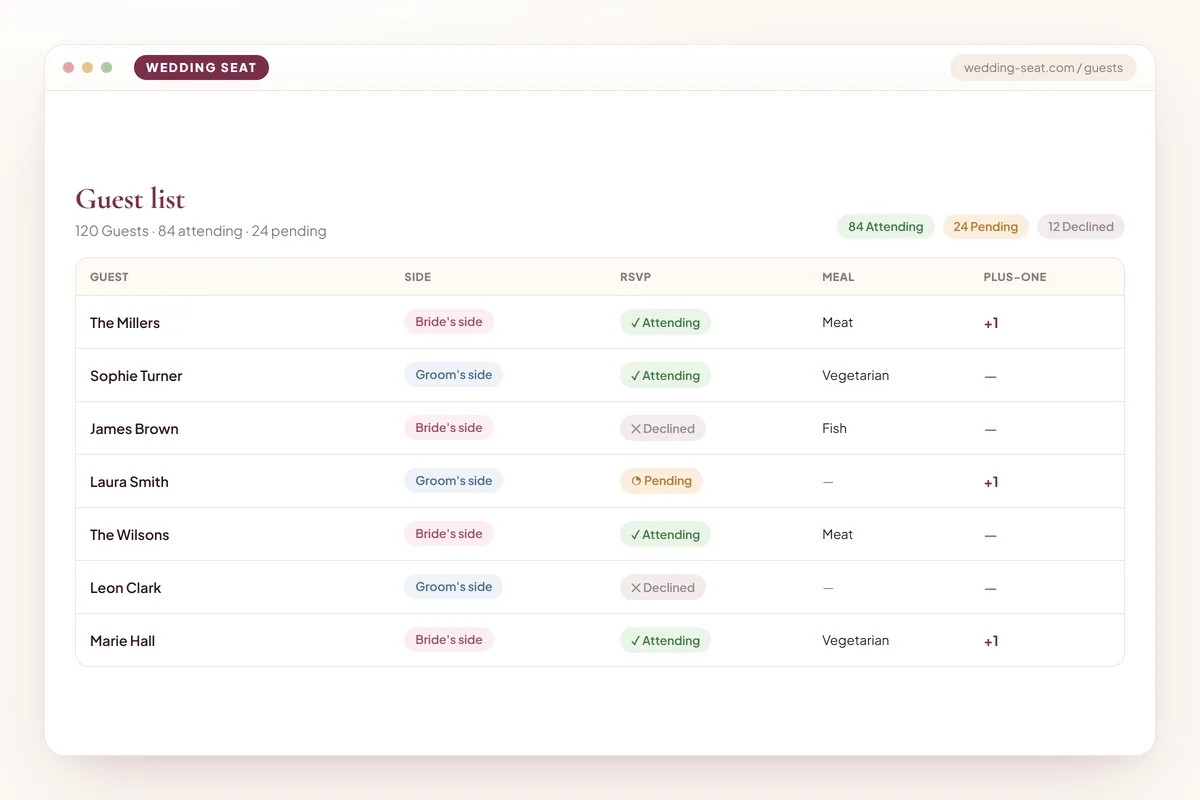
1.Guest list · Sage & Olive 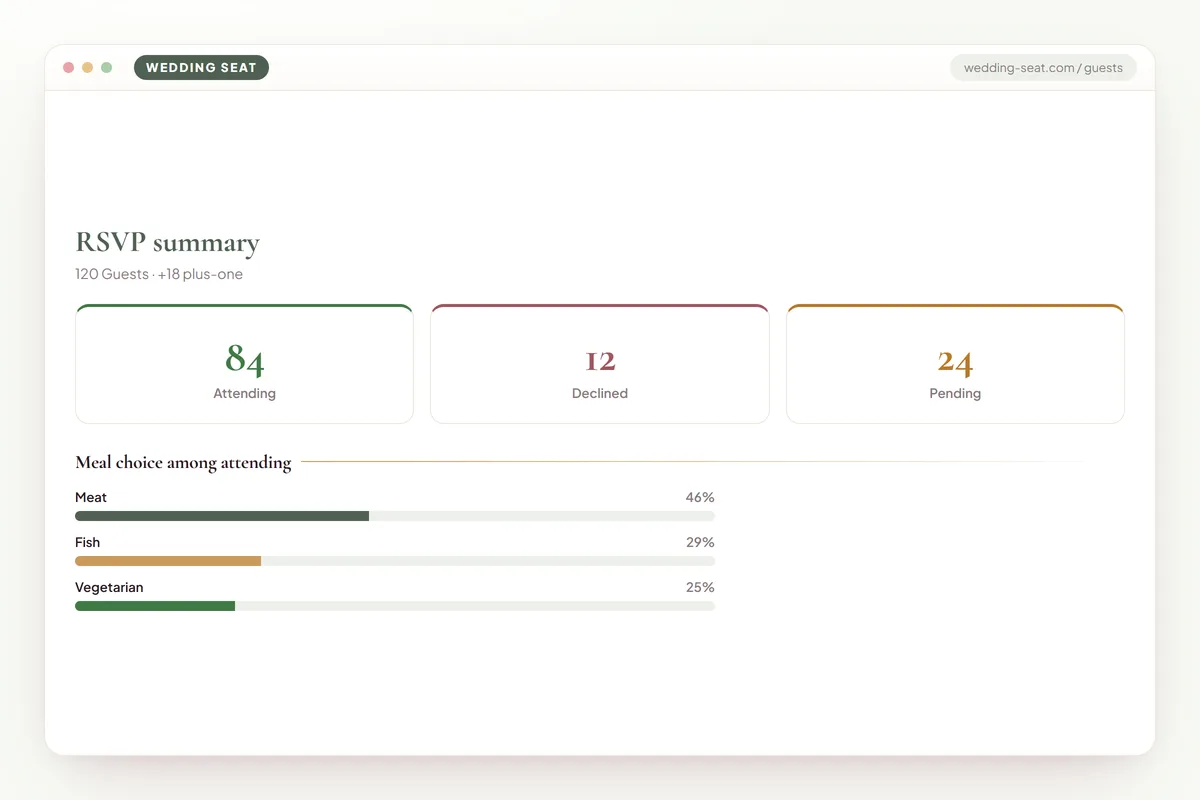
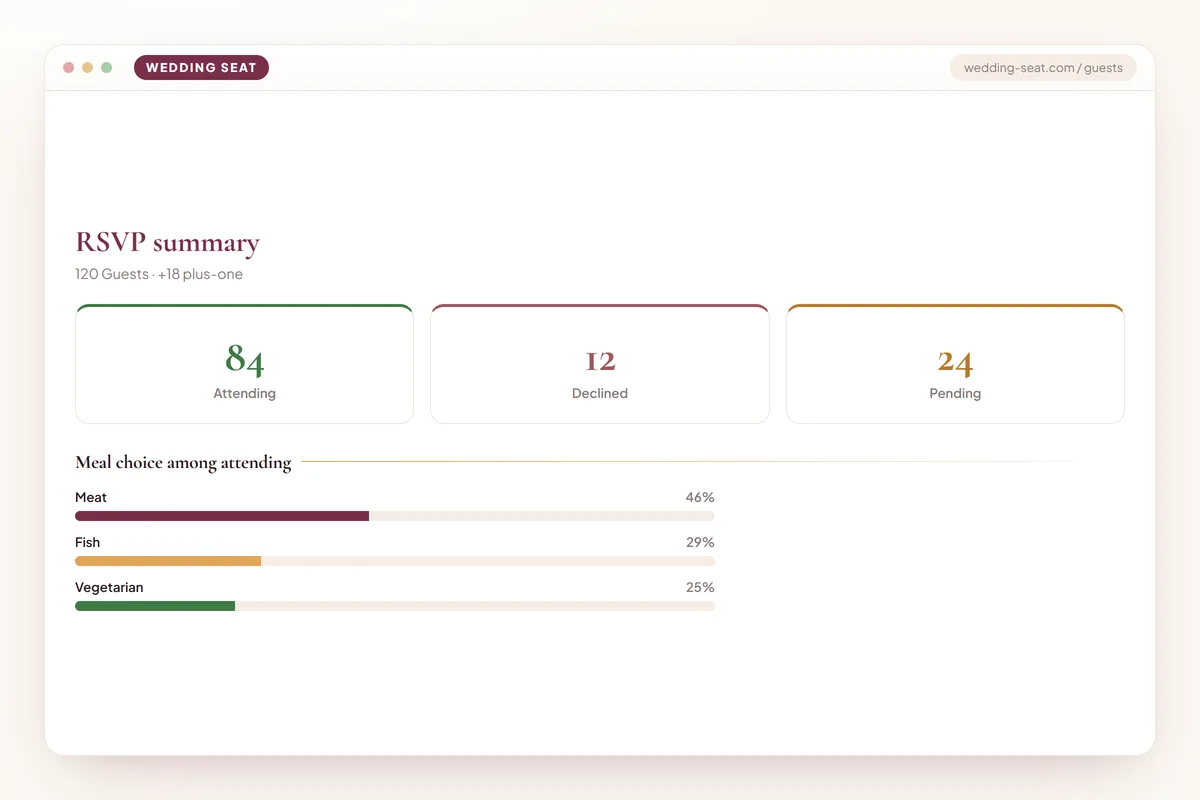
2.RSVP summary · Sage & Olive 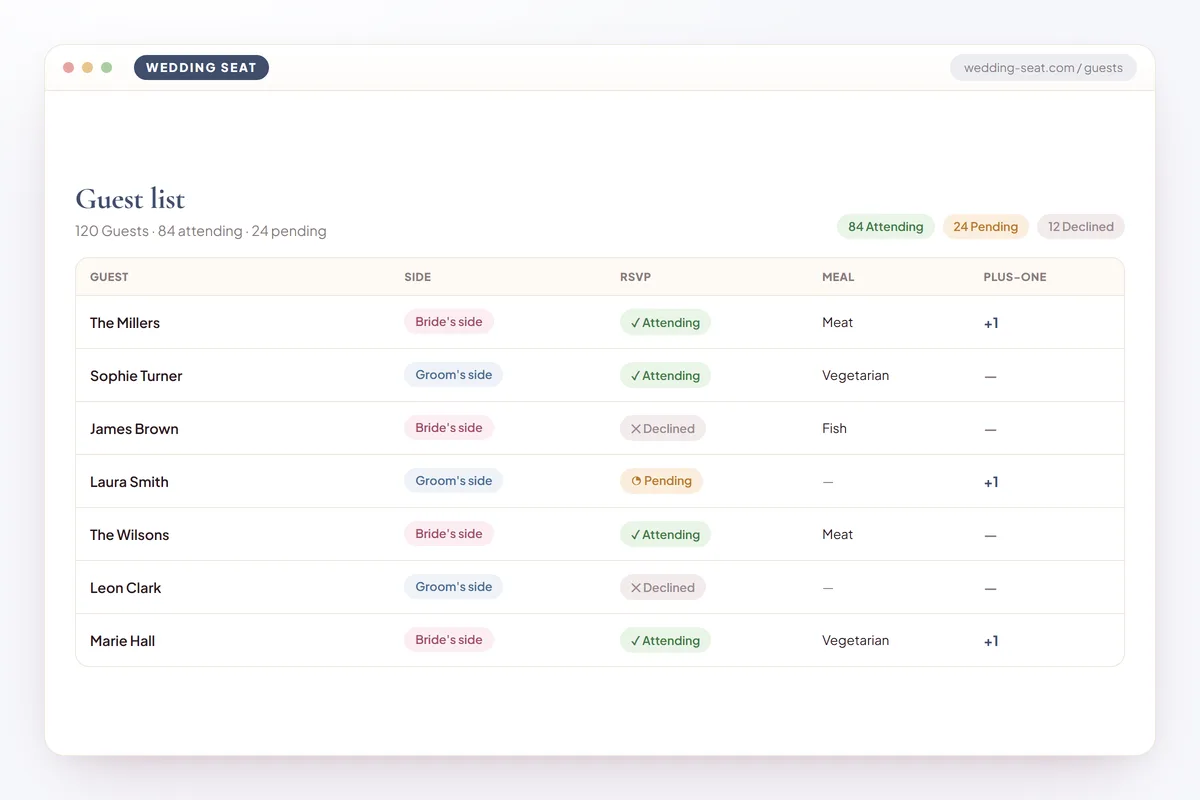
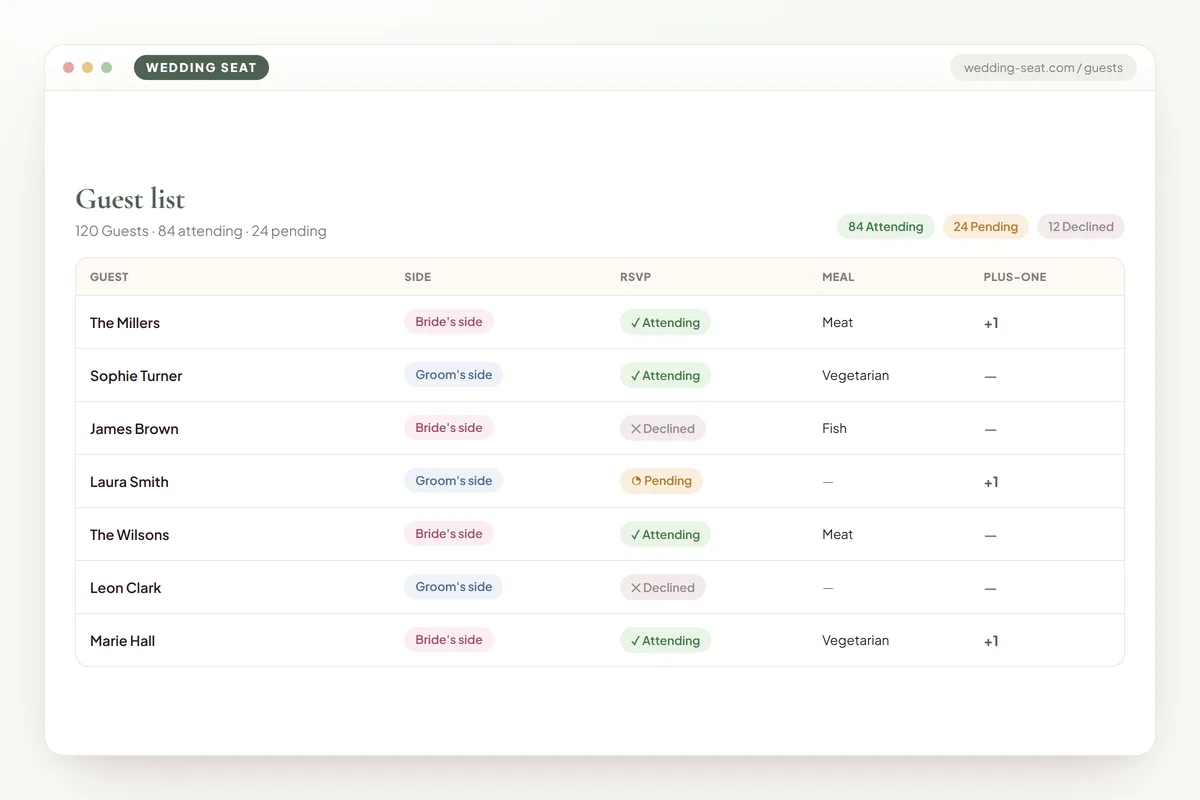
3.Guest list · Dusk Blue 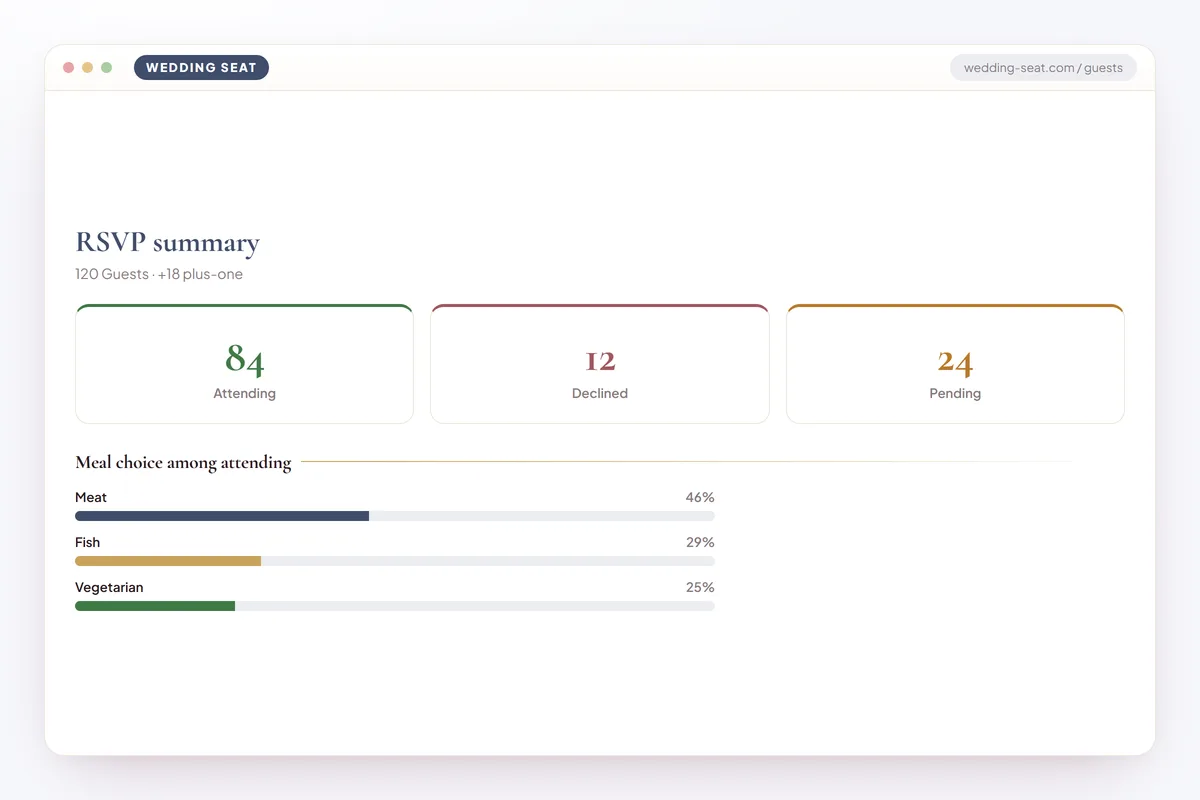
4.RSVP summary · Dusk Blue 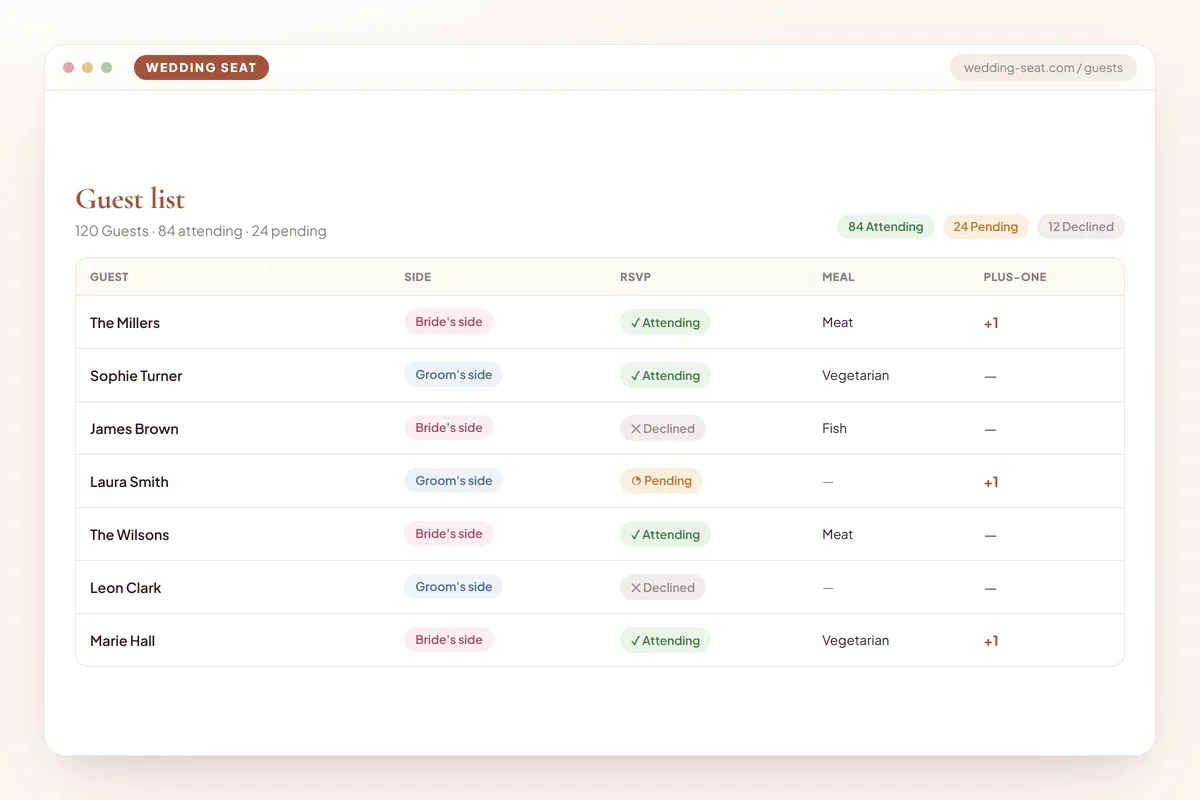
5.Guest list · Terracotta 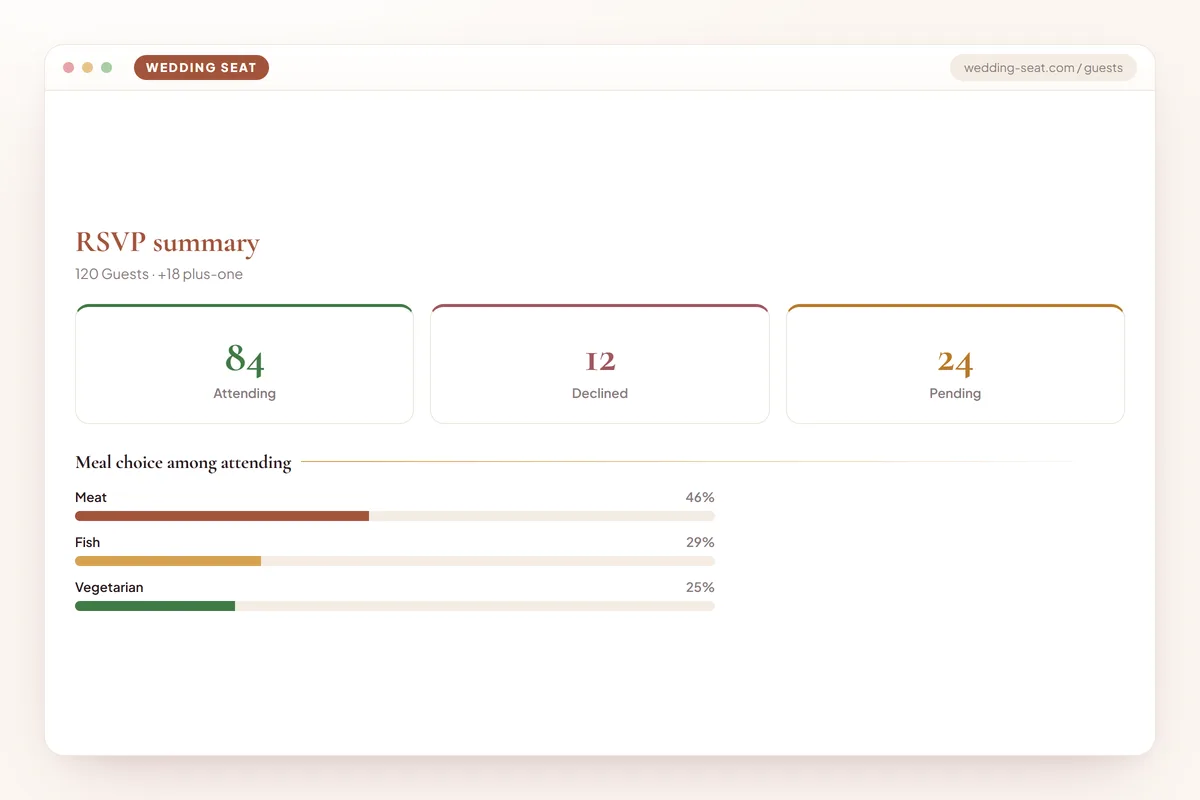
6.RSVP summary · Terracotta
Frequently asked questions
How far in advance should we finalize our guest list?
Aim to have your full master list finalized about 4–5 months before the wedding, since this gives you time to collect addresses, order invitations, and mail save-the-dates 6–8 weeks ahead of the wedding for local guests and 3+ months ahead for destination or out-of-town guests. Waiting until 2–3 months out to finalize the list usually forces a rushed invitation timeline and cuts into the buffer you'd want for A/B-list tiering.
Do we have to invite coworkers to our wedding?
No — there's no obligation to invite coworkers unless you're genuinely close outside of work. If you're inviting a couple of close work friends but not the whole department, keep wedding talk low-key at the office in the weeks leading up to the date to avoid anyone feeling left out. It's completely acceptable to have zero coworkers on your list if your friend group doesn't overlap with your job.
Is it rude to have an adults-only wedding?
It's not rude as long as it's communicated clearly and applied consistently to every guest, including your own siblings' or friends' children. Address invitations only to the adults by name, avoid ‘and family’ wording, and be prepared for a small number of guests with young kids or no childcare to decline — that's a normal and expected outcome of this choice, not a sign you've done something wrong.
What's the difference between the A-list and B-list, and is it rude to send B-list invites late?
The A-list is your must-invite core sent first, and the B-list is the group you invite from as A-list declines free up space; it's standard practice, not rude, as long as B-list invitations go out within a few weeks of the A-list deadline. What does read as an afterthought is sending B-list invitations noticeably later — say, three weeks before the wedding — since the compressed RSVP window makes the timing obvious to the guest.
How do we split the guest list fairly between two divorced parents?
Give each parent (and their household if remarried) a set number of invitations to allocate as they choose, rather than the couple guessing who each parent wants included — this avoids putting the couple in the middle of old family tension. Put the agreement in writing early, tag each entry in your list by who allocated it, and revisit the split together only if the total needs to shrink, so no single parent feels singled out for cuts.
What should our final headcount to the caterer actually include?
Your final headcount should be pulled directly from your confirmed ‘Attending’ RSVP total, not your original invite count, and it should include any vendors your contract requires you to feed, such as your photographer, DJ, or planner. Submit this number by your caterer's deadline, typically 1–3 weeks before the wedding depending on the contract, and treat it as final, since most caterers bill for the guaranteed minimum regardless of last-minute no-shows.
Ready to see it in action? Start building your own list in the tool above — group households, tier your A-list and B-list, and watch your live headcount and budget update as RSVPs come in, all for free.
Plan faster
Start your free wedding project in seconds.