
Wedding RSVP
Collect guest replies online instead of paper cards. Track who’s coming, meal choices, and plus-ones in one place.
- See replies the moment they arrive
- Capture meal choices and dietary notes
- Share one private link with guests
- Live headcount as replies come in
- Meal and dietary preferences per guest
- Plus-ones and song requests in one view
- Works on mobile and desktop

Why paper RSVPs fall short
Reply cards go missing, replies trickle in for weeks, and you end up chasing answers by text right before the deadline.
How the wedding RSVP works
Set up your questions, share a private link, and watch replies land in one organized list you can filter and total.
1) Set up your RSVP questions
Start from a ready form and add meal options, plus-ones, or song requests.
2) Share your private link
Send one link by message, email, or on your wedding website.
3) Track replies as they arrive
See your headcount, meal counts, and notes update automatically.
What you can collect with an online RSVP
An RSVP is more than a yes or no — it’s everything you need to plan the day.
Wedding RSVP: online vs reply cards
Reply cards work until answers scatter across texts, cards, and lists. An online RSVP keeps every reply in one place.
Paper reply cards
- Replies arrive slowly or get lost
- You retype answers into a list
- Meal counts are easy to miscount
- Chasing late guests takes weeks
Wedding Seat
- One organized list of replies
- Headcounts total automatically
- Meals and dietary notes in one view
- Share one private link
More wedding planning tools
Wedding Guest List
Track invitations, RSVPs, plus-ones, and families in one place.
Guest List Template
Use a live template instead of spreadsheets — always accurate.
Wedding Seating Chart
Build a visual seating plan and share for approvals.
Seating Chart Template
A live seating template that stays consistent as guests change.
Wedding Budget
Track costs, deposits, payments, and remaining totals.
Wedding Checklist
Stay on track with a checklist that adapts as you plan.
Wedding Timeline
Build the wedding-day schedule and share it with vendors.
Wedding Website
Publish a shareable site with details, RSVP, and registry.
Your guest list only becomes real once people actually reply — and getting a clear, on-time answer from every invitee is one of the most underestimated jobs in wedding planning. Below, we walk through exactly how American couples handle RSVP wording, deadlines, tracking, and the follow-up calls nobody enjoys, plus how to run all of it through the tracker above instead of a scattered spreadsheet.
What RSVP Really Means for Your Wedding
RSVP stands for répondez s'il vous plaît, French for 'please respond,' and on a wedding invitation it is a direct request: tell us if you're coming. It sounds simple, but the RSVP is the single data point your entire wedding budget hangs on — your caterer's final headcount, your venue's chair rental, your cake size, your favor count, and your seating chart all trace back to that one yes-or-no. Couples who treat the RSVP as an afterthought almost always end up scrambling in the final two weeks, calling aunts and cousins to ask if they're actually showing up. Couples who treat it as infrastructure — with a clear deadline, an easy way to respond, and a system for tracking answers — spend that same two weeks finalizing details instead of chasing people down. Think of the RSVP process as three separate jobs: asking clearly, collecting answers in one place, and following up on silence. Most wedding stress around guest count comes from skipping the second job and trying to do the third from memory.
What Couples Actually Call This
Depending on where you're from and how formal your wedding is, you'll hear this piece of the invitation suite called several different things, and none of them are wrong. On formal or traditional invitations, it's usually the 'response card' or 'reply card' — the small enclosure guests fill out and mail back in a pre-addressed envelope. Casually, most Americans just say 'the RSVP card' or even 'the RSVP' as shorthand for the whole reply process, not just the card itself. Southern and older-generation invitation suites sometimes still use 'the favor of a reply is requested,' a phrasing lifted straight from etiquette books, while modern minimalist suites just print 'Kindly respond by [date].' On the digital side, you'll see 'RSVP link,' 'wedding website RSVP,' or simply 'reply online' — all pointing to the same web form. Wedding planners and caterers, meanwhile, talk about the 'final count' or 'guaranteed number,' which is really just the finished product of your RSVP tracking. None of these terms are interchangeable with 'invitation' itself — the invitation asks people to the wedding; the RSVP card, link, or form is strictly the mechanism for them to answer.
- Response card / reply card — formal paper term
- RSVP card — everyday shorthand
- Favor of a reply is requested — traditional phrasing
- RSVP link / reply online — digital equivalent
- Final count / guaranteed number — the caterer's term for your finished tally
Choosing Your RSVP Deadline
The standard rule for a local, weekend wedding is to set your RSVP deadline three to four weeks before the wedding date. That gives you a real buffer to chase stragglers, hand a locked headcount to your caterer (who typically wants final numbers seven to fourteen days out), and adjust seating without panic. For a destination wedding, push the deadline to six to eight weeks out, since guests are booking flights and hotel rooms around your answer and you need lead time to firm up room blocks and transportation. Work backward from your caterer's final-count deadline, not forward from your invitation mail date — that's the mistake that traps most couples. If your caterer needs numbers on June 1st and you know you'll need ten to fourteen days to track down non-responders, your RSVP deadline should land around May 15th to 18th, not June 1st itself. Mail invitations six to eight weeks before that deadline for local weddings, and ten to twelve weeks before it for destination weddings, so guests have breathing room to plan without feeling rushed into a decision.
Never set your RSVP deadline on the same date your caterer needs final numbers — you need at least ten days between the two to chase non-responders.
Formal RSVP Wording Templates
Traditional, formal invitations pair a formal response card with matching language. A classic version reads: 'The favour of a reply is requested by the twentieth of May' with blank lines below for 'M_____________________' and checkboxes for 'accepts with pleasure' or 'declines with regret.' If you're including a plated dinner, add a line for entrée selection: 'Herb-Roasted Chicken ___ Seared Salmon ___ Wild Mushroom Risotto ___.' Keep the tone consistent with your invitation — if your main card uses formal third-person language ('request the honour of your presence'), your response card should match, not suddenly turn casual. For guidance on getting that formal tone right across your entire suite, our formal wedding invitation wording guide walks through the full set of traditional phrasing options side by side. One formal-etiquette detail that trips people up: the correct spelling is 'favour' with a 'u' only if the rest of your suite uses British-influenced formal spelling; otherwise 'favor' is standard American usage and perfectly correct.
Casual & Modern RSVP Wording
Casual and modern couples have far more room to have fun here, and it's one of the easiest places to inject your personality without touching the main invitation copy. Instead of stiff checkboxes, try: 'We can't wait to celebrate with you! Let us know by August 10th: ___ Wouldn't miss it! ___ So sorry, can't make it.' Backyard, brewery, and casual daytime weddings often skip paper reply cards entirely and drive guests straight to a wedding website RSVP form, which is faster to track and cheaper to produce. If you're going the playful route, our casual wedding invitation wording guide has matching tone examples so your RSVP language doesn't feel jarringly formal next to a relaxed main invite. A practical note regardless of tone: always include the deadline directly on the RSVP element itself, not just in a separate insert — guests skim, and the date needs to be unmissable on the exact card or screen where they're expected to act.
Digital RSVP vs Paper RSVP
Digital RSVPs — collected through a wedding website or a tool like the one above — respond faster, cost nothing to mail, and feed straight into a live tracker instead of a stack of envelopes you have to transcribe by hand. Paper RSVPs feel more traditional and tend to get a slightly better response rate from older relatives who aren't comfortable filling out a web form, but they cost postage on both ends, take longer to arrive, and require manual data entry that introduces typos into your guest list. Most couples today run a hybrid: a wedding website RSVP as the default, with a small note on paper invitations for guests without internet access to call or mail instead. If you're weighing which route fits your crowd, our guide on digital RSVP vs paper RSVP breaks down response rates, cost, and etiquette for each by guest demographic. Whichever you choose, the real win is having every answer land in one tracked place automatically — which is exactly what the RSVP tool above does regardless of whether guests reply online or you're logging paper replies by hand.
Step-by-Step: Setting Up Your RSVP Tracker Above
1. Import or add your guest list into the tool above, entering each household or individual exactly as they'll appear on the invitation envelope. 2. Set your RSVP deadline in the tracker settings — use the caterer-deadline math from earlier in this guide, not just 'a few weeks before.' 3. Toggle on plus-one and children fields only for the guests they actually apply to, so the tool doesn't invite a blanket extra seat to everyone. 4. Add your meal or dietary options if you're serving a plated dinner, so guests select their entrée at the same time they RSVP. 5. Generate your shareable RSVP link or print-ready response card text directly from the tool, matching the wording style — formal or casual — you chose earlier. 6. Send invitations, then watch the live dashboard as replies roll in, sorted automatically into 'attending,' 'declined,' and 'awaiting response.' 7. Ten days before your deadline, use the built-in reminder feature to nudge anyone still marked 'awaiting response' without you having to track who you've already texted. 8. Once your deadline closes, export your final attending count straight into your seating chart and catering order, eliminating the manual re-typing that causes most headcount errors.
Real RSVP Layouts, Styles Across Weddings
Different wedding styles call for genuinely different RSVP presentation, and seeing them side by side makes it easier to pick what fits yours. A black-tie formal suite pairs an engraved response card with a small return envelope and a single elegant deadline line. A boho garden wedding often swaps the card for a hand-lettered insert reading 'Save us a seat!' with simple check-boxes. Destination beach weddings frequently go fully digital, since guests are already booking travel online and a mailed card adds friction. Backyard and casual weddings tend to favor a wedding website RSVP with a playful headline and a photo of the couple. Minimalist and modern suites strip the response card down to a single line of type with a QR code linking straight to the digital form. Seeing these formats side by side helps you match your RSVP presentation to the same tone as your invitations, so the two never feel like they came from different weddings.
- Black-tie: engraved card, formal single deadline line
- Boho garden: hand-lettered insert, casual checkboxes
- Destination beach: fully digital RSVP link, no paper card
- Backyard casual: wedding website form with photo header
- Minimalist modern: single line of type plus QR code
RSVP Etiquette and the Mistakes That Cost You Money
The most expensive RSVP mistake is skipping the deadline entirely — 'kindly respond soon' gives guests no reason to act, and you'll be chasing forty replies the week of the wedding. The second most common mistake is mailing a paper response card without a pre-stamped, pre-addressed return envelope; guests without stamps on hand will simply set it aside and forget it. Never write 'and guest' on an invitation meant for a specific plus-one you already know by name — it reads as an afterthought and confuses guests about whether they're allowed to bring someone. On the guest side, proper etiquette means responding within a week of receiving the invitation, not waiting until the deadline, and it means RSVPing for exactly the names printed on the envelope — not assuming children or partners are included unless specifically named. Couples also frequently forget to note dress code or venue changes on the RSVP element itself, assuming guests will re-read the main invitation; put critical logistics everywhere a guest's eyes will land. Finally, never delete a 'declined' response from your tracker — keep it recorded, since you'll need that final list later for thank-you notes and gift tracking.
Handling Plus-Ones Without Awkwardness
Plus-one policy causes more hurt feelings than almost any other wedding decision, so handle it through the invitation itself, not conversation. If a guest has a long-term partner or spouse, name that partner directly on the invitation and RSVP line — 'Sarah Chen and James Rivera' — rather than 'Sarah Chen and Guest,' which forces her to ask if her partner counts. If you're not offering a blanket plus-one policy, simply address the invitation and envelope to only the people you're inviting; most guests correctly read that as the boundary and won't ask for more, though a few will. Have a short, kind response ready for anyone who does ask — 'We kept our guest list intentionally small for [venue/budget] reasons, but can't wait to celebrate with you!' — and use the RSVP tracker above to lock the exact number of seats per household so there's no ambiguity when the day-of headcount is finalized.
Kids at the Wedding — RSVP Wording That Avoids Confusion
If your wedding is adults-only, the clearest and kindest method is to print only the invited adults' names on the envelope and invitation — no 'and family' — and let the RSVP card reinforce it with named lines for reply rather than a blank 'number attending' field that invites guests to write in extra names. Some couples add a gentle line like 'While we love your little ones, we've planned an adults-only celebration' on an insert card, which heads off confused calls from parents. If children are welcome for some families but not others, that's normal and fine — just be precise: name every invited child by name on the invitation itself, since a generic 'and family' line will get interpreted inconsistently across your guest list. On the RSVP tracker, add a children's field only to the households where kids are actually invited, so your catering and seating counts reflect who's genuinely expected rather than every possible child in your extended family.
Tracking Meals and Dietary Restrictions
If your reception includes a plated dinner, your RSVP card or online form should collect entrée selection at the same time as the yes/no answer — asking separately later means a second round of chasing replies. List two or three options by name ('Herb Chicken, Salmon, Vegetarian Pasta') rather than vague categories, and include a short line for allergies or dietary restrictions so your caterer gets real detail instead of guessing. Buffet and family-style receptions still benefit from a simple 'any dietary restrictions we should know?' field, since gluten, shellfish, and nut allergies matter regardless of service style. In the tracker above, dietary notes attach directly to each guest record, so when you export your final numbers for the caterer, allergy information travels with the headcount instead of living in a separate email thread you have to reconstruct from memory two days before the wedding.
Chasing Down Non-Responders Without Feeling Rude
Every wedding has guests who miss the deadline, and the fix is a short, friendly nudge rather than an awkward guessing game. About five to seven days after your RSVP deadline passes, reach out personally — a text or phone call works better than another mailed card, which they've likely already lost track of. Keep it light: 'Hey! Just finalizing numbers for the caterer — would love to know if you'll be able to make it!' works far better than anything that sounds like a scolding. Assign this task by relationship, not alphabetically — have each side of the family or wedding party reach out to their own circle, since a familiar voice gets a faster answer than the couple calling a distant cousin directly. The tracker above flags anyone still marked 'awaiting response' after your deadline automatically, so you're never relying on memory to know who still owes you an answer, and you can check names off in real time as replies finally come in by phone or text.
Destination Wedding RSVP Timelines
Destination weddings need an RSVP timeline built around travel logistics, not just etiquette convention. Send save-the-dates eight to twelve months out, formal invitations six to eight months before the wedding, and set your RSVP deadline at least twelve weeks before the event — far earlier than a local wedding — since guests need that answer locked in to book flights, request time off, and reserve hotel rooms within your group block. Include travel details directly alongside the RSVP element: nearest airport, recommended arrival window, and a link to your room block, since guests often can't commit to attending without knowing the trip is logistically doable for them. Expect a lower overall response rate than a local wedding and build that into your venue minimums early rather than being surprised later. Our destination wedding RSVP tips guide covers the exact week-by-week timeline and wording adjustments destination couples need, and pairs well with our destination wedding guest list planning guide if you're still deciding who makes the cut for a smaller, travel-heavy celebration.
RSVP for Micro Weddings, Elopements and Weekday Celebrations
Smaller and less traditional wedding formats still need a real RSVP process — arguably more so, since every seat matters when your guest count is under fifty. For a micro wedding, skip the formal response card altogether and simply text or call your short guest list personally, logging each answer in the tracker above so you have one clean record rather than scattered text threads. Weekday weddings need extra lead time on your RSVP deadline, since guests are weighing time off work; give them at least four weeks beyond the standard local timeline to sort out their schedule before committing. Elopements with a small witness group afterward often use a simple 'let us know by [date] if you can join us for dinner after' message rather than a full invitation suite — the RSVP is really just a headcount for the venue, and keeping it casual matches the intimacy of the day itself.
How RSVP Numbers Drive Your Budget
Every 'yes' on your RSVP tracker has a direct dollar value attached to it, and locking that number early is one of the most effective budget moves you can make. If your per-plate catering cost is $95 and you invited 150 guests expecting an 85% acceptance rate, you're planning around roughly 128 attendees — but if your actual response comes in at 70%, that's 105 guests, a difference of over $2,000 in catering alone, plus fewer rentals, less alcohol, and a smaller cake. Track your running acceptance percentage in the tool above as replies arrive so you can adjust vendor orders in real time rather than guessing until the deadline. A useful rule: expect roughly 80-85% acceptance for a local wedding and closer to 60-70% for a destination wedding, and don't finalize per-head vendor orders until you're within ten days of your actual deadline, when your real numbers are close to locked.
Response Card Design Details That Matter
If you're mailing paper response cards, a few small production details separate a smooth process from a mess of undeliverable envelopes. Always include a pre-stamped, pre-addressed return envelope sized to match your card — guests are far less likely to respond if they have to find a stamp themselves. Standard response cards run 3.5 by 5 inches and slide inside the main invitation envelope alongside any other inserts; keep card stock consistent with your invitation so the suite feels cohesive rather than mismatched. Print your return address clearly on the envelope flap, and double-check that the postage rate matches current first-class letter rates for the card's weight — underpaid postage causes real delays and sometimes returns cards to you instead of forwarding them. If you're combining a paper invitation with a digital RSVP, print the website URL and a short QR code directly on the response card insert rather than a separate card, so guests aren't confused about which method to actually use.
Recording Regrets Gracefully
A 'declines with regret' or simple 'can't make it' response deserves the same careful tracking as an acceptance — you'll need that list later for thank-you notes, since guests who couldn't attend but sent a gift still get a personalized note referencing their gift, not the wedding day itself. Keep declined responses visible in your tracker rather than deleting them, both for your gift log and in case a guest later changes their travel plans and asks to attend after all. If a close family member declines and it stings, resist the urge to follow up asking why — a simple 'so sorry you can't make it, we'll miss you!' keeps the relationship warm without pressuring anyone to justify their answer. Some couples send a small keepsake, like a printed photo or a slice of cake by mail, to close family who couldn't attend; that's a lovely personal touch but entirely optional and worth budgeting for separately if you choose to do it.
Syncing RSVP Data With Your Seating Chart
The moment your RSVP deadline closes, your attending list should flow directly into seating — not get retyped from a spreadsheet into a separate chart, which is where duplicate names and missed guests creep in. The tool above keeps guest records, plus-ones, children, and meal choices attached to each name from the moment they RSVP, so when you move to building tables, you're arranging real confirmed attendees rather than a guessing-game list built off your original invite count. This matters most for reception logistics you can't easily undo last-minute: table counts, chair rental quantities, and place-card printing all depend on a final number that matches who's actually walking in the door. Finalize seating only after your ten-day non-responder chase is complete, and keep a small buffer of one or two unassigned seats per section for the inevitable last-minute change that happens even after a locked deadline.
Remote and Livestream Guest RSVPs
If you're livestreaming your ceremony or reception for guests who can't travel, treat that as its own RSVP category rather than folding it into your in-person count. Add a separate 'watching remotely' option on your digital RSVP so you know how many livestream links to send and can plan a shoutout or toast moment that acknowledges remote guests during the event itself. This is especially common for destination weddings and for older relatives who can't manage travel — collecting their RSVP the same way as in-person guests, just routed to a different attendance type, keeps your overall guest communication in one consistent system instead of a separate email chain you're managing by hand alongside everything else.
Worked Example — A 150-Guest Wedding RSVP Timeline
Here's how a typical local, 150-guest wedding timeline actually plays out. Twelve weeks before the wedding: invitations mail, RSVP deadline printed as five weeks before the wedding date. Nine weeks before: first replies trickle in — expect roughly 20% of your list back within the first two weeks. Six weeks before: acceptance rate should be climbing past 50%; check the tracker weekly. Five weeks before: RSVP deadline hits — realistically 60-70% of your list has responded by the actual cutoff date, which is completely normal. Four weeks before: begin personal outreach to the remaining 30-40% who haven't replied, working through the list by family group. Three weeks before: nearly everyone has now answered; lock your near-final count and share a preliminary number with your caterer. Two weeks before: submit your true final guaranteed count to catering and rentals, finalize your seating chart using the tracker's export, and print any remaining day-of materials like place cards and menus based on that locked number.
Why Couples Use Wedding Seat's Free RSVP Tool
Wedding Seat's RSVP tool exists to replace the spreadsheet-plus-text-thread system most couples default to, which almost always loses track of a plus-one, a dietary note, or a reply buried in someone's inbox. Built on Sigvanta's guest-data engine, the tool keeps every RSVP, meal choice, plus-one, and note attached to a single guest record from the moment an invitation goes out to the moment your seating chart is finalized, so nothing needs to be retyped or reconciled by hand. It's free to use for exactly the workflow described throughout this guide — import your list, set your deadline, share your link or print your card wording, and watch responses populate a live dashboard you can check from your phone the week before the wedding, instead of digging through mailed envelopes at 11pm.
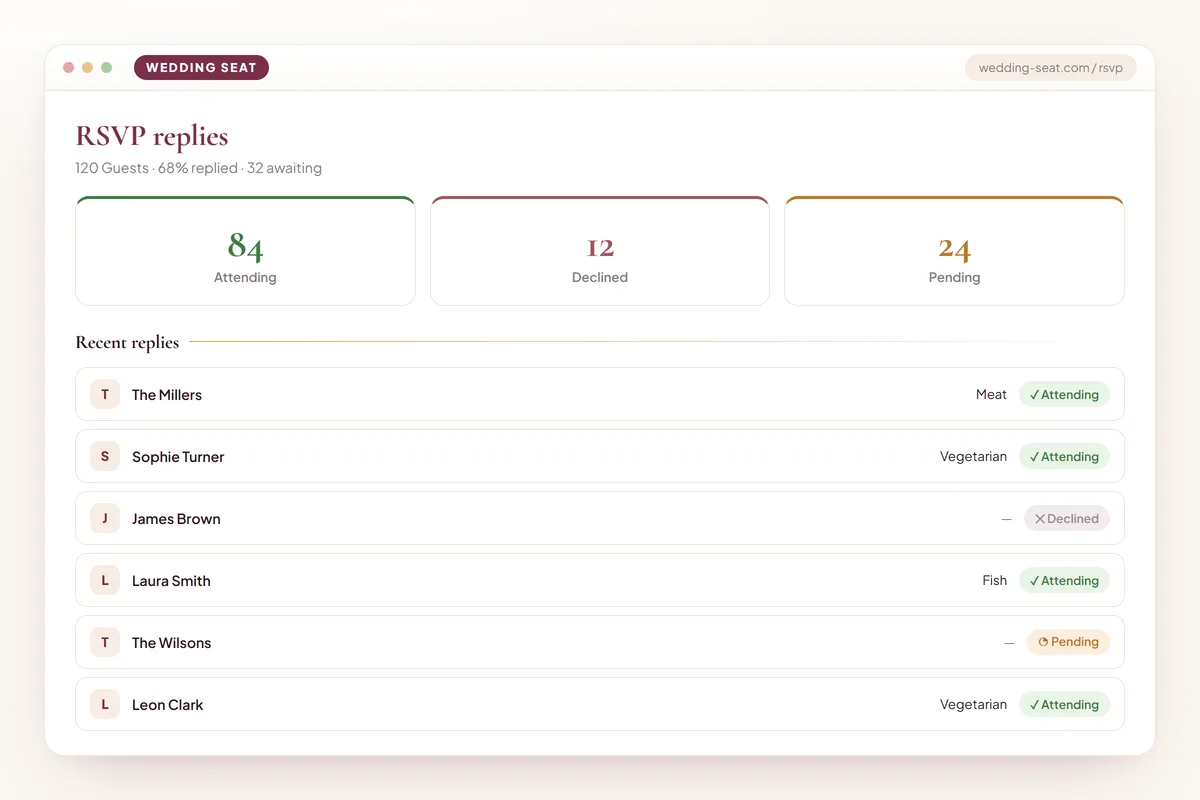
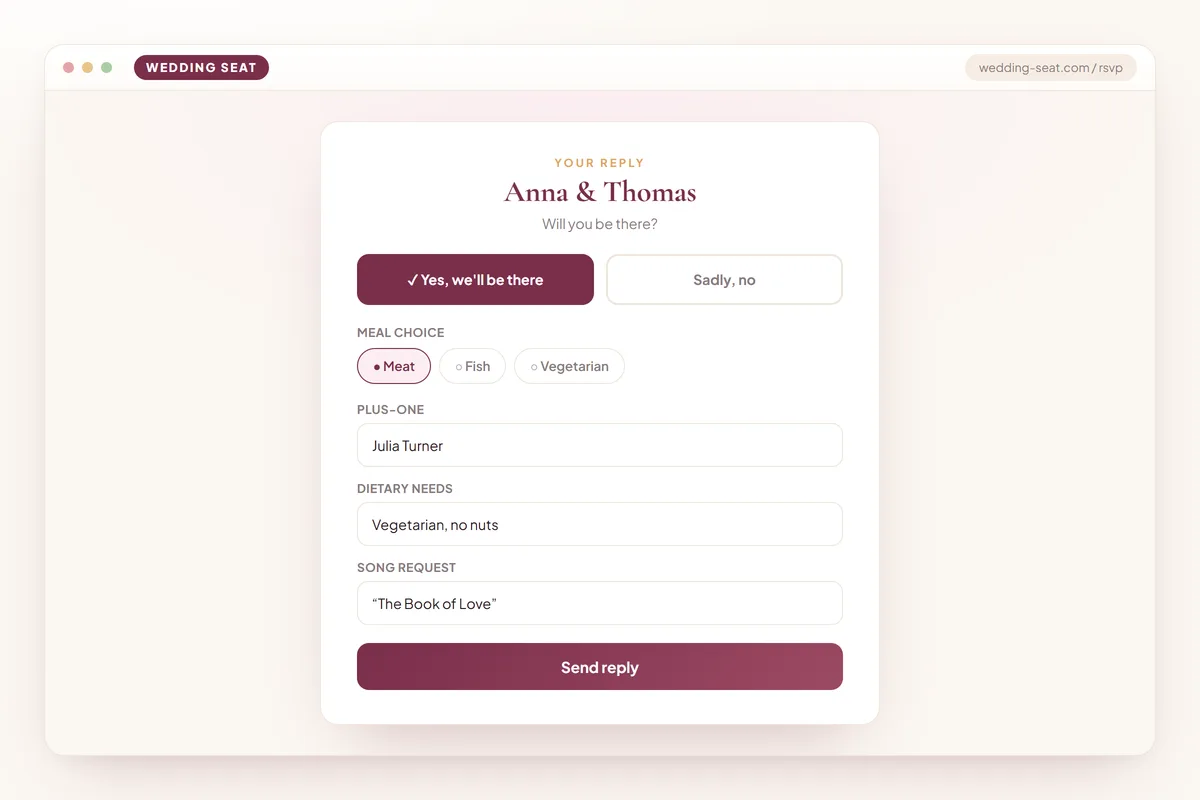
Examples in every theme
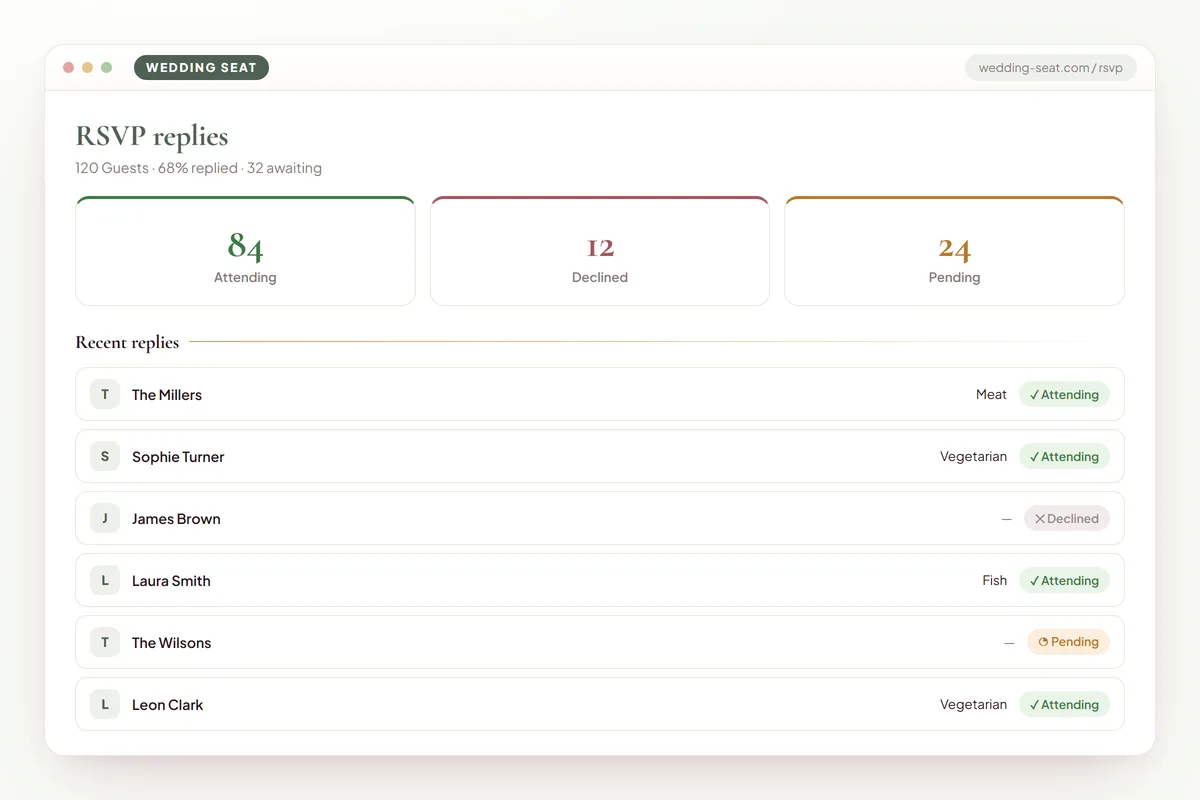
1.RSVP replies · Sage & Olive 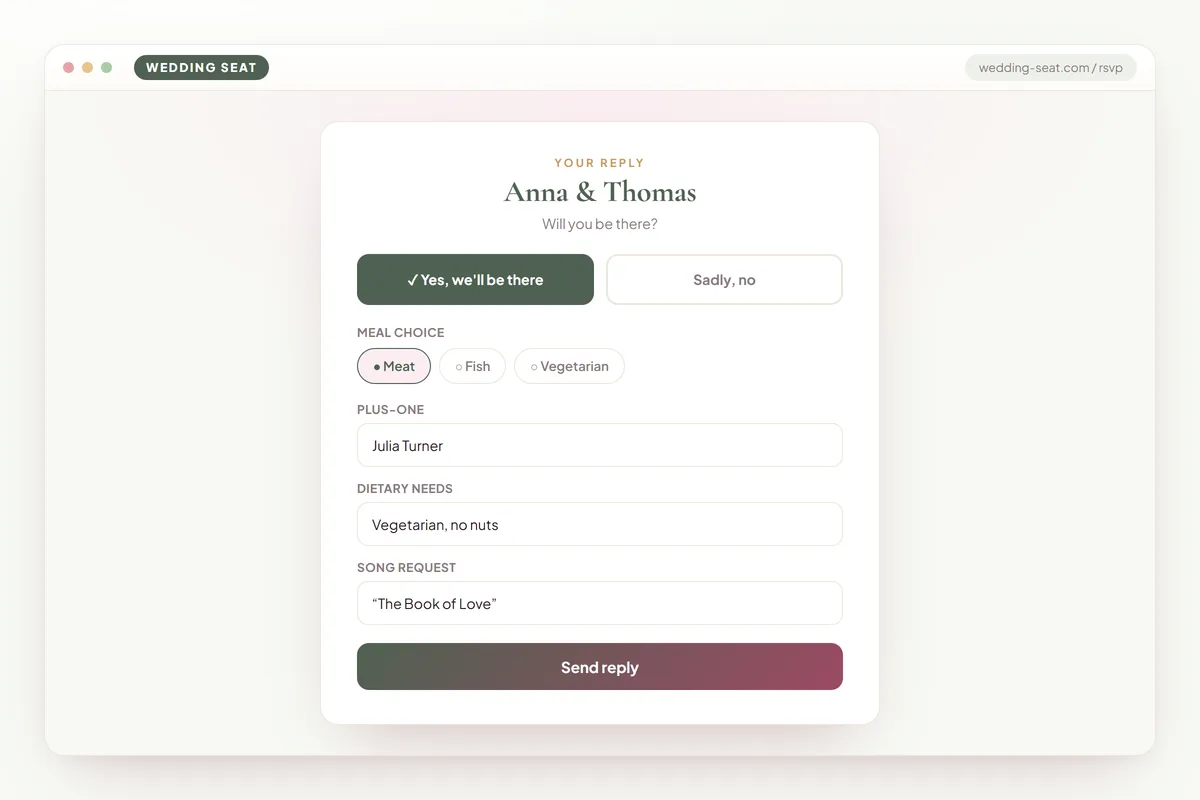
2.Your reply · Sage & Olive 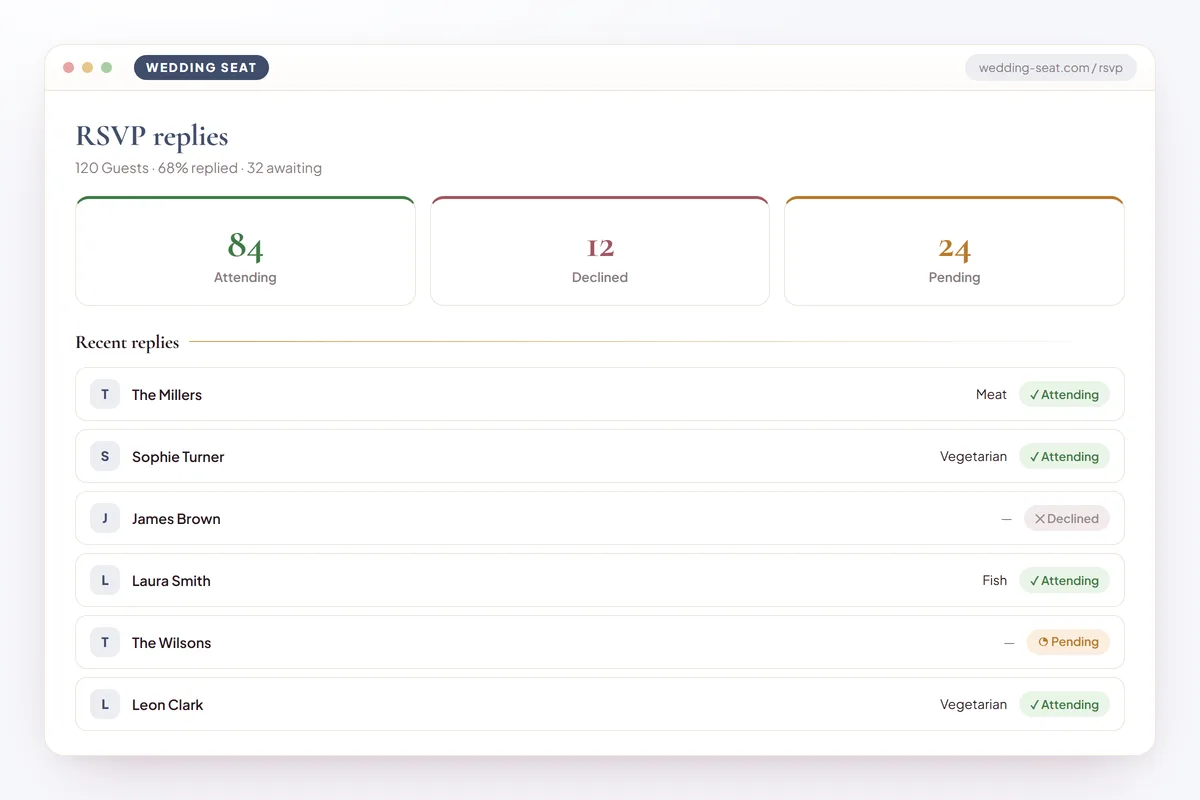
3.RSVP replies · Dusk Blue 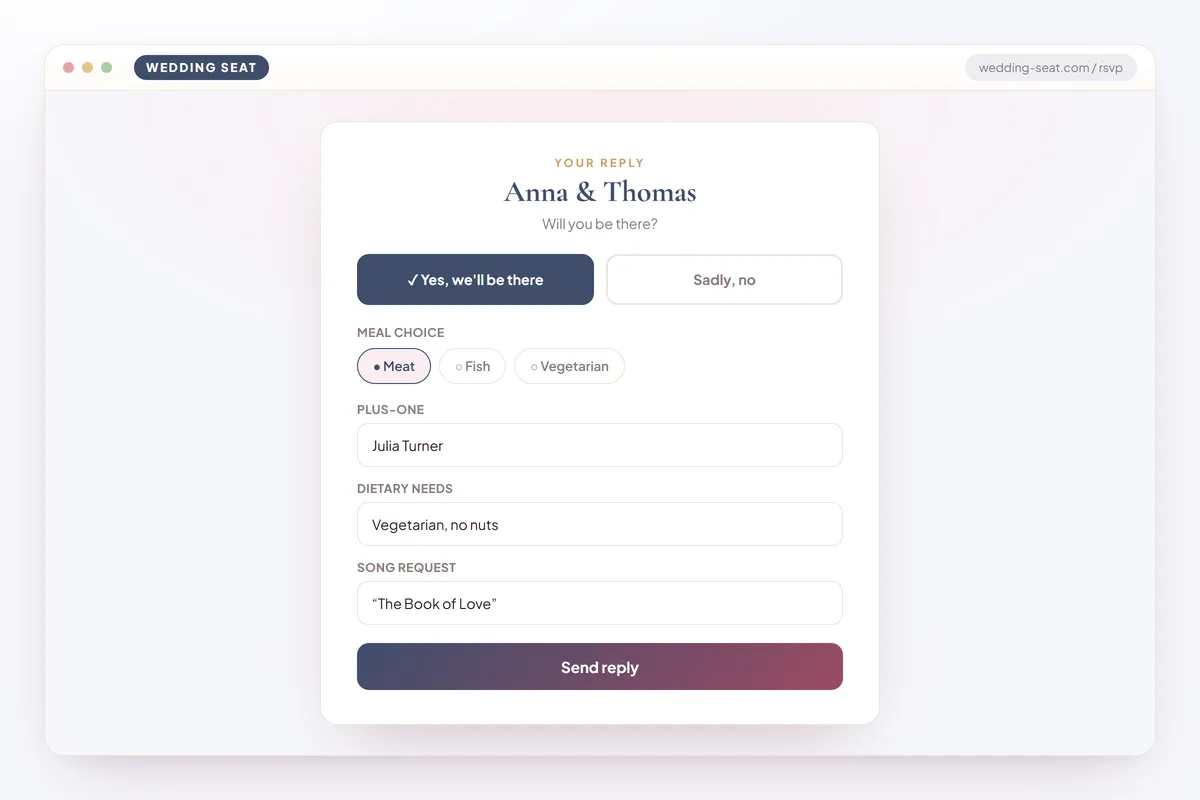
4.Your reply · Dusk Blue 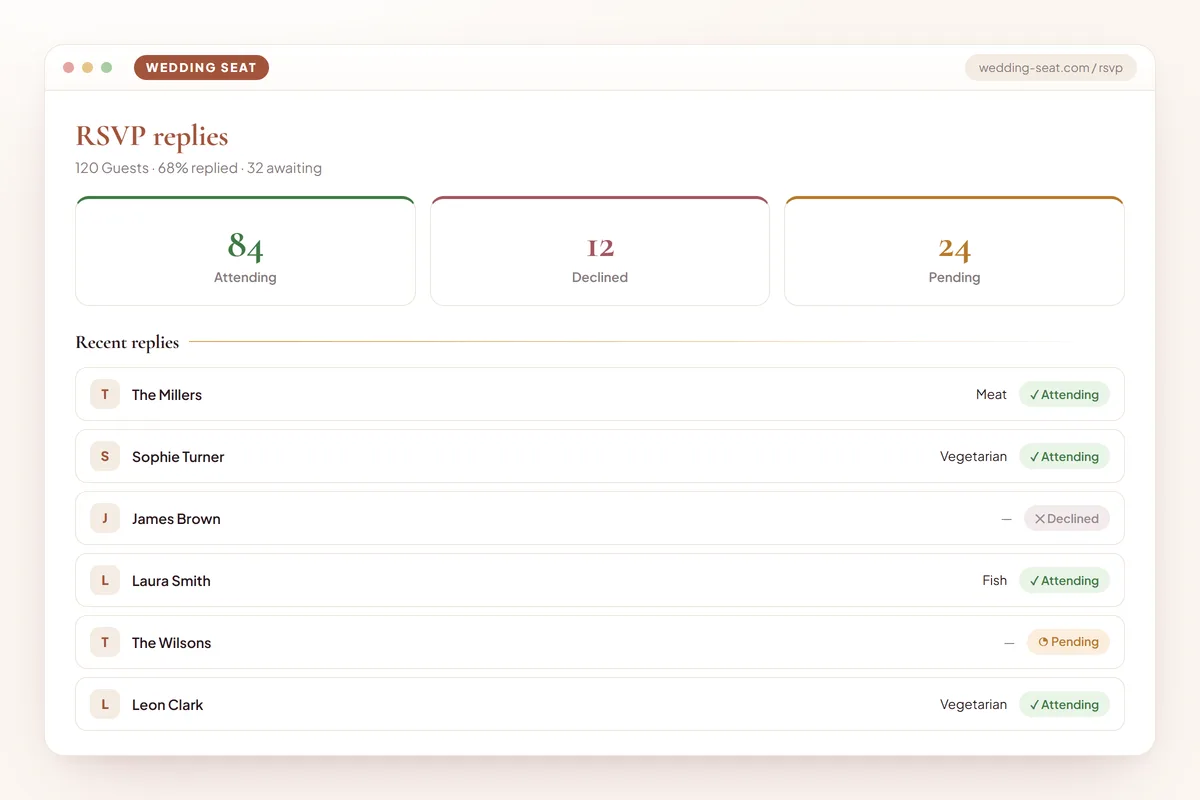
5.RSVP replies · Terracotta 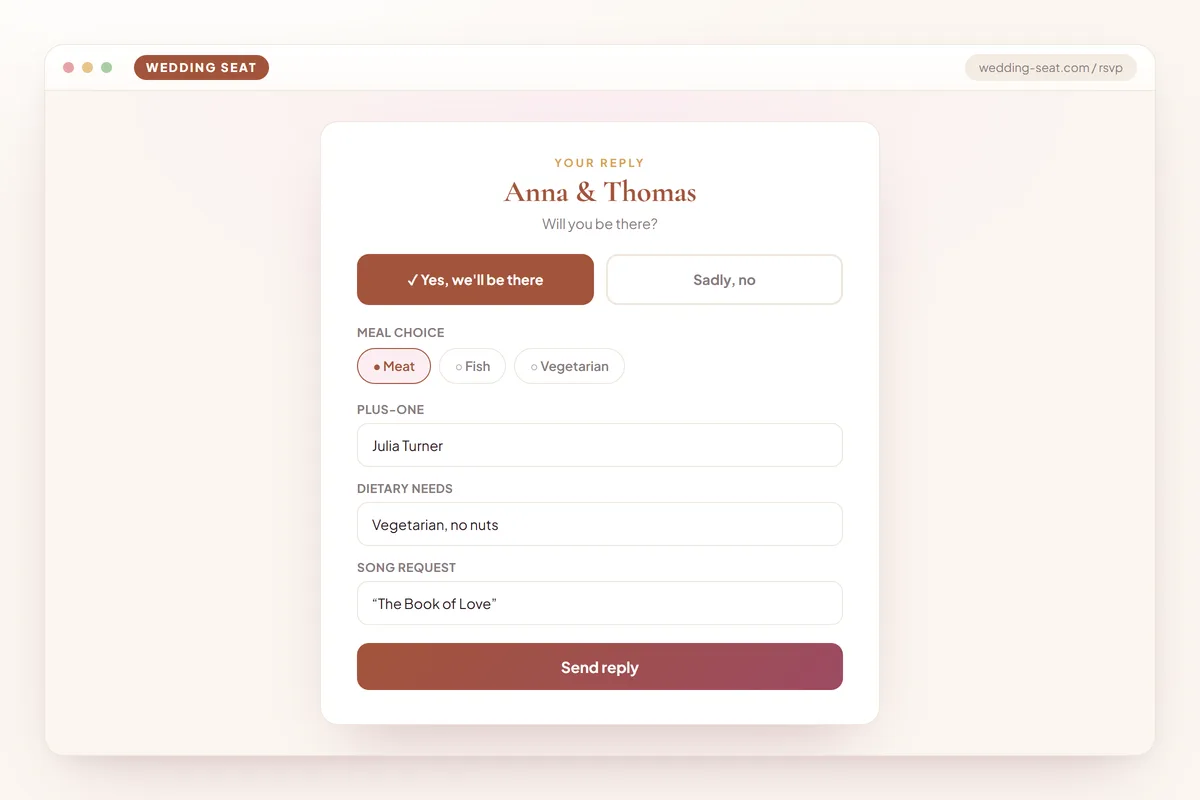
6.Your reply · Terracotta
Frequently asked questions
How far in advance should I set my RSVP deadline?
For a local wedding, set your RSVP deadline three to four weeks before the wedding date, working backward from whenever your caterer needs a final guaranteed headcount — usually seven to fourteen days before the event. Destination weddings need a much earlier deadline, typically six to eight weeks before the wedding, since guests are coordinating flights and hotel bookings around your answer. Always build in at least ten days between your RSVP deadline and your caterer's final-count due date so you have time to chase non-responders without missing your vendor deadlines.
What do I do if guests don't respond by the deadline?
Expect it — most weddings have 20-30% of guests miss the initial deadline, and it's not worth taking personally. About five to seven days after your cutoff, follow up with a short, friendly text or phone call rather than another mailed card, and split the outreach by family group so a familiar voice is doing the asking. Use your RSVP tracker to flag exactly who's still unanswered so nobody gets missed or double-contacted, and give yourself a hard secondary deadline about ten days before your caterer's final-count date to close out the list for good.
Should I include a plus-one option on every invitation?
No — a blanket plus-one policy for every single guest usually isn't necessary or budget-friendly. Reserve plus-ones for guests in serious relationships, married couples, and engaged partners, naming that partner directly on the invitation rather than writing 'and guest.' For single friends or extended family without a long-term partner, it's entirely acceptable to invite them alone, especially for smaller or destination weddings, as long as your invitation only lists the names you actually intend to seat.
Is a digital RSVP or a paper response card better?
It depends on your guest demographic more than personal preference. Digital RSVPs are faster, free to send, and feed directly into a live tracker, making them ideal for tech-comfortable guest lists and destination weddings. Paper response cards still perform slightly better with older relatives who prefer mail, but they cost postage twice over and require manual entry into your tracking system. Most couples run both — a digital RSVP as the default with a note allowing guests without internet access to call or mail a reply instead.
How do I word an RSVP card for a child-free wedding?
Print only the invited adults' names on the envelope and invitation itself, with no 'and family' language, and optionally add a gentle insert line such as 'While we love your little ones, we've planned an adults-only celebration.' The response card should ask guests to reply using the exact names printed rather than a blank number field, since a blank field tends to invite guests to write in children who weren't actually included.
How many guests typically decline a wedding invitation?
For a local wedding, expect roughly 15-20% of invited guests to decline, giving you an overall acceptance rate around 80-85%. Destination weddings see a notably lower acceptance rate, often 60-70%, because travel cost and time off work are real barriers for many invitees. Use these ranges as planning estimates only — track your actual responses in real time so you can adjust catering, rentals, and seating as your true numbers come in rather than relying on averages alone.
What information should I collect on my RSVP besides a yes or no?
Beyond basic attendance, most couples also collect meal or entrée selection for plated dinners, dietary restrictions or allergies, whether named plus-ones or children are attending, and sometimes a short note field for song requests or well wishes. Collecting all of this at the same time as the initial RSVP — rather than in a separate follow-up — saves you a second round of guest outreach and gives your caterer and seating chart complete information the moment your deadline closes.
Ready to stop chasing replies by text and spreadsheet? Head back up to the free RSVP tool above, drop in your guest list, and watch every yes, no, meal choice, and plus-one land in one live tracker — from your first invitation to your final seating chart.
Plan faster
Start your free wedding project in seconds.